


The Zhitong Finance App learned that from South Korea and Japan to China, the world's largest memory chip manufacturer will try to calm a major concern from the outside world this week: whether AI spending is surpassing future demand. What kind of financial reports they hand over and how they respond to investors' questions will influence market trends and reflect the broader prospects of the AI industry.
On Wednesday, SK Hynix (SKHY.US) will be the first to release financial reports, followed by Samsung Electronics, Japan's Kioxia Holdings, and China's rapidly rising Changxin Storage. This series of earnings reports is critical to the nearly $1 trillion memory chip market. The combined market capitalization of the four companies exceeds $2 trillion, and the components they supply account for one-third of the data center expenses of large technology companies.
The performance is expected to be impressive, but the market is more cautious
On the face of it, these four companies are expected to hand over amazing data, and both revenue and profit are expected to grow several times. Behind this is a shortage of semiconductors, which is expected to continue for several years. However, since OpenAI launched ChatGPT in 2022 and became a global sensation, investors are now more cautious than ever before. Investors are increasingly concerned about rising borrowing costs and are worried that large AI spending plans will be difficult to return accordingly.
Investors have been increasingly nervous over the past few weeks. Oracle invokes force majeure clauses to protect itself from the New Mexico data center extension, and interest spreads on industry-wide bonds widened as a result. The stock price of the new cloud company CoreWeave has plummeted, and its debt yield has also soared. Nvidia-backed Australian data center operator Firmus Grid has withdrawn its IPO plans. Furthermore, the listing plan for Nscale in the UK came under pressure after Microsoft withdrew from its UK data center project.
“Storage is the best real-time indicator to reflect AI needs,” said Billy Leung, investment strategist at Global X Management. “Prices are changing every day, and they can't be faked.” He said that performance may not be able to calm the AI bubble dispute, but it should help determine whether this boom is supported by real orders.
When Asian chip makers release earnings reports, the world's largest AI spenders, including Alphabet, Microsoft, and Amazon, will also announce their results. These financial reports will be a key test of AI beliefs: can the huge amount of money invested in data centers generate sufficient returns to prove the rationality of hardware manufacturers expanding production capacity? The concern is not that demand for AI will disappear, but that revenue may struggle to keep up with the cost of building infrastructure.
Whether price increases and orders can continue is a key verification
The chip shortage has affected every industry, from automobiles to smartphones, and four Asian storage manufacturers have experienced unprecedented price increases as a result. If prices and orders continue to soar, it will confirm one thing: the most resourceful customers such as Alphabet and Meta are continuing to expand even as doubts continue to rise.
However, Roundhill Investments CEO Dave Mazza said that judging from these companies' moderate trading valuation multiples, investors are already setting prices for the next downward cycle and are less concerned about the previous quarter's results. “The numbers themselves are almost irrelevant,” he said.
For storage investors, uncertainty in the bond and IPO markets evokes memories of past boom and bust cycles, and heightens concerns that the industry is nearing the peak of the cycle. The stock prices of Samsung and SK Hynix have fallen by about half from their June highs.
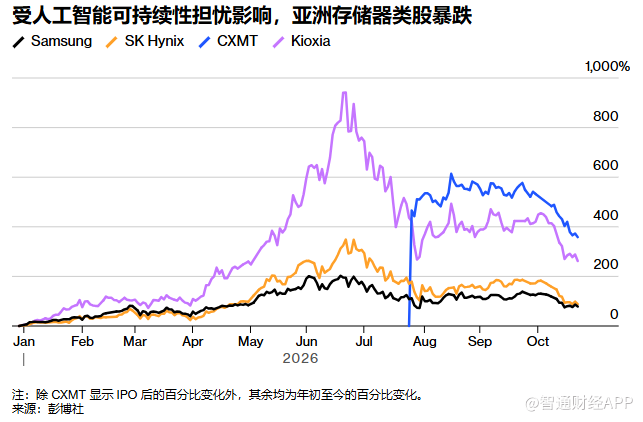
Phillip Wool, head of portfolio management at Rayliant Global Advisors, said the era of “blind optimism” is giving way to a more rigorous review of fundamentals. He said, “The opportunity to make easy money on this subject is over.”
Analyst: The sell-off overreaction, storage supercycle or continuation
Some analysts believe that the market has been overreacting recently. They pointed out that buybacks, dividends, and other measures to enhance shareholder returns could be a potential catalyst in the coming months. Samsung Securities analyst Jongwook Lee predicts that related companies' stock prices are expected to rebound to new highs in the second quarter of next year. Macquarie analysts believe the current is a structural shortage rather than an impending oversupply. Citibank analyst Peter Lee predicts that the storage supercycle will last nine years, longer than previously anticipated.
The global AI computing power competition is bringing huge profits to Samsung and SK Hynix. Together, the two account for approximately 60% of global dynamic random access memory (DRAM) revenue and more than 80% of high-bandwidth storage (HBM) revenue. Jeff Kim of KB Securities estimates that the combined operating profit of these two companies in 2026 and 2027 will reach 1,571 trillion won (about 1.2 trillion US dollars), about double the cumulative profit of the previous 26 years.
Most of the expected growth has been reflected in the order book. Kim said that more than 70% of the storage production planned by Korean chipmakers next year has been covered by five-year supply agreements signed with major technology companies, leaving less than 30% to other customers (including smartphone and PC manufacturers).
This created an opportunity for Changxin Storage, which is vastly expanding its traditional DRAM business. The company also recently unveiled a 4F² architecture aimed at increasing storage density and narrowing the technology gap with overseas rivals.
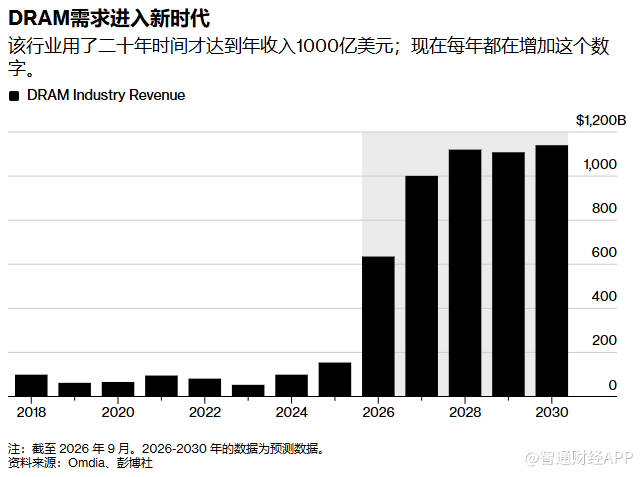
Investors will also pay attention to the pace of capacity expansion of various storage companies. Some analysts believe that the price pressure on general-purpose DRAM chips is more noteworthy: with the gradual release of new production capacity in the industry, pricing may come under pressure before the AI terminal market is impacted. However, Macquarie believes that it is still difficult for Chinese producers to meet domestic demand, and market concerns about global oversupply may be overestimated.
For Kioxia, which specializes in NAND flash memory, the market focus is that the company has so far been unwilling to raise prices drastically to seize the opportunity of soaring demand for enterprise-grade solid-state drives (SSDs). Analysts of the Tokyo-based company, which operates and produces in a joint venture with SanDisk, expect its operating profit to increase more than 20 times in the September quarter. The focus is on whether it can lock in a longer-term agreement to withstand NAND's brutal price fluctuations.
Long-term commitments will not eliminate the risk of a slowdown in AI infrastructure spending, particularly as financing costs rise or it is difficult for customers to get sufficient returns; nor does it guarantee that current shortages will eventually turn into overcapacity.
However, Roundhill's Mazza said that strong demand and concrete evidence of capital expenditure discipline will help buy time. He said, “If the four major manufacturers can prove that the current order has been locked by contract rather than just by expectations, then the storage peaking dispute can be postponed for a year.”