


The Zhitong Finance App learned that the ECB indicated that Eurozone banks tightened credit conditions in the third quarter and reported that demand for loans had weakened. This situation further supports the ECB's cautious stance on further interest rate hikes.
The ECB said that rising risk perception and declining risk tolerance among lenders are still the main reasons why banks are tightening loan standards. Some banks have discovered that the pressure brought about by geopolitical uncertainty and energy market fluctuations is increasing.
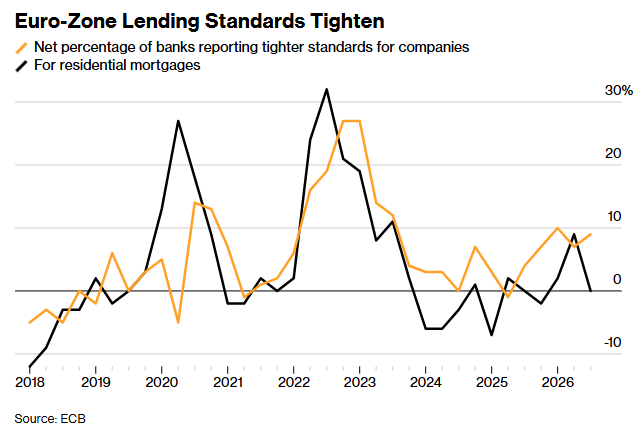
Eurozone credit terms tightened
The ECB stated in the “Bank Loan Survey” released on Tuesday: “The overall level of interest rates is a major factor inhibiting demand for loans. The weakening demand for fixed investment by small and medium-sized enterprises and the shift of enterprises to other financing channels has also dragged down the demand for loans to a certain extent.”
When the survey was announced, the ECB was about to hold a two-day monetary policy meeting. The market expects the bank to keep interest rates unchanged. Although the inflation rate is close to double the 2% target and the economy has shown resilience, the recent sharp rise in long-term bond yields, compounded by factors such as the war between China and the Middle East, is putting more resistance on the economic outlook.
Bank loans play a key role in boosting economic activity, particularly corporate investment. At the same time, the loan situation is also a leading indicator for measuring how monetary policy affects economic growth. Since June, the ECB has raised borrowing costs twice, raising deposit interest rates to the upper limit of the interest rate range considered to have a neutral impact on the economy.
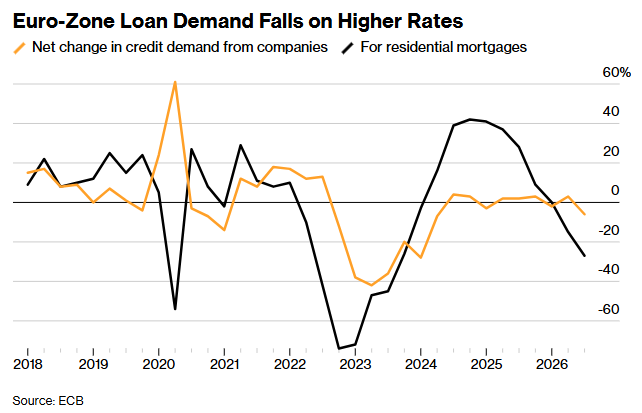
Higher interest rates have led to lower demand for loans in the Eurozone
Another report released by the ECB on Monday found that companies believe credit costs are rising, and loan availability is falling more than their demand can explain.
Furthermore, Tuesday's report showed that the ECB's asset portfolio reduction over the past year had a “slight negative impact” on banks' market financing conditions and liquidity conditions. The report said, “The impact on banks' profitability was slightly positive, with higher net interest income partially offsetting small capital losses. The bank expects these effects to continue over the next 12 months.”
David Powell, a senior economist in the Eurozone, said, “The ECB's survey shows that in the face of the uncertainty brought about by the Middle East war and rising borrowing costs, both credit supply and demand are weakening. At this week's meeting, dovish members of the ECB Governing Council will use the findings to argue that the interest rate hike cycle should end soon.”
However, the ECB said that banks have observed that demand for loans to finance artificial intelligence (AI) infrastructure construction is gradually but continuously growing. The report said: “Most banks say they have not introduced specific quantitative criteria to evaluate AI-related loans in their credit standards. A few banks point out that the application of artificial intelligence and its associated risks are becoming increasingly important in the qualitative assessment of borrowers, with IT companies receiving the most stringent scrutiny.”
It is worth mentioning that apart from these two reports issued by the ECB, the weakening momentum of economic growth also supports the ECB's cautious stance on further interest rate hikes. According to the latest survey, data to be released this Friday will show that the Eurozone's economic growth rate in the third quarter may slow to 0.2% from 0.6% in the second quarter. Meanwhile, several other surveys showed that the inflation rate of the Eurozone's four largest economies did not show a clear general upward trend in October.
The European economy, which has shown strong resilience since the outbreak of war in the Middle East at the end of February, may be starting to lose momentum, and commercial activity is beginning to show signs of fatigue. During the third quarter, European economic output was impacted by a number of factors, including summer heatwaves, low water levels in major waterways, and a sharp rise in global bond yields. Since then, the overall environment has deteriorated further. France has faced large-scale protests, and its public finance situation has raised more and more questions.
The sharp rise in energy prices caused by the Middle East conflict is putting pressure on inflation in the Eurozone. However, policymakers emphasized that they have yet to see second-round effects such as wage increases. Some officials, including ECB chief economist Philip Lane, said that adopting a “controlled” policy response should be sufficient to restore price stability.
ECB President Lagarde said earlier that high inflation in the Eurozone, driven by high energy prices, has not yet spread to the wider economy. She said that ECB officials are evaluating “how much indirect impact is being transmitted through the economy and see how we can best make early judgments if the second round of effects begins to appear.”
Bank of France Governor Emmanuel Moulin also took a position similar to Lagarde on the issue of inflation. He said that the ECB expects “indirect effects and second-round effects to continue to be controlled,” while Eurozone core price indicators will only accelerate “moderately”.
Economic growth is slowing, and inflationary pressure has not worsened further or made it less urgent for the ECB to act. For economists, this means that the ECB will probably not raise deposit mechanism interest rates for the third and last time until December, rather than this week. This judgment is in stark contrast to the market's bet that there will still be multiple interest rate hikes in the future — traders expect the ECB to raise interest rates three more times in the next year.