


- Fiserv rolled out its Commerce Hub platform globally, while Klarna and VikingCloud separately announced integrations that extend Fiserv’s reach across payments and cybersecurity for merchants in multiple regions.
- These moves suggest Fiserv is pushing to make Commerce Hub and Clover more of an all-in-one operating layer for merchants, spanning checkout, security, and alternative payments on a single infrastructure.
- Attention now turns to how Fiserv’s broader commerce ecosystem push through Commerce Hub influences the existing investment narrative around execution and margins.
Scan how Fiserv’s push to unify payments, security, and alternative checkout options compares with other hand-picked payment and fintech players in our 21 high quality undiscovered gems.
Fiserv Investment Narrative Recap
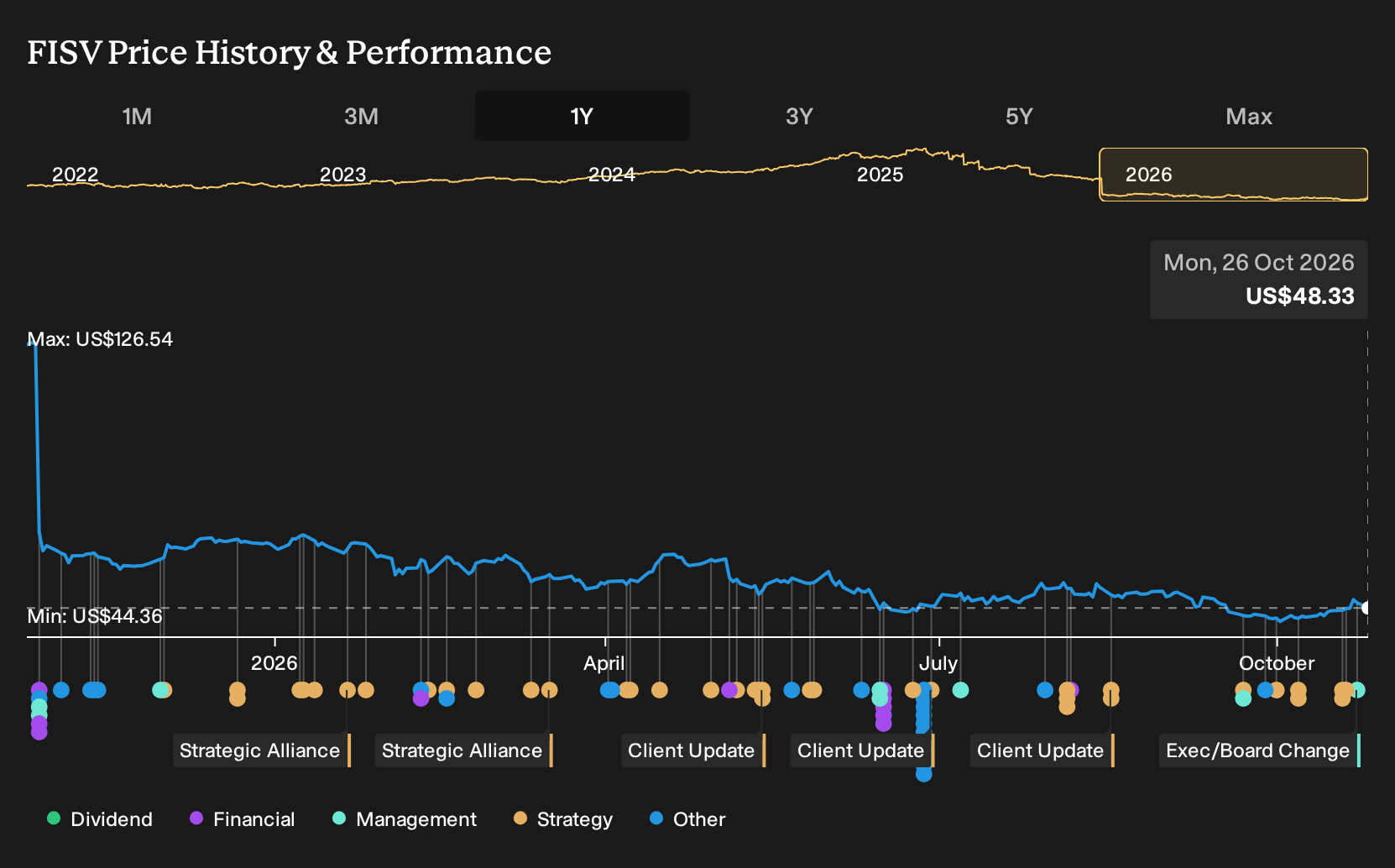
For Fiserv, the core belief is that a large recurring revenue base, modernized platforms and cost programs like Project Elevate can offset recent revenue softness and margin pressure. The most important short term swing factor is still execution on that margin story after guidance cuts for 2026. These new product and partnership announcements do not yet change that near term test.
The biggest risk remains that weakness in Merchant and Financial Solutions persists, which could keep organic revenue flat to slightly negative and limit operating leverage. Commerce Hub, Clover and AI or data products need to gain traction without major missteps on integration, or the path to higher profitability and free cash flow becomes harder.
The global rollout of Commerce Hub, combined with Klarna’s integration across the US, Canada, the UK and parts of Europe, appears most relevant to the current catalyst mix. The merchant story depends on turning processing scale into higher value software and services. A single connection that handles checkout, alternative payments and value added tools fits squarely into that ambition.
Operationally, the key question is whether merchants actually consolidate volume onto Commerce Hub and Clover in a way that steadies Merchant Solutions after recent revenue declines. If uptake is slower, then margin targets linked to Project Elevate and platform efficiency could be harder to reach, particularly with interest costs already identified as a pressure point.
Fiserv's current analyst narrative points to forecast revenues of US$21.3b and consensus earnings of US$3.1b by 2029, compared with earnings of US$2.8b today. This implies an earnings increase of about US$0.3b on what is expected to be fairly flat annual revenue over the period.
Uncover why Fiserv's fair value indicates a 19% potential upside to its current price, which could narrow quickly.
Exploring Other Perspectives
One alternate view zooms in on earnings risk. The most pessimistic analysts were modeling revenues of about US$20.0b and earnings of US$2.2b by 2029, well below the US$21.3b and US$3.1b consensus path. You can see how opinions differ, and then ask whether Commerce Hub and the VikingCloud and Klarna deals push forecasts closer together or further apart.
Explore 13 other Fiserv fair value estimates, including one that suggests as much as 17% downside from the current price.
Form Your Own Verdict
Don't just follow the ticker; dig into the data and build a conviction that's truly your own.
- A great starting point for your Fiserv research is our analysis highlighting 3 key rewards and 1 important warning sign that could impact your investment decision.
- See our latest analysis for Fiserv. The report includes a comprehensive fundamental analysis summarized in a single visual, the Snowflake, making it easy to evaluate Fiserv's overall financial health at a glance.
Looking For More Investment Ideas Beyond Fiserv?
If the Fiserv story has sharpened your thinking about risk, quality and payout profiles, it may be useful to compare it with other opportunities that share similar traits. The Simply Wall St Screener lets you filter for the exact mix of balance sheet strength, income focus or valuation profile that fits your own playbook.
- If capital preservation is high on your checklist, you could start with companies that show resilient fundamentals by reviewing the 30 resilient stocks with low risk scores.
- For investors who care most about financial strength, a good next step is to scan the list of solid balance sheet and fundamentals (24 results) and see which businesses match your quality threshold.
- Income focused readers can shortlist potential payers by checking out the 5 dividend fortresses and considering which yields and coverage profiles look sustainable to them.
Have feedback on this article? Concerned about the content? Get in touch with us directly. Alternatively, email editorial-team@simplywallst.com