


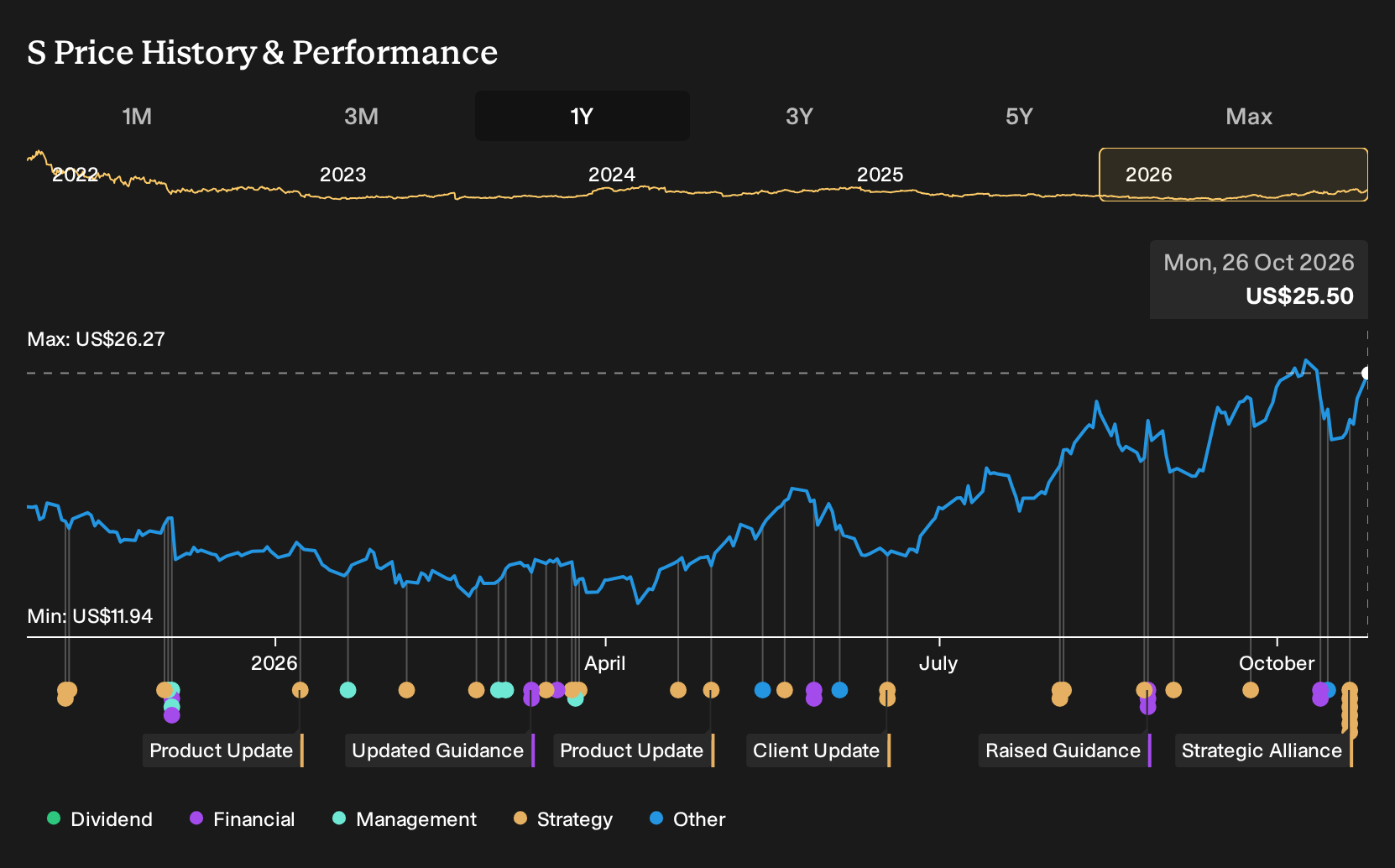
- At its October 2026 OneCon conference, SentinelOne rolled out Singularity ADR and Singularity ASOC while deepening alliances with N-able, Lenovo and LevelBlue to extend AI-driven security, managed services and public sector coverage across endpoints, cloud, identities and AI workloads.
- These moves push SentinelOne further into AI security governance and outsourced operations, and they tie its platform more tightly to partners that influence enterprise buying decisions and recurring service spend.
- The focus now shifts to how SentinelOne’s expanded AI security and autonomous SOC stack could reshape the existing investment narrative.
SentinelOne Investment Narrative Recap
For SentinelOne, the core belief is that AI driven security and an expanding platform across endpoint, cloud, identity and AI workloads can justify continued investment despite current losses. The near term focus is on execution, turning strong product velocity into predictable recurring revenue while managing deal timing swings and partner concentration.
The recent OneCon announcements deepen reliance on major partners like N able, Lenovo and LevelBlue. That cuts both ways. It can support the key short term catalyst, broader multi product adoption on the Singularity Platform, but it also amplifies the existing risk that partners favor their own tools or compress SentinelOne’s pricing power.
The LevelBlue expansion around Wayfinder and the new Autonomous SOC suite is the most relevant development. It aligns directly with the push to turn Purple AI, AI SIEM and Hyperautomation into a full service operations layer, especially for customers that cannot staff a large in house security team around the clock.
For you as a shareholder, the question is whether SentinelOne can convert this outsourced operations model into larger, stickier contracts quickly enough to offset ongoing margin pressure from R&D and M&A. It also concentrates execution risk. Any stumble in LevelBlue delivery or customer satisfaction would flow straight back into the broader ASOC and Wayfinder story.
SentinelOne Forecasts and Valuation Anchors
SentinelOne's narrative projects US$1.8b revenue and US$213.5 million earnings by 2029. This assumes 18.3% yearly revenue growth and an earnings increase of about US$553.6 million from current earnings of a US$340.1 million loss.
Those analyst assumptions effectively ask you to weigh two separate bets. One is on top line expansion as AI led security spending filters into endpoint, cloud, identity and AI workload protection. The other is on a sharp swing from losses to profitability as margins move from a reported loss of 31.0% today toward the US software sector average margin of 11.7% by 2029.
On the earnings side, the consensus path implies SentinelOne would need to move from a US$340.1 million loss to US$213.5 million in profit over the next few years. That is a swing of roughly US$553.6 million. For context, analysts link that shift to a future P/E multiple of 54.3x on those projected 2029 earnings, compared with a current P/E of 23.7x in loss territory and an industry P/E reference point of 30.3x.
Revenue expectations are just as important for your model. The Street framework calls for 18.3% annual revenue growth over the next three years and a path to US$1.8b in sales by 2029. For investors, that kind of expansion usually assumes steady multi product adoption, successful cross sell into cloud and identity modules, and no major disruption from partners changing priorities.
Those future earnings targets also rest on how share count evolves. Analysts expect the number of shares outstanding to rise by 2.41% per year across the next three years. That means part of the journey to an expected earnings per share figure of US$0.57 by 2029 depends not only on profit growth but also on how much dilution holders are willing to tolerate.
Price targets tie the whole story together in a single reference number. The current consensus sits at US$24.25, with the highest estimate at US$28.0 and the lowest at US$17.5. With the stock recently trading at US$23.17, that central target is 4.5% above the market price, which suggests analysts on average see the shares as roughly in line with their view of fair value rather than materially mispriced.
The catch is what you need to believe for that US$24.25 target to make sense. The framework assumes that by 2029 SentinelOne is producing US$1.8b in revenue, generating US$213.5 million in profit and trading on a P/E multiple of 54.3x. The implied discount rate of about 8.6% then converts those future cash flows into a present value anchor, which you can compare against your own expectations for growth, margins and risk.
For your portfolio decisions, the key is not whether these exact figures will play out. The question is whether the OneCon product set, partner extensions with N able, Lenovo and LevelBlue, and the broader autonomous SOC pitch make those revenue and earnings milestones feel conservative, aggressive or roughly aligned with how you view SentinelOne's execution potential.
Uncover why SentinelOne's fair value indicates a 5% potential downside to its current price, which leaves little room for error.
Exploring Other Perspectives
One alternative view you may want to stress test is the bearish focus on regulatory and data residency costs. Those analysts already worked off slightly lower assumptions, such as 17.3% yearly revenue growth and about US$208.3 million in earnings by 2029, and a US$19.19 fair value. The fresh SentinelOne partnerships could force those expectations to shift.
Explore 3 other SentinelOne fair value estimates, including one that suggests it could be worth just $24.25.
Form Your Own Verdict
Don't just follow the ticker. Dig into the data and build a conviction that's truly your own.
- A great starting point for your SentinelOne research is our analysis highlighting 2 key rewards and 2 important warning signs that could impact your investment decision.
- See our latest analysis for SentinelOne. The report includes a comprehensive fundamental analysis summarized in a single visual, the Snowflake, making it easy to evaluate SentinelOne's overall financial health at a glance.
Looking For More Investment Ideas Beyond SentinelOne?
If SentinelOne has sharpened your focus on where AI and security intersect, it can help to line it up against other businesses with different risk and return profiles. The Simply Wall St Screener lets you filter by balance sheet strength, valuation, income focus and more so you can build a watchlist that matches your own playbook rather than relying only on the latest headline.
- If capital preservation sits high on your list, start with a group of companies that pair resilience with lower risk scores by reviewing the 30 resilient stocks with low risk scores.
- If quality at a reasonable price is your priority, compare SentinelOne against a broader universe of companies that look underpriced on fundamentals through the 29 high quality undervalued stocks.
- If you prefer businesses that can potentially fund returns directly back to shareholders, focus your attention on income opportunities by scanning the 5 dividend fortresses.
Have feedback on this article? Concerned about the content? Get in touch with us directly. Alternatively, email editorial-team@simplywallst.com