


I get to interact with a wide range of investors. That includes a decent number of folks who have all the money they will need to live nicely through their own days, and still be in position to leave a lot to their heirs.
Most often, I don’t ask them their situation, but they tell me anyway. And as someone who for decades was in the personal advice business, I always enjoy hearing how their thought process works.
One comment that keeps coming up lately makes me think that the pervasive amount of Fear Of Missing Out (FOMO) built up by Baby Boomers and non-Boomers alike is not going away. In fact, I fully expect the “buy the dip” mentality to stick around for a while. Longer than most would think possible. And that might be the source of some of the most emotional financial letdowns any of us have seen.
I like to compare this era to the dot-com bubble, which was the late 1990s bull run followed by three years of declining markets. And the death of “buy the dip” for many years.
But one way in which this era is vastly different from 25 years ago is that investors en masse have a lot more at stake. They are older, they are riding on the hopes of a fragile AI trade and not much else, and they are ignoring 5% bond yields in droves.
If you are 28 or 38 years old, you have time on your side. If you are 58, 68, or 78, you simply do not.
One angle I continue to hear about, particularly among those who allocate their day-to-day decision-making to professional wealth advisors, is the question of how often you should check your account balances. Some say you should bury your head in the sand and ignore the daily noise. Others check every 10 minutes and trade on pure emotion.
The reality lies in between: checking your account regularly is a great habit… only if you use it as an objective diagnostic tool.
When you track how your portfolio behaves relative to the broader stock and bond markets on down days, you are running a real-time stress test. You learn what you actually own and how each piece interacts. I do that all day, because I ALWAYS want to know what my “beta” to the broad markets is.
That is, for every $100 up and down in the market, how much is my portfolio going up and down. My typical is around $20-$40 out of that $100. I’m a low-beta investor.
And I have different accounts for different objectives. So my bond-driven accounts are analyzed differently than my aggressive trading accounts.
The danger only arrives when investors try to invent emotional narratives to justify daily swings, lose sight of their mission, and abandon their strategy at the worst possible moment. If you are managing your own portfolio in a volatile market, here is how to view the playing field, protect your nest egg, and turn market turmoil into an advantage.
Why Conventional Portfolios Break Down
When market sentiment turns, high-flying tech indexes typically show the first cracks, followed by a broader breakdown in general equities. In a conventional “buy-and-hold” portfolio, investors simply sit there and absorb the full brunt of the drawdown. They watch hard-earned savings evaporate because they were taught that suffering through painful drops is just the price of admission.
It doesn’t have to be. A resilient portfolio is built with distinct roles playing offense and defense simultaneously. A quick glance at ROAR 10, one of the automated model portfolios I created and have discussed here before, is perhaps the longest-tenured proxy for that “offense and defense at the same time” mantra.
This chart of year-to-date performance of that model portfolio shows both sides of the return and risk coin in a very straightforward manner. If you look to the left, you see that as of March 27 of this year, SPY was down more than 7% for the year. ROAR 10 was up 1.4%, because it defended better.
The next few months were “no contest” as SPY “roared” higher (pun intended). The actual benchmark for ROAR 10 is the iShares Core 40/60 Moderate Allocation ETF (AOM), an ETF that represents a 40% bond, 60% stock portfolio. Importantly, ROAR 10 has not trailed AOM for more than a few days during 2026.
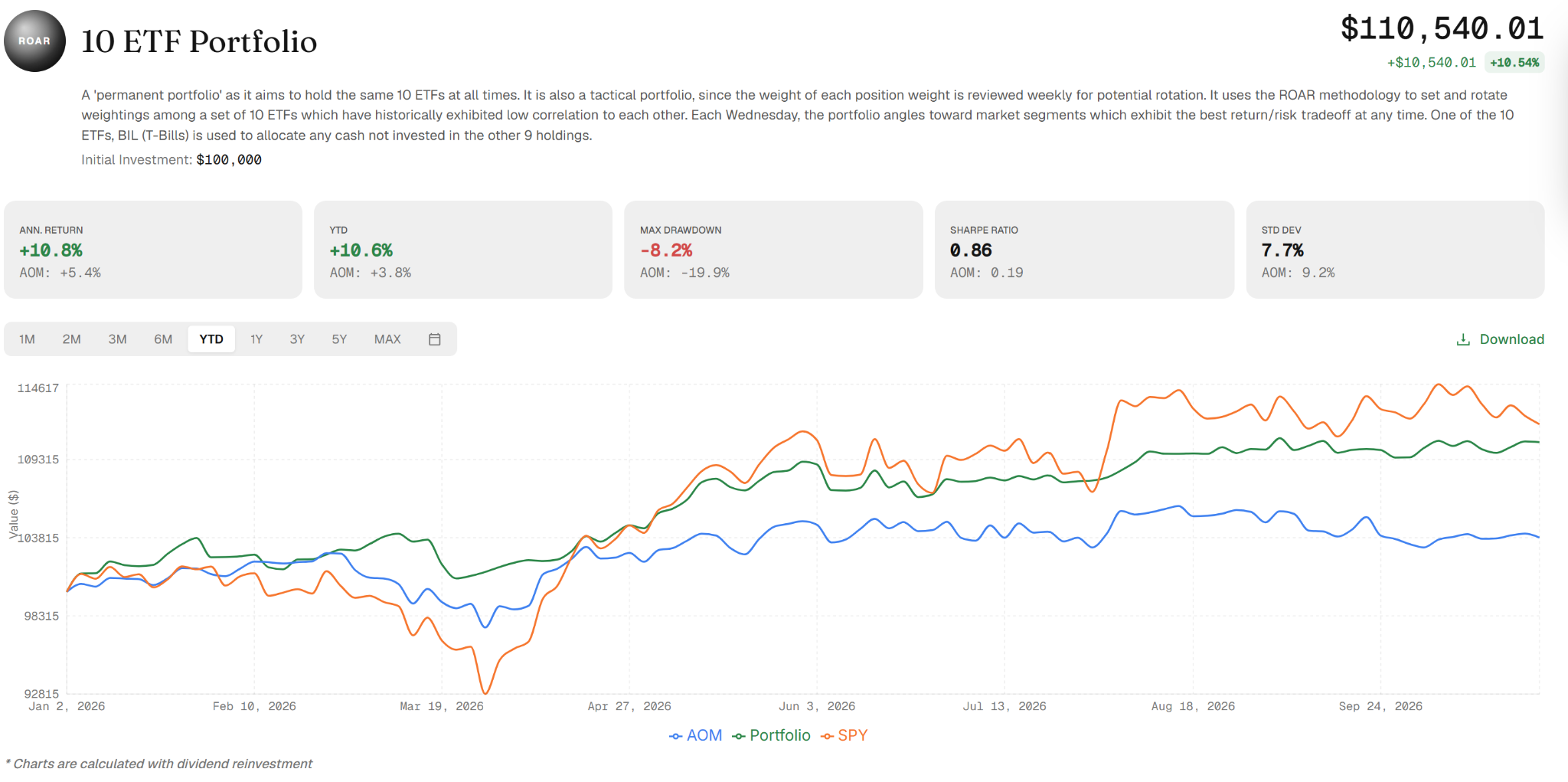
But as of SPY’s peak in August, ROAR 10 was a solid 5% behind. More recently, it is evening out, and with nine weeks to go in the year, ROAR 10, that moderate risk blend of ETFs, has a fighting chance to beat SPY for the full year. That says more about investing for a wide range of market climates than anything else.
This is a case where using defense alongside one’s offense provides an opportunity to profit when your friends and neighbors are caught in a market-wide slump. Which ironically, will give THEM the FOMO.
I use 10 ETFs, own all 10 at once, and the mix includes ETFs that attack up and down stock markets, up and down bond markets, commodities, and a cash oasis. I even own the AGF U.S. Market Neutral Anti Beta Fund (BTAL), which might just be the most timely of the bunch right now.
But to a self-directed investor, the true takeaway here is not so much the 10 ETFs that make up my “permanent tactical portfolio.” It is about how investing is an ongoing learning experience about yourself.
Which ETFs or stocks are the ones most important for you to own most or all of the time, and why? How much can you lose before you say “OK, enough’s enough?” And how much FOMO are you willing to pursue, at risk of being on the losing side of market breaks?
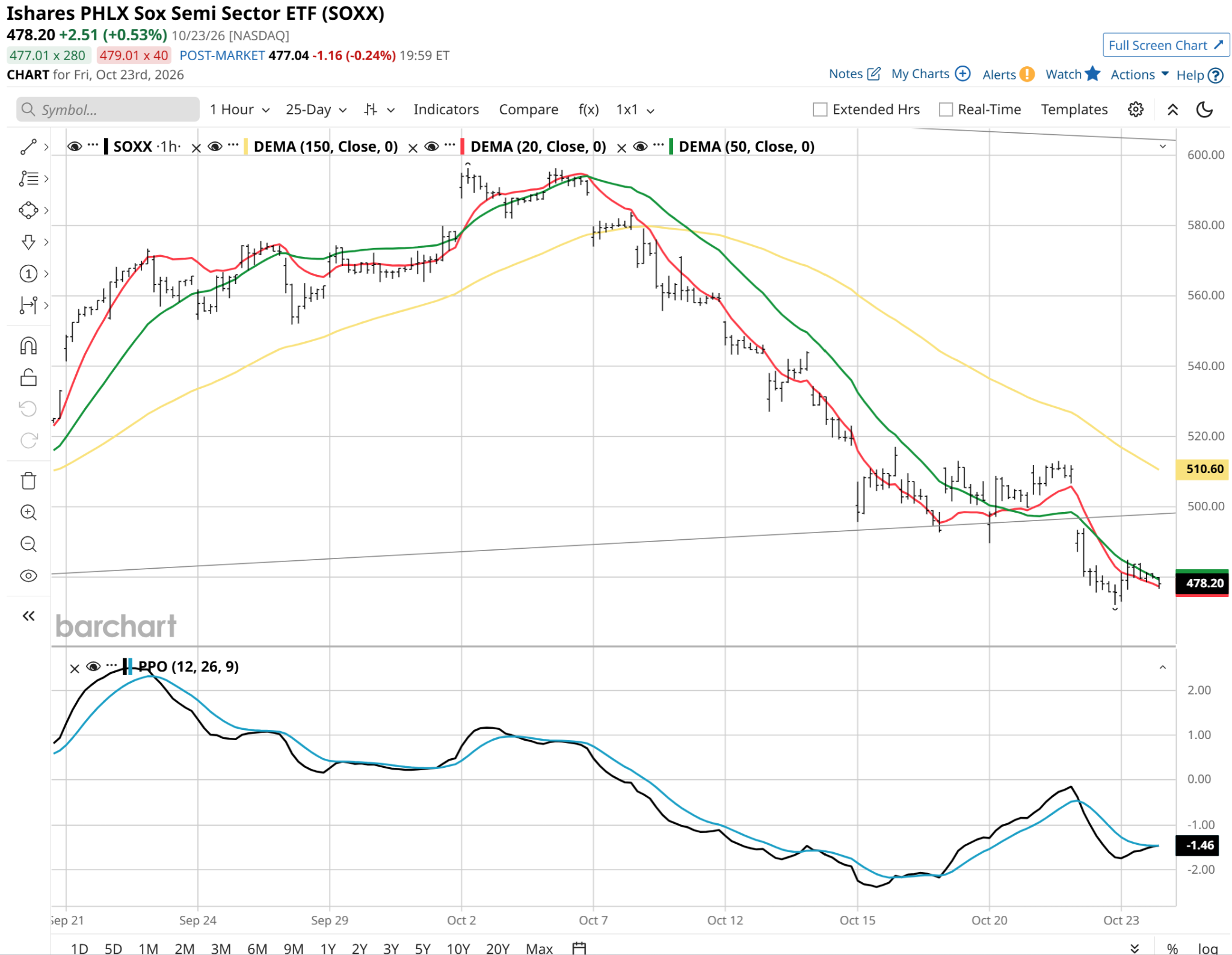
I say track your portfolio regularly, even daily. Why? Because you want to get “reps” (repetitions). Not because you want to have a second-guessing festival with yourself. You want to understand how you are positioned for a wide range of outcomes.
Investing is never about predicting the exact day a market tops or bottoms. It is about recognizing when overall risk is uncomfortably high, pulling out the stops to avoid the big mistake first, and letting the profits follow second. That’s my decades-long story, and I’m sticking to it.
Rob Isbitts is a semi-retired CIO, former fiduciary investment advisor, Barchart columnist, and straight-talker. Download his new free e-book on hedged bond investing for retirement at ETFYourself.com. His research and model portfolios are at ROAR.PiTrade.com.
On the date of publication, Rob Isbitts did not have (either directly or indirectly) positions in any of the securities mentioned in this article. All information and data in this article is solely for informational purposes. For more information please view the Barchart Disclosure Policy here.