


Brazil’s shock election result, a sharp Ibovespa selloff of up to 17% and a weaker real of as much as 12% against the dollar have turned prediction markets on their head and thrown big local stocks into the bargain bin. Panic selling and a trading halt on B3 created forced sellers, not just cautious thinkers. This piece walks through 3 large cap Brazilian stocks exposed to the news shock that the screener currently flags as potential opportunity, and explains what has changed in their risk reward profile so you can decide whether to lean in or stay on the sidelines.
The three Brazilian large caps covered below are just a first pass, and the full value screen on Simply Wall St currently flags 31 more local giants with equally detailed narratives that are not unpacked in this article.
If you want to identify your own post election opportunities across sectors and risk profiles, go straight to the Brazil Large-Cap Value Stocks screener to filter, analyze, and focus on the ideas that best fit your playbook.
Telefônica Brasil (BOVESPA:VIVT3)
Overview: Telefônica Brasil runs the Vivo brand, providing mobile and fixed telecom, broadband, TV, and digital services to households and businesses across Brazil.
Operations: Telefônica Brasil generates about R$61.8b in revenue from providing telecommunications services entirely within Brazil.
Market Cap: R$103.6b
Telefônica Brasil fits the Brazil Large-Cap Value Stocks theme as a heavily traded telecom heavyweight. In this segment, resilient service demand and broad index ownership can matter more than election noise when political volatility compresses valuations.
"Ongoing expansion of convergent mobile and fiber offers, with FTTH accesses at 8.2 million, homes passed at 32 million and take up at 25.6%, together with historically low fiber churn of 1.4%, supports the case that higher value bundles can lift recurring revenue and help sustain margins."
What happens to that value case depends on how one emerging pressure ultimately feeds through into pricing power and long term profitability.
How that pressure plays out is exactly what the full narrative for Telefônica Brasil unpacks, including where pricing power could be stalling or quietly accelerating.

TIM (BOVESPA:TIMS3)
Overview: TIM provides mobile, fixed line and multimedia telecom services across Brazil, giving the screener exposure to a large, liquid cash generator that can be sold off mechanically during political shocks.
Operations: TIM generates about R$27.4b in mobile telecom revenue, entirely from customers within Brazil.
Market Cap: R$45.6b
Where Telefônica Brasil offers one value anchor for this screen, TIM adds a second telecom pillar. The screener flags its cash profile and liquidity as reasons it can be thrown out with the broader index when politics whipsaws sentiment.
"Further scale up of TIM’s B2B operation, with contracted revenues of about R$1.1b growing around 30% year over year in early 2026, can keep lifting the B2B share of service revenue beyond the current 6.6 to 7% range and support service revenue growth and earnings quality."
What happens to that upside case turns on how one persistent pressure shapes future pricing discipline and the durability of those high margins.
That pricing pressure is exactly where the story gets interesting, and the full narrative for TIM shows whether TIM’s premium profile is quietly decoupling from the election shock.

Companhia de Saneamento Básico do Estado de São Paulo - SABESP (BOVESPA:SBSP3)
Overview: Companhia de Saneamento Básico do Estado de São Paulo SABESP runs São Paulo’s main water supply and sewage network, providing regulated sanitation services across the state.
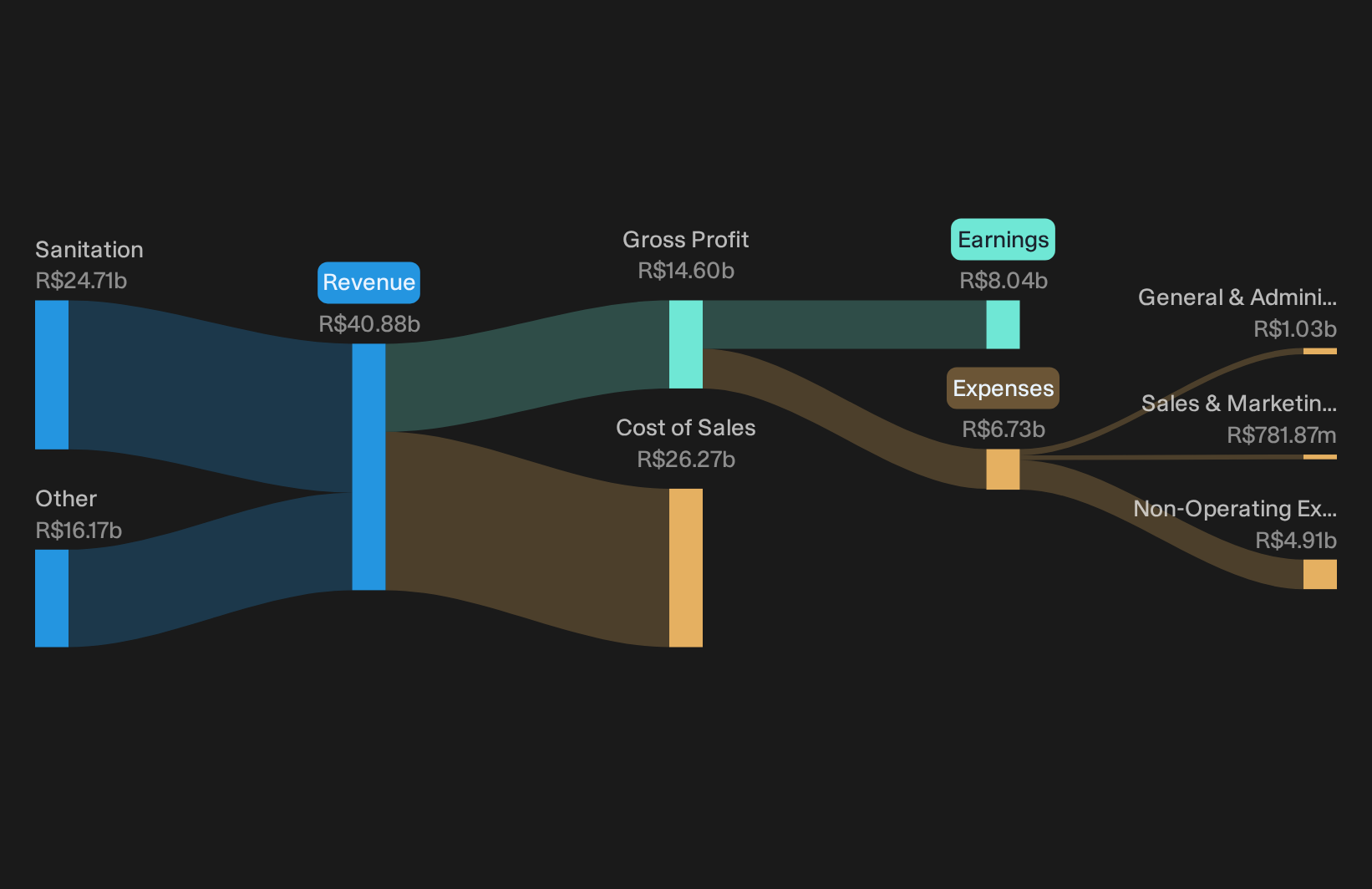
Operations: SABESP generates about R$24.7b from sanitation activities and R$16.2b from other services, all sourced from customers in Brazil.
Market Cap: R$112.1b
For a value screen built around large, liquid Brazilian stocks, SABESP brings a regulated São Paulo utility angle. In this context, sentiment around politics often moves faster than the underlying sanitation demand or asset base.
"The accelerated Universal Access program, supported by more than R$40b of contracted CapEx backlog through 2029 and progress on U-Factor water and sewage targets, increases the customer base and network scale, which can support revenue and earnings over time."
What ultimately matters for investors is how one evolving pressure on returns shapes future margins once this expansion work and its financing fully settle in.
That return pressure is where the real story sits, and the full narrative for Companhia de Saneamento Básico do Estado de São Paulo - SABESP shows whether SABESP’s regulated engine is quietly accelerating or masking brewing risks.
Curious About What You Might Be Missing?
Fresh opportunities can move quickly. Some are breaking out, others are dropping into potentially attractive ranges, and many stay under the radar for now. Do your own research while it matters and consider taking action early if it fits your strategy.
- Target resilient cash generators that aim to keep paying investors through different market conditions by scanning the curated 224 dividend fortresses before the competition crowds in.
- Track fast-moving themes where real earnings matter, not just hype, by running the focused 39 profitable AI stocks that aren't just burning cash while quality ideas are still flying under the radar.
- Pinpoint operators tied to real assets instead of story stocks by surveying the curated 35 elite gold producer stocks before momentum traders get fully caught up.
Have feedback on this article? Concerned about the content? Get in touch with us directly. Alternatively, email editorial-team@simplywallst.com