



Financial services company Robinhood (NASDAQ:HOOD) met Wall Street’s revenue expectations in Q3 2026, with revenue up 11.8% year on year to $1.42 billion. Its non-GAAP profit of $0.60 per share was 6.9% below analysts’ consensus estimates.
For more on Robinhood, read our free full research report.
Robinhood (HOOD) Q3 2026 highlights:
- Revenue $1.42 billion vs S&P analysts’ consensus estimates of $1.43 billion (11.8% year-on-year growth, in line)
- Crypto revenue continues to fall year-on-year, down 55%
- Adjusted EPS $0.60 vs S&P analysts’ consensus estimates of $0.64 (6.9% miss)
- Adjusted EBITDA $808 million vs analysts’ consensus estimates of $794 million (56.7% margin, 1.8% beat)
- Operating margin 43.9%, down from 49.8% in the same quarter last year
- Free cash flow margin 84.6%, up from 53.2% in the previous quarter
- Funded customers 28.7 million, up 1.9 million year on year
- Market capitalization $83.47 billion
"Our vision is to make everyone an owner, because broad ownership is essential to a free, stable, and prosperous society," said Vlad Tenev, Chairman and CEO of Robinhood.
Revenue growth
Reviewing a company’s long-term revenue performance reveals insights into its quality. Any business can have short-term success, but a top-tier one grows for years. Robinhood’s revenue grew at a strong 42% compounded annual growth rate over the last three years. Its growth surpassed the average consumer internet company and shows its offerings resonate with customers.
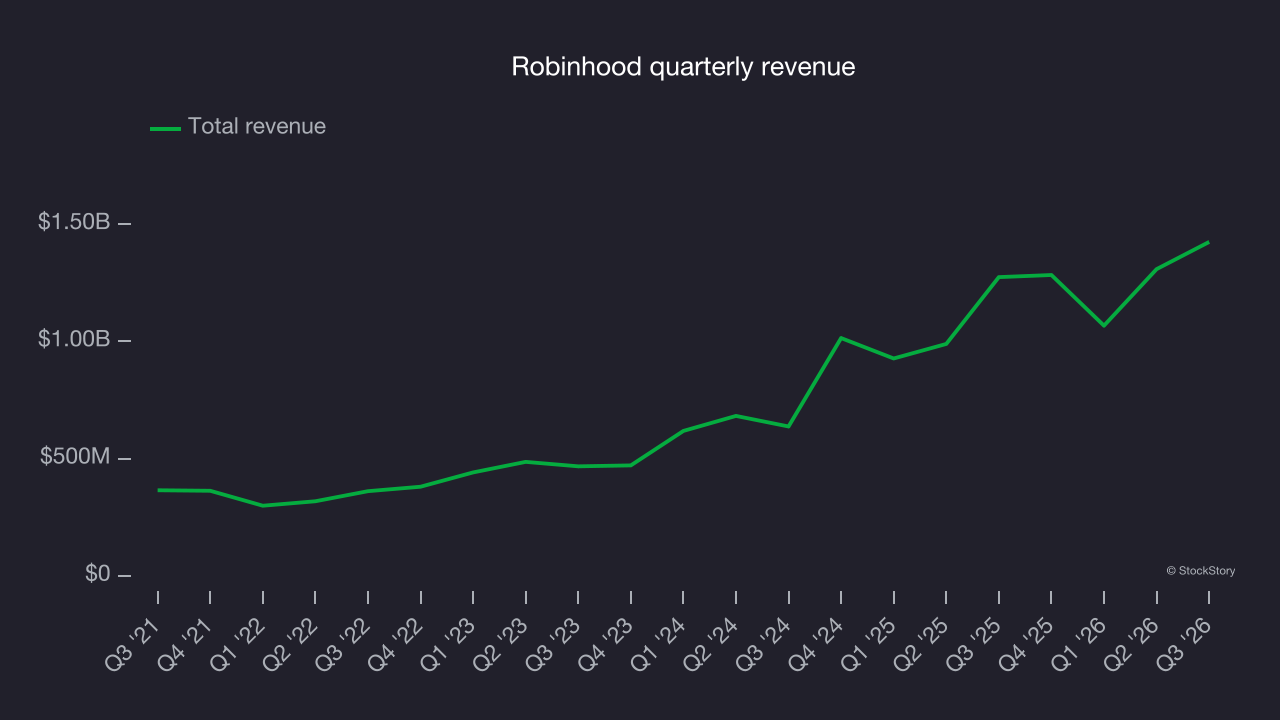
This quarter, Robinhood’s year-on-year revenue growth was 11.8%, and its $1.42 billion of revenue was in line with Wall Street’s consensus estimates.
Looking ahead, sell-side analysts expect revenue to grow 30% over the next 12 months, according to S&P, a deceleration versus the last three years. Despite the slowdown, this projection remains strong and suggests the market is forecasting success for its products and services.
Funded customers
User growth
As a fintech company, Robinhood generates revenue growth by increasing both the number of users on its platform and the number of transactions they execute.
Over the last two years, Robinhood’s funded customers, a key performance metric for the company, increased by 8% annually to 28.7 million in the latest quarter. This growth rate is decent for a consumer internet business and indicates its offerings appeal to users.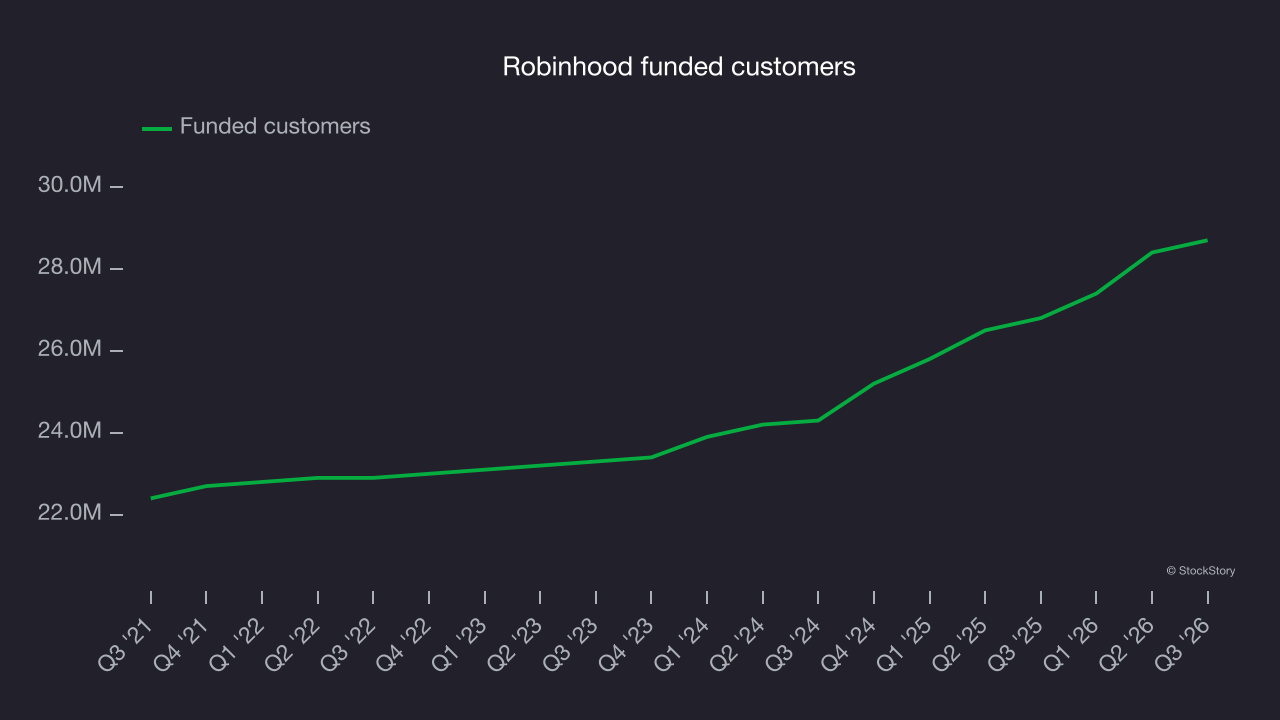
In Q3, Robinhood added 1.9 million funded customers, leading to 7.1% year-on-year growth. The quarterly growth rate is similar to its two-year pace, suggesting its new initiatives aren’t accelerating user growth just yet.
Revenue per user
Average revenue per user (ARPU) is a critical metric to track because it measures how much the company earns in fees from each user. ARPU also provides insight into the average transaction size on Robinhood’s platform and the company’s take rate, or “cut”, on each transaction.
Robinhood’s ARPU growth has been strong over the last two years, averaging 38.8%. Its ability to increase monetization while growing its funded customers demonstrates its platform’s value, as its users are spending significantly more than last year.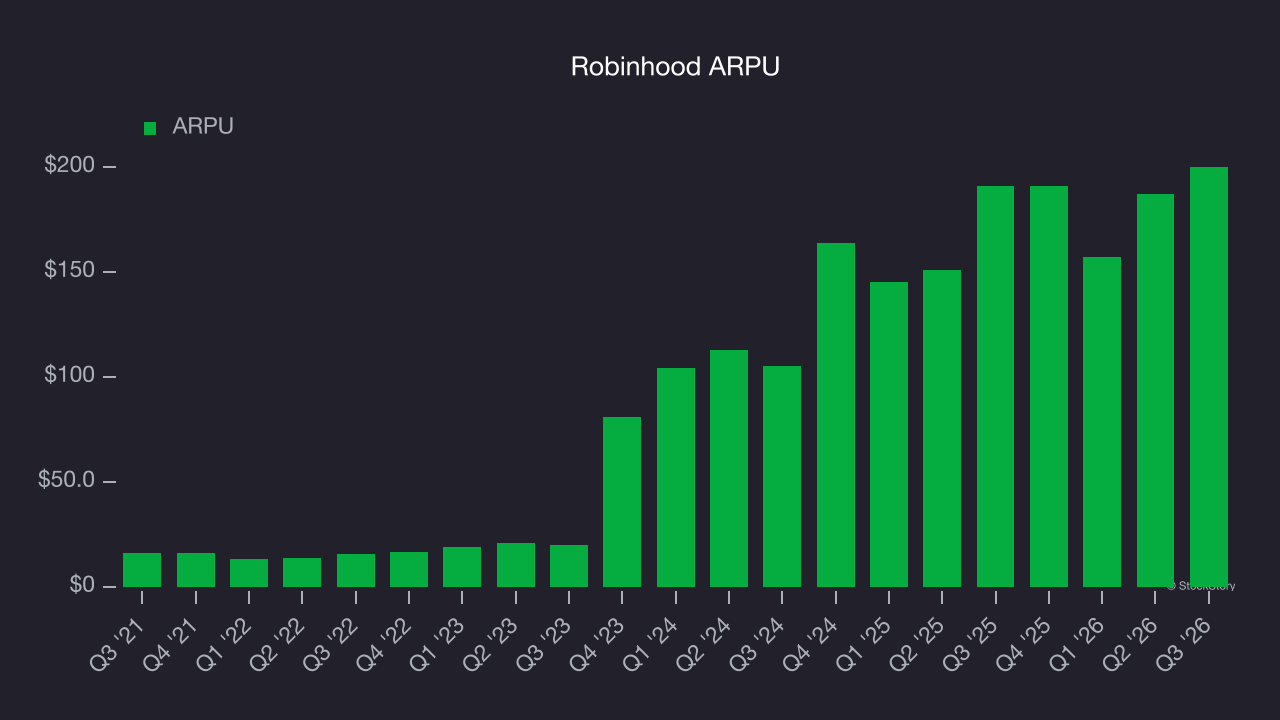
This quarter, Robinhood’s ARPU reached $200. It grew by 4.7% year on year, slower than its user growth.
Key takeaways from Robinhood’s Q3 results
It was encouraging to see Robinhood beat analysts’ EBITDA expectations this quarter. On the other hand, its revenue was in line, with a sharp decline in crypto revenue. Overall, this was a weaker quarter. The stock traded down 5.5% to $89.57 immediately following the results.
Is Robinhood an attractive investment right now? The latest quarter matters, but not nearly as much as longer-term fundamentals and valuation when deciding whether to buy the stock. For more on Robinhood, read the full research report here (it’s free).