


Sensor manufacturer Sensata Technology (NYSE:ST) beat Wall Street’s revenue expectations in Q3 2026, with revenue up 7.7% year on year to $1.00 billion. On the other hand, next quarter’s revenue guidance of $957 million was less impressive, coming in 1.4% below analysts’ consensus estimates. Its non-GAAP profit of $1.13 per share was 18.1% above analysts’ consensus estimates.
For more on Sensata Technologies, read our free full research report.
Sensata Technologies (ST) Q3 2026 highlights:
- Revenue $1.00 billion vs S&P analysts’ consensus estimates of $972.9 million (7.7% year-on-year growth, 3.2% beat)
- Adjusted EPS $1.13 vs S&P analysts’ consensus estimates of $0.96 (18.1% beat)
- Adjusted EBITDA $248.1 million vs analysts’ consensus estimates of $228.4 million (24.7% margin, 8.6% beat)
- Revenue guidance $957 million at the midpoint for Q4 2026, below analysts’ consensus estimates of $970.9 million
- Adjusted EPS guidance $0.97 at the midpoint for Q4 2026, roughly in line with what analysts were expecting
- Operating margin 17.5%, up from -13.2% in the same quarter last year
- Free cash flow margin 19.8%, up from 14.6% in the same quarter last year
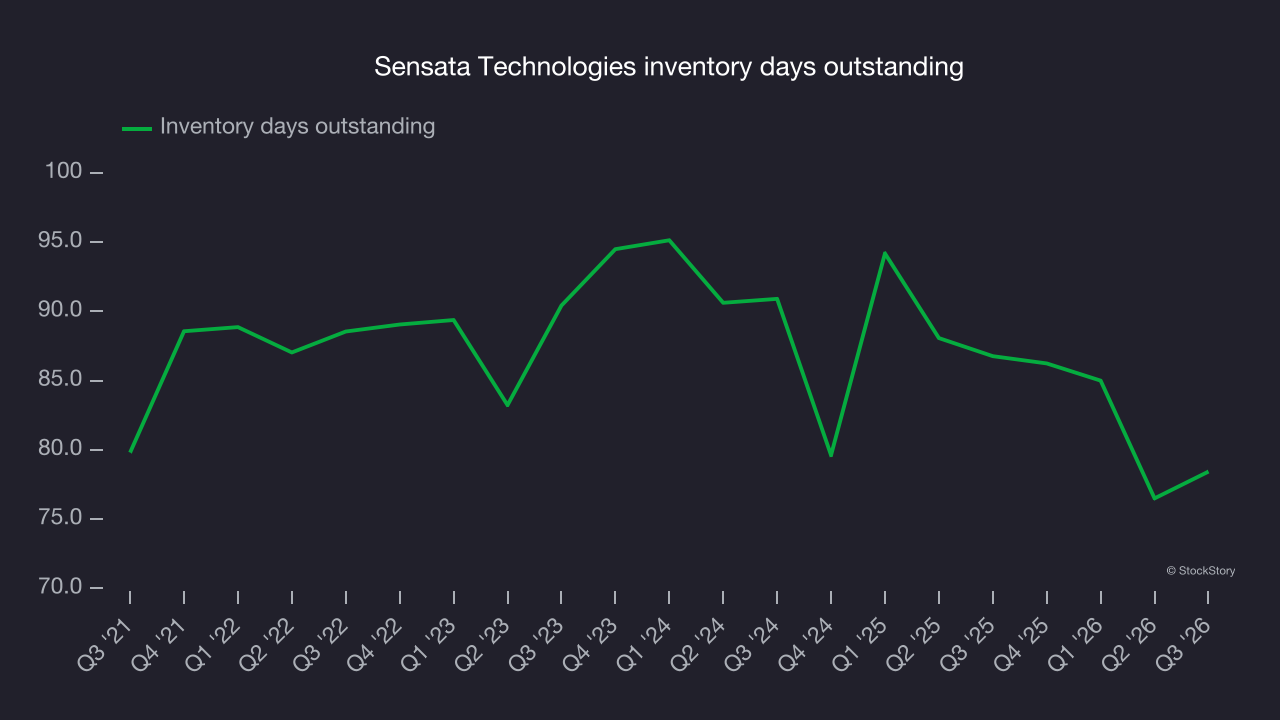
- Inventory days outstanding 78, up from 77 in the previous quarter
- Market capitalization $5.92 billion
“Our core business is stronger, and we have growing conviction in our ability to accelerate long-term organic growth,” said Stephan von Schuckmann, Sensata's Chief Executive Officer. “While I am encouraged by the value we have unlocked so far, I am even more excited about the opportunity ahead of us.”
Revenue growth
A company’s long-term revenue performance is one signal of its overall quality. Any business can have short-term success, but a top-tier one grows for years. Sensata Technologies struggled to consistently increase demand as its $3.85 billion of revenue for the trailing 12 months was close to its revenue five years ago. That underwhelming result is a sign of poor business quality. Semiconductors are a cyclical industry, and long-term investors should be prepared for periods of high growth followed by periods of revenue contractions.
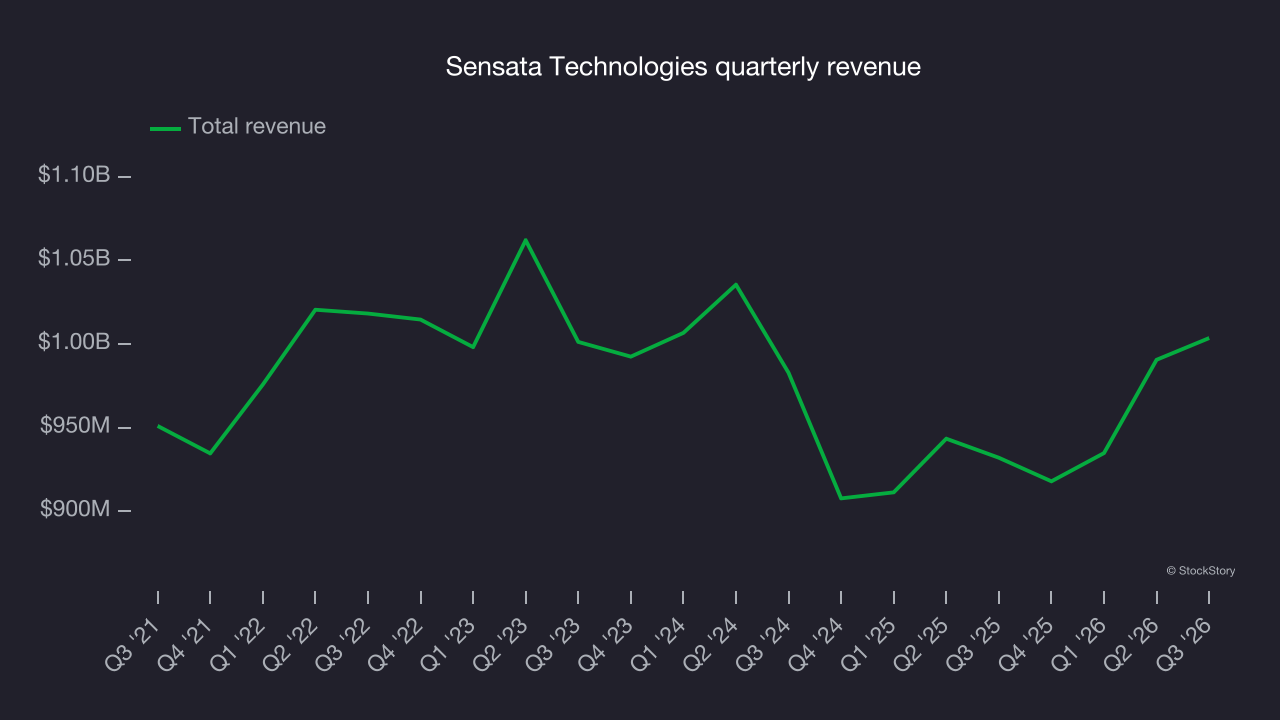
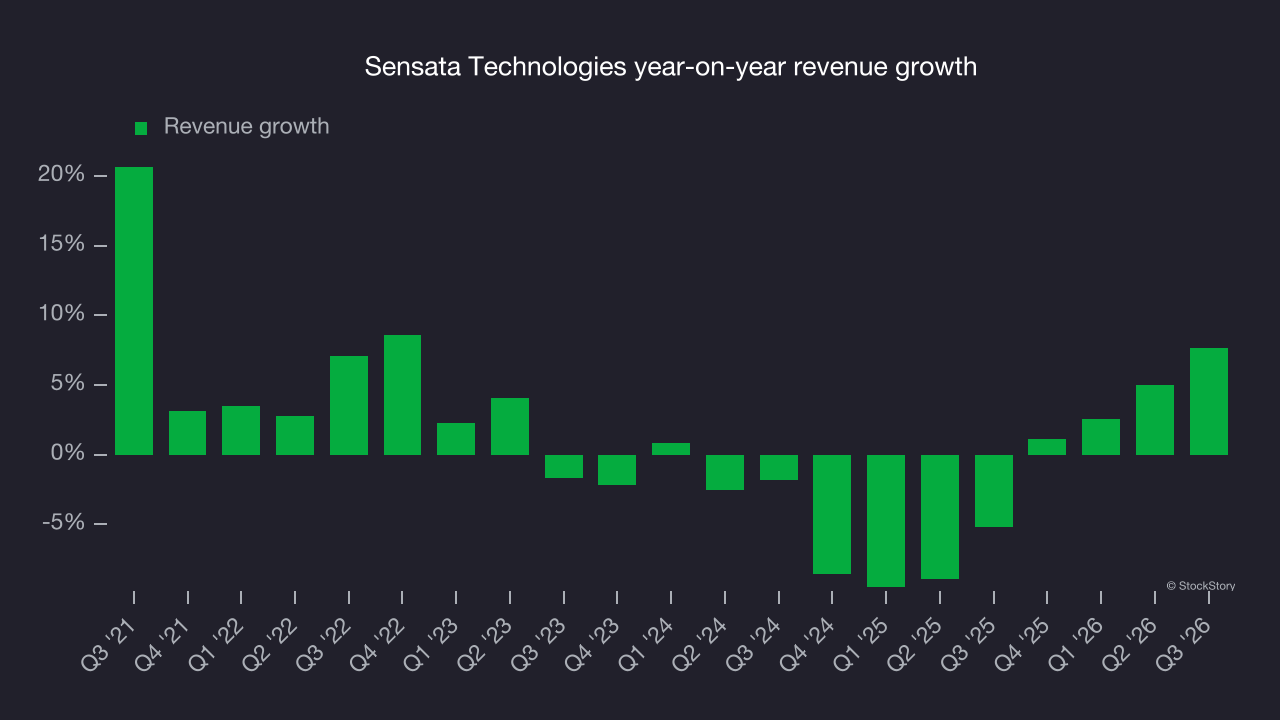
This quarter, Sensata Technologies reported year-on-year revenue growth of 7.7%, and its $1.00 billion of revenue exceeded Wall Street’s consensus estimates by 3.2%. Beyond the beat, this marks 4 straight quarters of growth, implying that Sensata Technologies is in the middle of its cycle – a typical upcycle generally lasts 8–10 quarters. Company management is currently guiding for a 4.3% year-on-year increase in revenue next quarter.
Looking further ahead, sell-side analysts expect revenue to grow 3.3% over the next 12 months, according to S&P. Although this projection indicates its newer products and services will fuel better top-line performance, it is still below the sector average.
Product demand & outstanding inventory
Days Inventory Outstanding (DIO) is an important metric for chipmakers, as it reflects a business’s capital intensity and the cyclical nature of semiconductor supply and demand. In a tight supply environment, inventories tend to be stable, allowing chipmakers to exert pricing power. Steadily increasing DIO can be a warning sign that demand is weak, and if inventories continue to rise, the company may have to downsize production.
This quarter, Sensata Technologies’s DIO came in at 78, which is 9 days below its five-year average. These numbers show that despite the recent increase, there’s no indication of an excessive inventory buildup.
Key takeaways from Sensata Technologies’s Q3 results
It was good to see Sensata Technologies beat analysts’ EPS expectations this quarter. We were also excited its operating income outperformed Wall Street’s estimates by a wide margin. On the other hand, its revenue guidance for next quarter slightly missed and its inventory levels slightly increased. Overall, this print was mixed. The stock remained flat at $42.43 immediately after reporting.
Sensata Technologies may have had a good quarter, but that alone doesn’t make the stock a buy. The latest quarter does matter, but not nearly as much as longer-term fundamentals and valuation when deciding if the stock is a buy. Read the full research report here (it’s free).