


Fed policy is back in the spotlight, with sticky 3.7% inflation, debate over a possible December rate hike, and fresh energy price pressure keeping investors on edge about borrowing costs and market swings. Defensive dividend stocks can appear more attractive when cash yields remain competitive and volatility can spike without warning. This article examines three large cap dividend payers from our screener that are closely exposed to these macro crosswinds.
The three stocks covered below are only a sample of what fits this defensively tilted income theme, as the full quantitative screen surfaced 24 additional large cap dividend payers with similarly detailed narratives that are not discussed in this article. To see the rest of the list and quickly identify which ones best fit your own risk and income profile, head straight to the US Large-Cap Defensive Dividend Stocks screener.
Marzetti (MZTI)
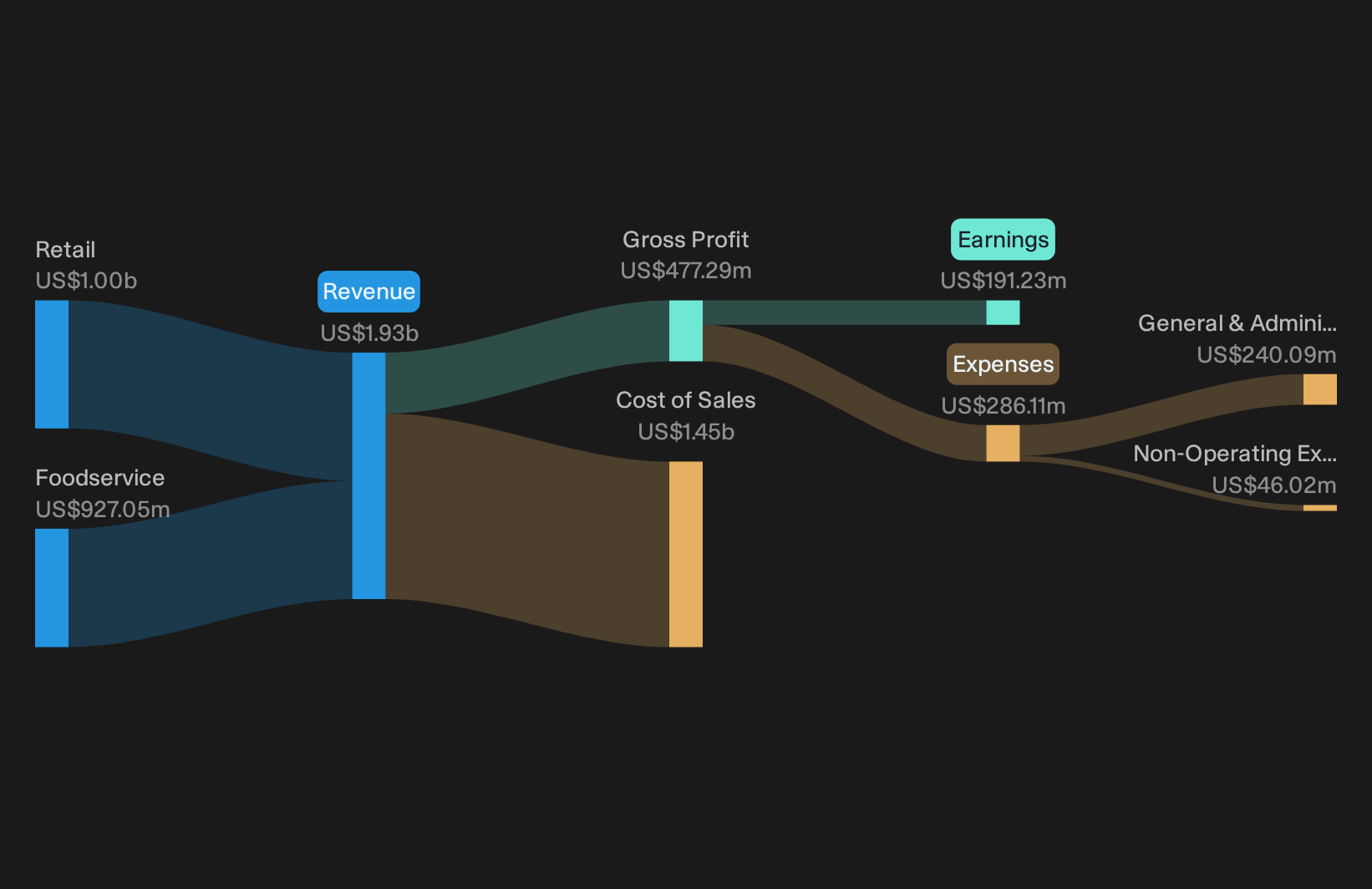
Overview: Marzetti makes branded sauces, salad dressings, frozen breads, rolls and related specialty foods for supermarkets and restaurant chains across the United States.
Operations: Marzetti generates about US$1.0b from Retail products and US$927 million from Foodservice, with all US$1.9b of revenue coming from the United States.
Market Cap: US$3.0b
For a defensive dividend screen focused on large U.S. issuers, Marzetti offers something simple but valuable: everyday food brands that households and restaurant customers tend to keep buying even when borrowing costs rise and rate policy feels uncertain.
"Although the acquisition of Bachan's adds a premium, high margin sauce brand that currently sells at a higher price point, the reliance on 100% co-manufacturing and a cautious approach to integration could delay expected cost synergies and slow any uplift to consolidated gross margin and earnings."
What happens to Marzetti’s income profile if one unseen pressure quietly shifts the balance between dependable cash returns and future profit potential?
If that trade off matters to you, the full narrative for Marzetti lays out where current cash returns, brand strength and reinvestment ambitions could be slowly decoupling.
Southwest Gas Holdings (SWX)
Overview: Southwest Gas Holdings distributes and transports natural gas to more than 2.2 million homes and businesses across Arizona, Nevada, and California, giving the stock a direct link to the defensive dividend utility theme.
Operations: Southwest Gas Holdings generates about US$1.7b in revenue from its Natural Gas Distribution segment, which reflects its core regulated utility activity.
Market Cap: US$6.6b
Southwest Gas Holdings fits the screen as a regulated utility that pairs regular dividends with a business model built around long term service obligations rather than short cycle demand swings. That matters more when rate expectations are uncertain and cash yields elsewhere keep resetting higher.
"Accelerated infrastructure investment opportunities are now anchored by a larger US$2.3b capital plan for the Great Basin 2028 Expansion Project and a broader US$6.3b 5 year utility capital program. These are expected to expand regulated rate base and in turn support higher future regulated revenue and earnings."
The real swing factor is how one future decision point affects the balance between that expanding asset base and the profitability attached to it.
That tipping point on Southwest Gas Holdings comes into focus when you read the full narrative for Southwest Gas Holdings, which maps how regulation, capital plans and rate decisions could interact.

STERIS (STE)
Overview: STERIS provides infection prevention equipment, chemistries, and outsourced sterilization services that help hospitals and manufacturers keep procedures and products safe.
Operations: STERIS generates about US$4.3b from Healthcare, US$1.2b from Applied Sterilization Technologies, and US$600 million from Life Sciences, largely in the United States.
Market Cap: US$22.6b
Within a defensive dividend screen, STERIS matters because hospitals and drug manufacturers still need reliable infection control even when borrowing costs stay elevated and policy signals remain noisy.
"Continued mix shift toward recurring chemistries and services, which now account for roughly 80% of STERIS revenue versus about 20% a decade ago, can add stability to organic revenue and support operating leverage into earnings."
What happens to STERIS’s resilient income story if one unresolved pressure quietly reshapes how much of that steady demand turns into margin?
If that margin tension is what you care about, the full narrative for STERIS explains how STERIS could turn that recurring mix into accelerating cash strength while remaining aware of the associated risks.

Curious About What You Might Be Missing?
Fresh opportunities can move from quiet to flying under the radar for now to fully caught by the crowd faster than headlines update. Scan the next wave and consider your options.
- Spot potential breakout yield plus balance sheet strength before momentum stories feel crowded by running the curated 5 dividend fortresses while it still reflects current conditions.
- Track early movers in AI infrastructure where capital is flowing and stories are still forming by focusing on the hand picked 55 AI infrastructure stocks.
- Rotate into real asset exposure when gold sentiment shifts and prices are dropping or breaking out by reviewing the focused 35 elite gold producer stocks.
Have feedback on this article? Concerned about the content? Get in touch with us directly. Alternatively, email editorial-team@simplywallst.com