


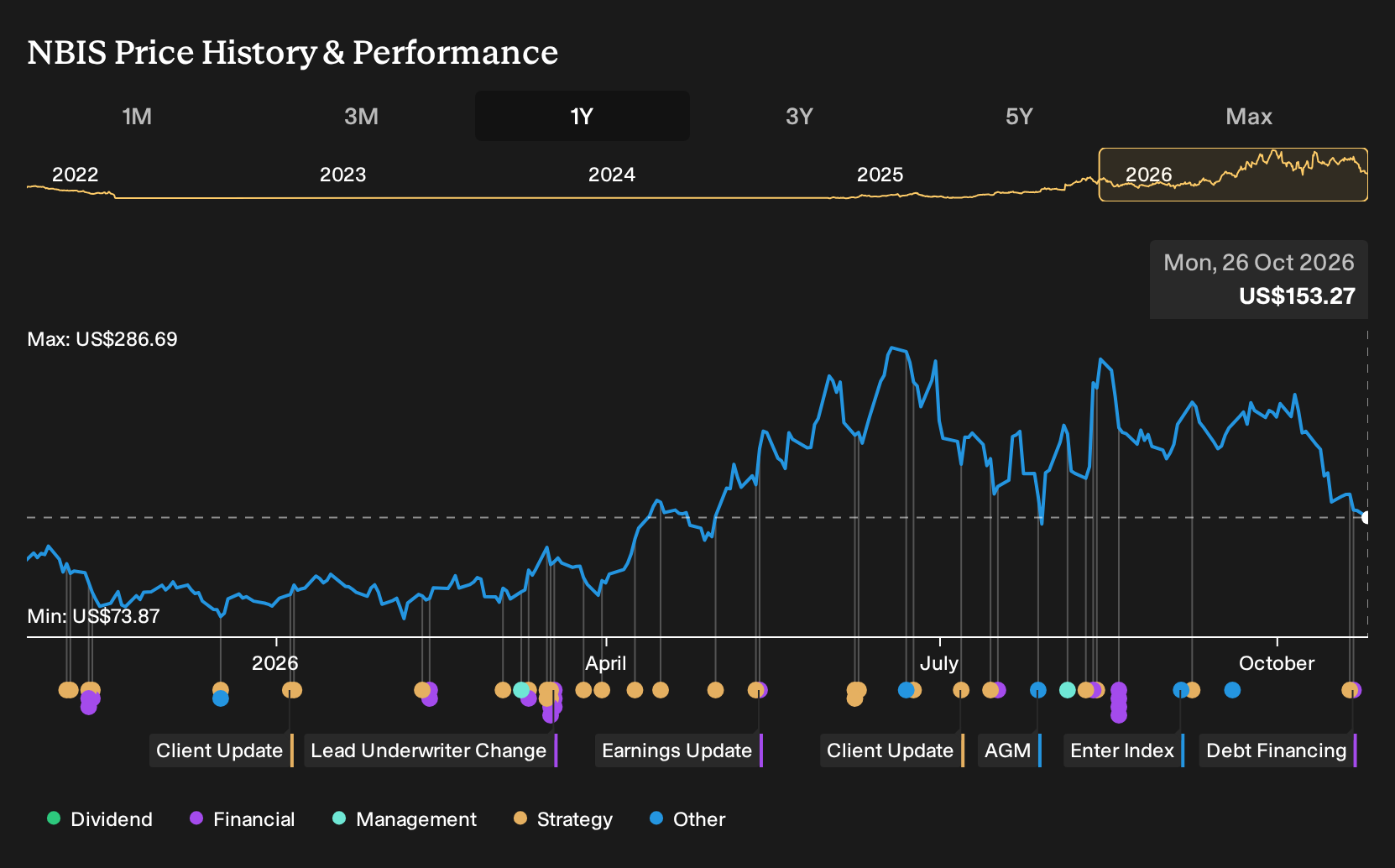
- Nebius Group reported very large year over year revenue growth driven mainly by AI cloud contracts, raised its 2026 revenue outlook, and secured a US$3.5b senior secured facility from Citi backed by long term deals with major investment grade clients.
- The shift toward asset light partnerships and stronger profitability, including a 41% adjusted EBITDA margin, suggests Nebius Group is trying to match aggressive AI capacity build out with tighter capital discipline in a sector worried about debt sustainability.
- This analysis will examine how Nebius Group's stronger AI contract visibility and new Citi facility may reshape its high growth investment narrative.
Nebius Group Investment Narrative Recap
To own Nebius Group, you need to believe its full stack AI infrastructure can attract enough large, long duration cloud contracts to support heavy GPU and data center spending while still improving profitability from a low net margin base. The big short term swing factor is execution on new capacity in Europe and New Jersey, plus converting its contract pipeline into cash flow.
The biggest immediate risk is funding that build with almost entirely higher risk borrowing in a sector where debt markets have become cautious. The new US$3.5b Citi facility helps reduce near term refinancing worry but does not remove pressure on Nebius to keep projects on schedule and utilization high.
Among recent updates, the public live spot pricing for GPU compute looks most tied to these Citi financing headlines. Management is not just adding debt. It is trying to squeeze more revenue out of the same hardware through spot, reserve auctions, and pay as you go options so more of the GPU fleet earns money instead of sitting idle.
For you as a shareholder, the key question is whether Nebius Group can scale this pricing system fast enough to support the new borrowing and large projects like the €8b Béthune site and 300 MW New Jersey facility. If the spot model drives better utilization, it may help support the overall business case. If it does not, leverage increases the downside risk.
Nebius Group Forecast Setup
Nebius Group’s long term story in the AI build out now comes with very specific analyst assumptions. Consensus models point to revenue of US$30.0b and earnings of US$2.6b by 2029, paired with a shift to an 8.8% profit margin from 3.1% today. That mix of higher scale and fatter margins underpins the argument that today’s heavy GPU and data center commitments can eventually be supported by internal cash generation rather than relying mostly on fresh debt.
Nebius Group's narrative projects US$30.0b revenue and US$2.6b earnings by 2029. This assumes yearly revenue growth of 180.7% and an earnings increase of about 61x from US$42.4m today.
To get there, analysts are effectively treating the current US$42.4m of earnings as a starting point that compounds into a multibillion dollar profit pool. That move from roughly breakeven net income to US$2.6b of bottom line would need both sustained AI demand and tight cost control on new capacity, including sites like Béthune and New Jersey that carry large upfront power and construction bills.
The models also assume the share count grows by 7.0% per year over the next three years. For you as a shareholder, that means the pie is expected to get much bigger, but it is also sliced into more pieces. Any assessment of Nebius Group’s potential per share value needs to weigh that planned issuance alongside the headline earnings expansion.
On valuation, the consensus price target of US$290.63 rests on Nebius trading on a P/E of 47.7x those 2029 earnings. That is far below the current multiple of 1,218.0x, yet still above the 30.7x level quoted for the wider US software sector. The gap indicates that analysts are supporting a premium story, where high growth in AI infrastructure and better profitability are viewed as justifying a higher price per dollar of future earnings than for a typical software peer.
This bridge from today’s valuation to the 2029 scenario also uses a discount rate of about 8.8%. That rate is meant to capture time value of money and risk in a single number. If your own comfort with Nebius Group’s AI exposure, funding profile, and regulatory exposure suggests a higher or lower required return, your estimate of fair worth for the stock could land well away from the US$290.63 consensus.
Finally, the wide spread between the most bullish US$410 target and the most cautious US$84 view highlights how uncertain the AI infrastructure path still is. Investors who buy into the idea that Nebius can translate its US$3.5b Citi facility and large AI contracts into the US$30.0b revenue line that analysts are penciling in will read these projections one way. Those who worry about competition, open source tools, and data regulation eroding pricing power may treat the same figures as a stretch case rather than a base expectation.
Uncover why Nebius Group's fair value indicates a 70% potential upside to its current price, which could narrow quickly.
Exploring Other Perspectives
One alternate view treats Nebius Group’s funding need as the real swing factor. Bullish analysts were already assuming revenue could reach US$42.0b and earnings US$1.6b by 2029, compared with consensus of US$30.0b and US$2.6b. Those estimates came before the Citi facility, so you should expect opinions to shift as the debt story evolves.
Explore 10 other Nebius Group fair value estimates, including one that suggests potential upside of up to 512% from the current price.
The Verdict Is Yours
Don't just follow the ticker. Dig into the data and build a conviction that's truly your own.
- A great starting point for your Nebius Group research is our analysis highlighting 2 key rewards and 4 important warning signs that could impact your investment decision.
- See our latest analysis for Nebius Group. The report includes a comprehensive fundamental analysis summarized in a single visual, the Snowflake, making it easy to evaluate Nebius Group's overall financial health at a glance.
Looking for more investment ideas beyond Nebius Group?
If Nebius Group has sharpened your focus on where AI and infrastructure spending meet, it can help to compare it with other companies that fit clear financial themes. The Simply Wall St Screener lets you quickly narrow the universe to a handful of names that match the balance of growth, quality, and risk that suits you.
- For investors who want income potential with resilience, review 5 dividend fortresses that may align better with a steady cash flow profile.
- If capital preservation and peace of mind rank higher for you than rapid expansion, filter for companies in the 30 resilient stocks with low risk scores and see how their metrics stack up.
- When you want to focus on financial strength first and growth second, start with the list of solid balance sheet and fundamentals (24 results) and compare those balance sheets to Nebius Group.
Have feedback on this article? Concerned about the content? Get in touch with us directly. Alternatively, email editorial-team@simplywallst.com