


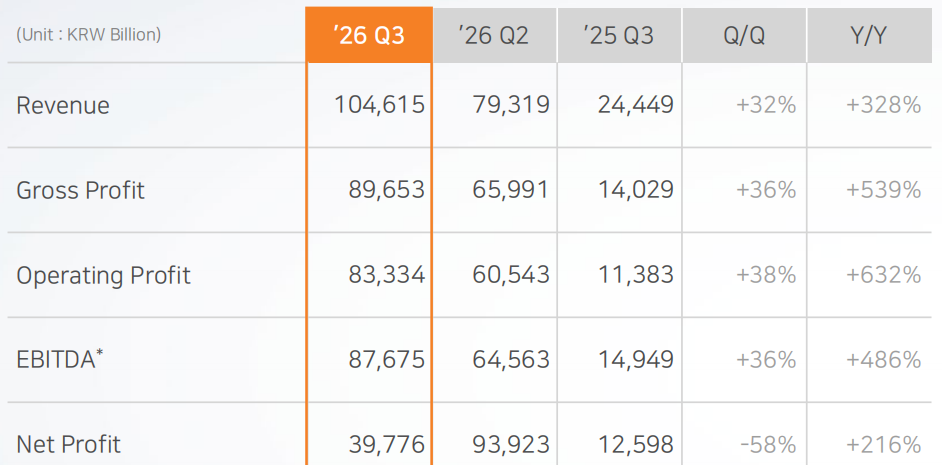
The Zhitong Finance App learned that SK Hynix (SKHY.US) announced the results for the third quarter of the 2026 fiscal year on October 28. Both revenue and profit surpassed market expectations, and this report card was viewed by the market as a strong response to the question of “whether the AI infrastructure investment boom can continue”. According to financial reports, the company's revenue for the quarter was 104.62 trillion won, up 328% year on year, exceeding 100 trillion won for the first time, higher than market expectations; operating profit of 83.33 trillion won, up about 7 times year on year, and 80% operating profit margin hit a record high in a single quarter, which also exceeded expectations.
Notably, net profit for the quarter was only 39.78 trillion won, which was lower than market expectations. The company disclosed that it recorded a non-operating loss of 32.63 trillion won during the quarter, including exchange rate related losses of 11.63 trillion won and losses related to investment assets of 22.92 trillion won. After the financial report was released, SK Hynix's US stock rose about 3% after off-market trading.
Looking at volume and price splitting, DRAM shipments increased by about 10% month-on-month, and the average selling price (ASP) rose 20% month-on-month; NAND shipments declined slightly month-on-month, and ASP rose 20% in the middle. The increase in the share of high-value-added server products was the main driver.
SK Hynix has always prioritized long-term contracts with customers, including Nvidia. Like rivals Samsung Electronics and Micron Technology, in recent years, the company has shifted its production focus to HBM, which has led to a tightening supply of traditional memory.
Looking ahead, the company expects DRAM shipments to increase by 20% month-on-month in the fourth quarter. HBM4 will surpass HBM3E as the main product in terms of both shipments and revenue in the fourth quarter, and the 2027 HBM supply negotiations have been completed. The company has signed long-term supply agreements with 14 core customers (including major global cloud service providers) to lock in more than 50% of production capacity from 2027 to 2028.
SK Hynix expects a significant increase in capital expenditure in 2027 compared to this year. Expenses will be used for advanced node portfolios and equipment investment to climb production capacity in the first year, as well as the accelerated growth of infrastructure investment in Korea and overseas. The company determined that storage supply shortages will continue until 2030 due to advanced process complexity and factory construction cycles.
The company also announced a total shareholder return of approximately 100 trillion won for the 2026 fiscal year, including more than 30 trillion won in cash dividends and over 60 trillion won repurchase cancellation; a third quarter dividend of 20,000 won per share, of which 10,000 won was a special dividend from Kioxia's investment income.
As the core supplier of Nvidia (NVDA.US) HBM, SK Hynix is one of the biggest beneficiaries of this AI boom. Its operating margin remains at an all-time high, reflecting tight supply. The company expects the shortage of memory chips to continue until 2030, and has signed long-term agreements with 14 major customers to lock in more than 50% of production capacity from 2027 to 2028.
Counterpoint Research pointed out that this quarter's profit surge was mainly due to the rapid rise in conventional DRAM and NAND prices. Quarterly profits have not peaked, and the upward trend will continue until at least 2027.