


The Zhitong Finance App learned that in the last week of October, the AI storage chain began an intensive financial reporting period. The two representative companies handed over “Yingxi” almost at the same time, but the market gave diametrically opposite stock price reactions.
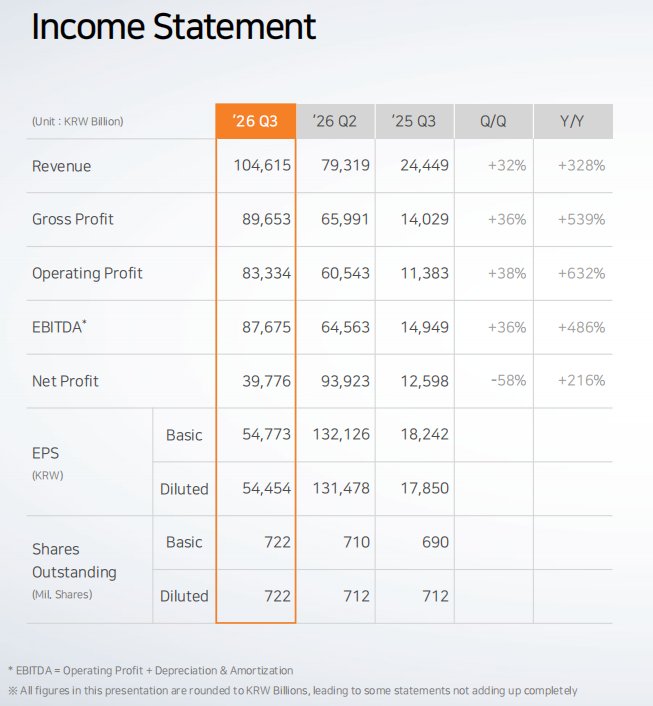
The profit and return of SK Hynix (SKHY.US) had a “double impact”, and the stock price bucked the trend and strengthened. According to the latest financial report released by SK Hynix, the company's revenue for the third quarter of fiscal year 2026 (up to September) was 104.61 trillion won, up 328% year on year, exceeding 100 trillion won for the first time in a single quarter; operating profit of 83.33 trillion won, up 632% year on year, setting a new record for six consecutive quarters, with an operating margin of 80%; net profit of 39.77 trillion won, an increase of 216% year on year. The company attributed the results to AI storage (HBM) and demand for high value-added products driving up the prices of key products.
On the same day, SK Hynix announced the 2026 shareholder return plan: on top of the 40 trillion won repurchase and cancellation, an additional 60 trillion won return plan will be added, bringing the annual shareholder return scale to more than 100 trillion won, of which the cash dividend will exceed 30 trillion won. The company also revealed that it has signed long-term agreements (LTAs) with 14 major customers to lock in production capacity corresponding to more than 50% of the total production capacity from 2027 to 2028, and it is expected that the shortage of memory chips will continue until 2030; the sixth-generation HBM4 will become the main product from the fourth quarter.
After the announcement of the financial report and return plan, as of press release, SK Hynix's stock price rose by nearly 8% in the Seoul market, and the increase in US stocks at night once extended to about 7%.
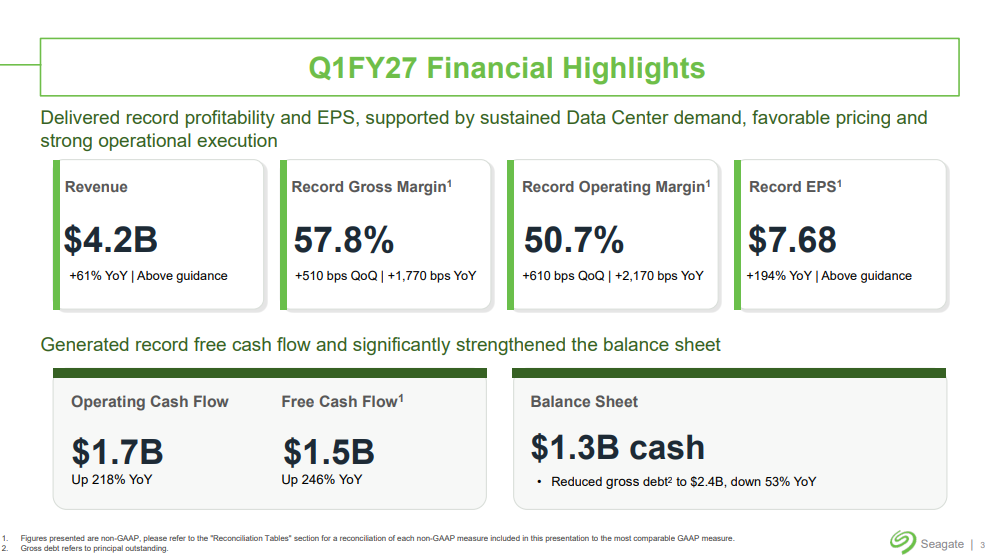
Seagate also announced record profits and overall exceeding expectations, but it was sold off after the market. According to Seagate's financial report for the first fiscal quarter of fiscal year 2027 (ending October 2, 2026), the company's revenue was US$4.233 billion, up 61% year over year, higher than analysts' general expectations of US$4.15 billion; non-GAAP diluted earnings per share (EPS) of $7.68 (US$2.61 in the same period last year), exceeding Wall Street expectations of US$7.45, GAAP diluted EPS of $7.59; non-GAAP gross margin of 57.8% (GAAP 57.3%), non-GAAP operating margin of 50.7% (GAAP) 48.8%); net profit (non-GAAP) of $1,781 billion. Free cash flow of US$1,479 million, a record for a single quarter; the principal amount of debt repaid during the quarter was about US$1.2 billion, total debt fell to US$2.4 billion at the end of the quarter, and further repayment of US$750 million after the quarter reduced total debt to US$1.6 billion. The company announced that it would raise its quarterly cash dividend by about 3% to $0.76 per share, and return US$568 million to shareholders through dividends and repurchases this quarter.
Facing the next quarter, Seagate's revenue for the second fiscal quarter of fiscal year 2027 was $4.8 billion (± $100 million) and non-GAAP diluted EPS of $9.20 (± 0.20 US dollars), both higher than analysts' previous expectations of $4.55 billion and $8.66.
However, this “performance and guidance both exceeded expectations” was exchanged for a sharp 8% drop in the post-market share price; by the close of Tuesday, its stock price had retreated about 35% from its historical closing high on June 22.
With the same AI storage circuit and the same financial reporting window, “profit rise” and “profit fall” coexist, forming an extremely clear differentiation in this financial reporting season.
Continued profit “pricing differences”
The market gave the opposite reaction. The main reason was not the deterioration in Seagate's fundamentals, but rather the difference in pricing “how long the profit will last” between the two.
Seagate's own fundamentals showed no signs of deterioration. According to statistics, Seagate analysts have lowered profit expectations zero times in the past 30 days, and nearline (nearline) production capacity has been allocated to 2027, and contract prices have been locked in for the 2027 fiscal year. In other words, the sell-off was more due to “high expectations and crowded positions after too much increase during the year.” The analysis points out, “After the sharp rise in stock prices at the beginning of this year, Wall Street has been scrutinizing Seagate more strictly in recent months; record profit performance has now become the basic expectation of the market, rather than a sign of entry into the market to buy.”
In contrast, SK Hynix gave the market a “rhythm and signal”: not only did profits exceed expectations, but it also combined 100 billion won in shareholder returns and long-term cooperative lock-ins. Ms Hwang, research director at Counterpoint Research, believes that the company's quarterly profit “has not yet reached its peak, and the upward trend will continue until at least 2027,” and that the jump in this round is mainly due to the sharp rise in traditional DRAM and NAND prices, not just HBM. Macquarie estimates that storage accounts for about one-third of all AI data center spending, and HBM prices are expected to more than double in 2027.
Notably, SK Hynix's net profit for the third quarter (39.77 trillion won) fell short of some market expectations (about 60 trillion won), but the operating profit and return plan still drove stock prices — this further shows that the market rewards “deterministic signals and shareholder-friendly behavior” rather than a single profit line that completely exceeded expectations.
The structural constraints on the supply side are different
The deeper reason is the difference in supply-side constraints between the two sub-tracks.
The memory/HBM side is “tight”. SK Hynix has signed agreements with 14 customers to lock in more than 50% of the total production capacity from 2027 to 2028. KB Securities analyst Jeff Kim pointed out that more than 70% of the Korean chipmaker's planned production in 2027 is covered by a five-year supply agreement, and the remaining less than 30% goes to other customers such as smartphones and PCs. Together, Samsung and SK Hynix control about 60% of DRAM revenue and more than 80% of HBM revenue, and the “crowding out effect” of HBM production lines on DRAM wafers keeps standard memory tight even as total production capacity expands. Citi analyst Peter Lee looked at the memory supercycle up to 9 years; Citi's other opinion is that the current cycle “is expected to outperform the 2001-2007 upward cycle,” and the total HBM capacity of a single AI system is expected to increase from 20.7 TB to 110.6 TB (434% increase).
Concerns about the “looseness” on the hard drive/HDD side are at its peak. Seagate's decline was partly triggered by competitive supply-side news: According to reports, Toshiba plans to nearly double its annual HDD production capacity for AI data centers by the 2027 fiscal year, triggering oversupply concerns; during the same period, Wells Fargo lowered Seagate's target price from $1,180 to $865, and J.P. Morgan Chase lowered it from $1,240 to $1,050. The data storage industry is traditionally cyclical, and any sign of weakening demand or supply expansion can easily trigger Wall Street unease.
Of course, Seagate isn't without hedging the narrative. CEO Dave Mosley said in the official earnings press release that data creation, retention, and reuse continue to superimpose storage requirements, and “the visibility of long-term customer demand supports our judgment over many years of growth,” and emphasized using the HAMR (Thermally Assisted Magnetic Recording) technology roadmap to meet Exabyte demand through surface density improvement while maintaining supply discipline. However, compared to demand from memory manufacturers that have been “locked in” by long-term cooperation, demand for HDDs is still more dependent on the capital expenditure of cloud vendors, a variable that is being questioned at the macro level.
The “double-edged sword” of discounted valuations
At the valuation level, the current transaction ratio for the entire storage/memory sector is significantly lower than the market. According to statistics, Micron (MU.US)'s forward price-earnings ratio is about 5 times, SanDisk (SNDK.US) is 6 times lower, Western Digital (WDC.US) is about 12 times, and Seagate is about 15 times lower, all lower than S&P 500 (about 19 times) and NASDAQ 100 (about 20 times).
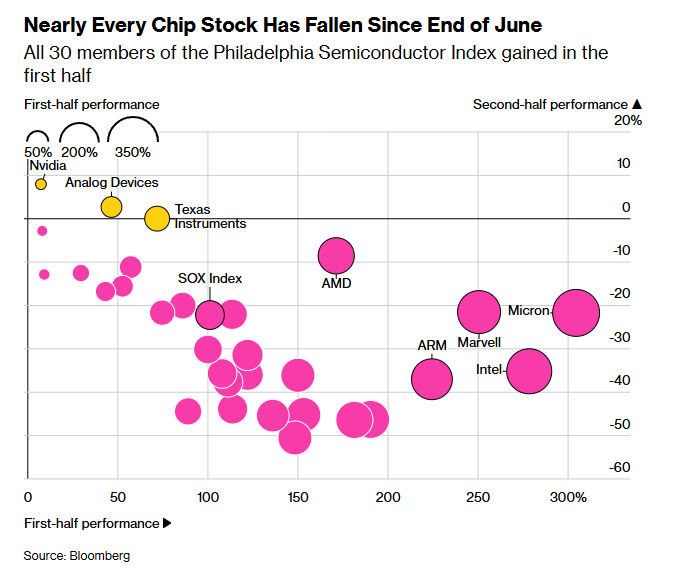
A low multiple is both a reason for a “mistaken kill” and a reverse warning that “the cycle is peaking.” Some Wall Streeters have warned that the historical cyclical nature of memory demand makes these low multiples a warning sign; however, the scale and speed of AI construction may also invalidate historical cycle comparability. Looking at institutional target prices, Seagate's 12-month implied increase of more than 70% and SanDisk over 80%, ranking among the top seven return potential in the S&P information technology sector.
Morningstar Research Director Lorraine Tan gave a cautious scenario: AI-related stocks may fall another 20%-30% before becoming “purchasable.” The risk is that if the capital expenses of hyperscale cloud vendors peak, the demand curve behind HBM will be flattened regardless of supply discipline. D.A. Davidson analyst Gil Luria stood on many sides and gave Micron a target price of $2,000, saying that this round is a “trinity” supercycle of GPU, CPU, and memory. The market is pricing the “end of the storage cycle,” and demand for AI computing power is still growing.
Asymmetric transmission of AI financing tightening
Taking a macro perspective, the background of this round of differentiation is the tightening of the AI financing environment, and the impact of this macroeconomic pressure on the two companies is not symmetrical.
Jefferies analyst Christopher Wood advised investors in a report to “keep an eye on credit spreads and look for any evidence that the market is no longer willing to finance the ongoing AI capital spending boom”: Oracle (ORCL.US) 5-year credit default swap (CDS) spreads once rose from 186 basis points on September 11 to 288 basis points, and CoreWeave (CRWV.US) rose from 749 basis points to 1,118 basis points, “the highest level since the start of the AI capital expenditure cycle in early 2023”; The report also said that the forward profit growth rate of global AI stocks is expected to slow from about 100% in 2026 to 30% in 2027 and 22% in 2028. AI stock trading is about 23 times the forward profit, and about 13 times that of non-AI stocks.
Meanwhile, Nvidia (NVDA.US) CEO Huang Renxun said in an interview that “capital is scarce” and that “the demand for capital far exceeds the availability of capital.” It is also reported that Oracle invokes force majeure clauses at the New Mexico data center, the sharp rise in CoreWeave bond yields and a sharp drop in stock prices, Firmus Grid's withdrawal of the IPO plan, and NScale is under pressure due to Microsoft's withdrawal from the UK project — all of these events point to pressure on financing and construction of AI infrastructure.
This means that the key to the transmission mechanism is “whether the demand has been contracted.” Dave Mazza, CEO of Roundhill Investments, said, “If the four major manufacturers can prove that order reserves have been signed rather than expected, the debate over peaking memory cycles will be postponed for a year.” This is the reason why SK Hynix received a “profit visibility” premium due to long-term locking volume, while Seagate HDD is in a more downstream and cyclical position, and faced with Toshiba's expansion of production and rising component costs (Seagate CFO Gianluca Romano acknowledged during the earnings call that the cost of some external components was much higher than a year ago), under the same macroeconomic headwinds.
It should be emphasized that Jefferies clearly “does not believe that AI project financing has stopped” in the report, but rather sees widening credit spreads as an “early warning sign that needs to be monitored.” In other words, macroscopic pressure is an “amplifier” rather than a “conclusion.”
Stringing together the above clues, we can see a clear transmission chain: macro-financing tightening has lowered the risk appetite and long-term profit expectations of the entire AI chain; however, within the sector, memory/HBM relies on long-term co-locking volume, share concentration (Samsung +SK Hynix controls more than 80% of HBM revenue) and structural supply constraints, so it still receives positive feedback in the face of headwinds; Seagate HDD is more downstream, more cyclical, and faces rising production and component costs from Toshiba. Cloud vendor capital expenses. As a result, the same macro headwind is transmitted through “profit visibility differences”, forming a differentiation between “rising earnings versus falling profit”.
Nevertheless, this interpretative framework is inconclusive. If Seagate later also announces a similar scale of long-term cooperation, or if Toshiba's production expansion plans are falsified, or the capital expenses of hyperscale cloud vendors are significantly reduced, then the logic of differentiation needs to be corrected. Furthermore, the bearish side still has weight -- the “big short” Michael Burry has turned Micron's short position into a bearish option, believing that the structural shortfall caused by current AI construction is temporary, and that the industry will return to boom and bust within two years; Sungkyunkwan University also warned that if AI demand falls short of expectations, the expansion of large-scale memory factories may cause the industry to fall into oversupply by 2028, while Morgan Stanley estimates that by 2028, China will account for about 30% of the world's net DRAM wafer production capacity.