


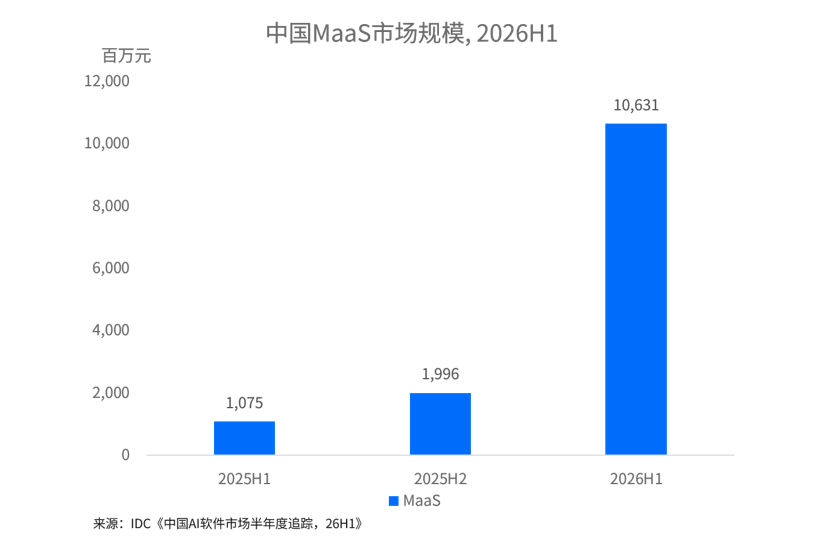
The Zhitong Finance App learned that according to a report recently released by the International Data Corporation (IDC), China's MaaS market reached 10.63 billion yuan in 2026H1, and its share of China's public cloud PaaS market rose from 5.2% in the second half of 2025 to 21.0%, beginning to have a disruptive impact on the existing market pattern. IDC believes that for industry users, MaaS has gone from being an option to becoming a business standard. For technology vendors, MaaS is also becoming a major growth position that cannot be lost.
2026H1, China's MaaS market size and token calls showed explosive growth
In the first half of 2026, China's MaaS market continued and amplified the high growth trend since 2025. According to revenue statistics, the market size reached RMB 10.63 billion, an increase of 889.4% over the previous year. This growth rate means that the market has expanded nearly 9 times in one year, and MaaS has officially entered the 10 billion level circuit.
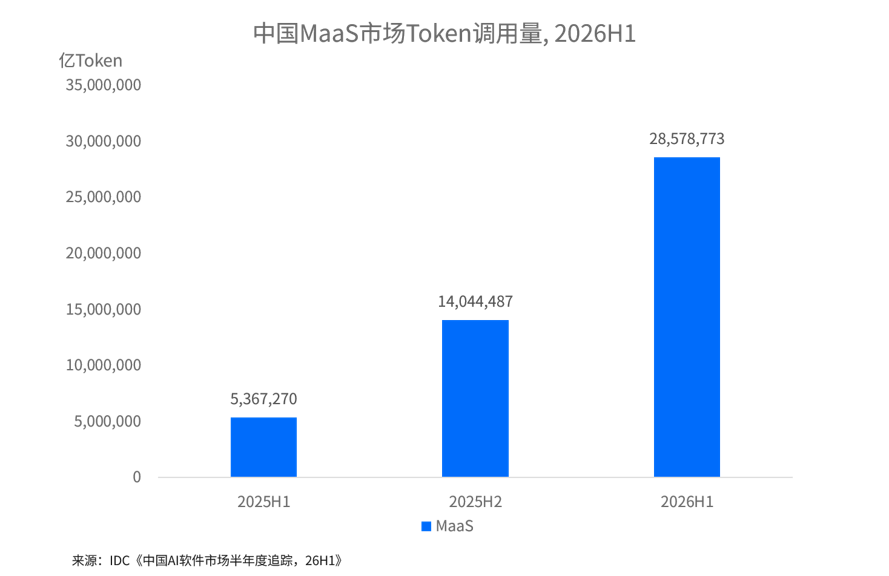
According to call volume statistics, the total token consumption in the 2026H1 market reached 2,857.9 trillion yuan, an increase of about 432.5% over the previous year.
Behind the growth: model upgrade, scene scaling, modal expansion
Model iteration - flagship upgrade, Flash meets standards, industry penetration accelerates, and user platforms continue to expand.
On the supply side, the two thresholds of model capacity and cost declined simultaneously in the first half of 2026. At the flagship level, models such as Qwen3.5 and GLM-5.2 continue to be upgraded in terms of reasoning, programming, and intelligence capabilities. The long context has generally reached the million-level, and the big model has been able to enter the core business links of more industries — from “auxiliary office” to “directly undertaking production tasks”; at the level of inclusiveness, various Flash/lightweight versions have reached the threshold of usability, making the originally highly cost-sensitive industry have the economy of large-scale calling models for the first time. The large model user market has expanded from pioneering industries such as the Internet to broader industrial hinterlands such as finance, retail, manufacturing, and government affairs.
Dig deep into the scene - build a large and concurrent chassis, and relay amplification for three types of scenes.
Large concurrent scenarios such as recommendation systems, search, conversation, and coding in the Internet's own business still form the backbone of MaaS revenue and contribute steadily. At the same time, the increase comes from three types of relay scenarios: one is the accelerated spread of everyday office processes, including the automation of office processes in various industries, and content generation scenarios represented by financial investment and research report writing; second, the penetration of intelligent customer service into more industries, with e-commerce and trading companies being particularly prominent; and third, new scenarios such as smart terminal assistants and IT automatic operation and maintenance are successively connected to large models. The penetration rate of these scenarios is still low, the business chain is long, and the requirement for longer context and stronger reasoning ability has caused the number of single task calls to rise simultaneously with the customer unit price, and is taking over as the main source of MaaS revenue growth.
Model iteration - flagship upgrade, Flash meets standards, industry penetration accelerates, and user platforms continue to expand.
On the supply side, the two thresholds of model capacity and cost declined simultaneously in the first half of 2026. At the flagship level, models such as Qwen3.5 and GLM-5.2 continue to be upgraded in terms of reasoning, programming, and intelligence capabilities. The long context has generally reached the million-level, and the big model has been able to enter the core business links of more industries — from “auxiliary office” to “directly undertaking production tasks”; at the level of inclusiveness, various Flash/lightweight versions have reached the threshold of usability, making the originally highly cost-sensitive industry have the economy of large-scale calling models for the first time. The large model user market has expanded from pioneering industries such as the Internet to broader industrial hinterlands such as finance, retail, manufacturing, and government affairs.
Modal scaling - The video generation model has become the second most important growth curve in the MaaS market.
The video generation model crossed the inflection point of commercialization in the first half of the year: the next-generation model represented by Seedance 2.0 greatly increased the availability rate of 15-second videos, and production processes such as skits, advertisements, and e-commerce content began to be introduced in batches. This trend directly reshaped the MaaS market structure: 2026H1. In the overall MaaS scale, big language models accounted for 47.0%, while the revenue generated by video generation model calls contributed 32.7%, and the remaining “other modal models” accounted for 20.2%. The video modality has substantially become the second-largest driver of MaaS growth.
MaaS has become a must, and players of all types are entering at an accelerated pace
In just half a year, MaaS's share of the Chinese public cloud PaaS market rose from 5.2% to 21.0%, beginning to have a disruptive impact on the existing market landscape. For cloud vendors and model vendors, MaaS is no longer an “option” in the cloud business: it is not only the most important source of incremental growth in the next few years, but also directly determines the distribution of voice in the next round of cloud market competition — not participating means being absent from the core of cloud computing. In this context, various types of vendors will rely on their own endowments to accelerate their influx into the MaaS market in 2026:
Cloud vendors use computing power resources, perfect model matrices and mature tool chains as the foundation, fully integrate model services into the cloud product system, and target the enterprise market with the overall solution of “model + computing power + tool chain”;
Big model companies use technological leadership and rapid iteration to establish brand mentality, enter enterprise customers with intensive new product launches and aggressive pricing, and transform model advantages into platform traffic through subscription systems and ecological cooperation;
Large model inference service providers focus on multi-model aggregation and ultimate cost performance to handle overflow demand from head models with inference efficiency and open card slots in the “multi-model era” traffic entry;
Operators brought a national computing power layout and deep government and enterprise channel resources into the market, forming a fourth force that cannot be ignored.
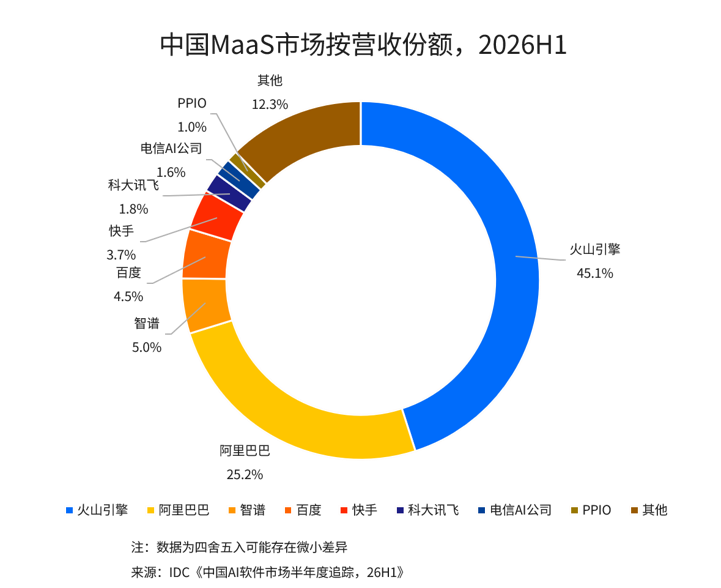
Model release, API price reduction, open source opening, and computing power expansion were carried out intensively in the first half of the year, and the intensity of market competition increased significantly. With their respective genetic advantages, in the first half of 2026, manufacturers such as Volcano Engine, Alibaba, Smart Spectrum, and Baidu gained advantages and major market shares.
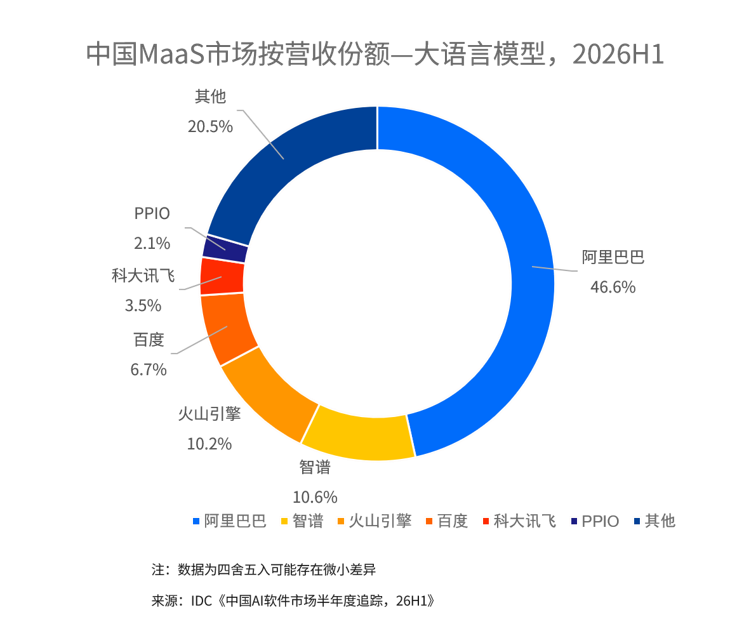
At the same time, the big language model remains the main modality. Technology maturity is higher, inference costs are falling faster, and most of the current enterprise requirements (knowledge quiz, code generation, agent orchestration) are text-centered, which together supports the absolute dominance of the big language model in terms of call volume and revenue. Because of this, competition within the model is the most intense, and manufacturers such as Alibaba, Smart Spectrum, Volcano Engine, and Baidu form the main competitive forces in the big language model market.
Model and reasoning efficiency build short-term barriers, and computing power is a long-term core moat
The MaaS market prospects have been verified by data, the types of participants are rapidly expanding, and the pace of competition has accelerated markedly. IDC believes that the competitive elements of MaaS vendors can be viewed in two time dimensions: in the short term, model ability and reasoning efficiency are the most direct grippers. On the one hand, the upgrade of the flagship model is still the first lever for customer acquisition. The model's effect, iteration pace, and completeness of the model matrix directly determine platform traffic; on the other hand, in the range where model capabilities converge, inference efficiency becomes the key to cost performance — optimization of inference frameworks, PD separation, and large-scale cluster scheduling capabilities determine the effective token throughput that manufacturers can supply to the outside world with the same computing power, and also determines the strength of the price war. The essence of competition at this stage is an “efficiency war”. In the long run, computing power is a core moat that is difficult to bypass: the scale of computing power acquisition, unit cost/computing power cost ratio, heterogeneous adaptability, and supply chain certainty make up the hardest ability for manufacturers to replicate. Model capabilities can be caught up through talent and capital, and tool chains can be replenished through investment, but large-scale, low-cost, and sustainable computing power bases require the accumulation of long-term capital expenditure and supply chain relationships. It is foreseeable that as token consumption levels continue to rise, the right to talk about computing power will be further concentrated at the head, and manufacturers that lack autonomy in computing power will be forced to migrate to the “asset-light model licensing+ecological cooperation” model. Large model platform privatization market volume simultaneously
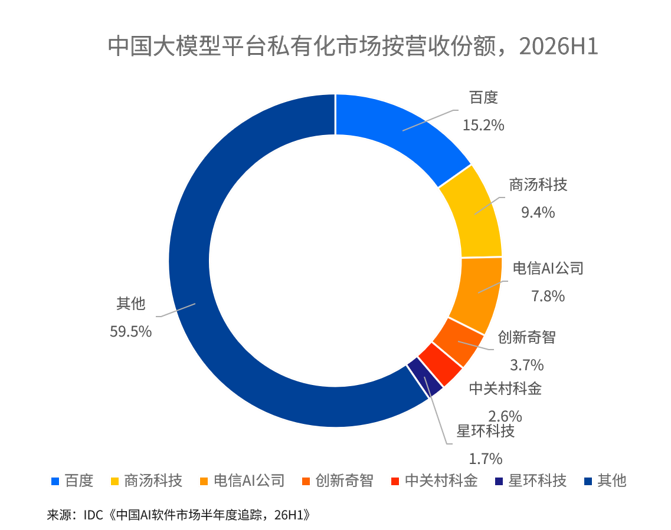
In parallel with the MaaS public cloud, the large-scale model private deployment market simultaneously enters the expansion period. In 2026 H1, the large-scale model privatization deployment market reached 2.88 billion yuan, an increase of 108.4% over the previous year. Demand mainly comes from government, manufacturing, energy, finance and other industries, and the driving logic is shifting from “IT facility construction” to “production environment implementation”: the customer's focus is also shifting from single-point model capabilities to the complete capabilities of the platform — data security, business customization, autonomy and innovation adaptation are essential. Engineering delivery and long-term operation and maintenance are the keys to project success or failure; at the same time, they place more emphasis on business support effects, and use business indicators rather than model lists to measure input and output. Delivery of “application+model” all-in-one machines has accelerated, leading customers have seen multiple repurchases, and the market is moving from single-point pilots to large-scale replication.
Future prospects
The MaaS market continues to grow rapidly, driven by video generation and general-purpose agents/everyday office work. On the one hand, video generation is still in the early stages of commercialization. As the single-generation time period breaks through to the 30-second level and the availability rate continues to rise, demand with real budgets such as advertising, short dramas, and e-commerce will continue to be converted into revenue, becoming the sector with the greatest growth flexibility. On the other hand, everyday office and other scenarios are still in the early to middle stages of penetration, and there is plenty of room for upward growth in call volume and customer unit prices. Accelerating diversification of business models: from “resource business” to “value sharing”.
In line with the expansion of market size, MaaS vendors are also rapidly diversifying their monetization methods. Standard API pay-as-you-go billing is still the most mainstream model; in addition, models such as subscription packages, predetermined resources, pay-per-performance, and cooperative profit sharing, represented by the Coding Plan, quickly launched in the first half of 2026, and the revenue structure showed a pattern of “pay-as-you-go, and multiple models accelerate penetration”.
The significance of business model innovation is not limited to revenue itself, but also the restructuring of customer relationships: pay-as-you-go billing wins “entry” with a low threshold, subscription systems and predetermined resources to guarantee “certainty” in consumption, while pay-for-performance and profit sharing models seek to upgrade MaaS from a “resource business” to a “value sharing business” — for the first time, a manufacturer's revenue is directly linked to the business results of enterprise customers.
Looking ahead to the next 18 months, the business model will accelerate its evolution towards “value anchoring”: billing methods linked to business results are expected to move from exploration to mainstream, the interest bonds between manufacturers and customers are deepening, and the revenue share of diverse models will continue to rise.
Shifting growth: from inventory mining to incremental development. In the domestic market, the penetration of first-mover concurrency scenarios such as coding is nearing saturation, and “internal scavenging” continues to be carried out in the stock market, and marginal revenue is declining. Vendors need to switch the growth engine to two directions: one is to transform “unentered” customers, such as finance, healthcare, government affairs, and the core business systems of large enterprises. They are not without demand, but are not afraid to use and inconvenient before; using solutions such as proprietary cloud inference and data not leaving the domain, to transform this group of customers into the next batch of incremental MaaS user accounts is a potential opportunity for manufacturers to gain growth; second, overseas markets have strong demand for cost-effective inference services, and mature API pricing and gross profit It is generally higher than at home, and is becoming New variables in the revenue structure of leading vendors.
Hong Wanting, senior analyst at IDC China, said that the first half of 2026 is an important watershed in China's MaaS market. The three forces of model upgrading, scene expansion, and video generation are all driving explosive market growth. In just half a year, the market size has surpassed 10 billion dollars, and its share in the public cloud market has increased markedly. Its importance is self-evident. Looking ahead, the market will move from “horse racing ground” to the “value management” stage: in the short term, model efficiency and inference costs determine entry eligibility; in the long term, computing power and systematization capabilities determine whether manufacturers can continue to deliver high-quality, reliable, and measurable services, which will ultimately determine the ownership of profit pools.