


As the artificial intelligence industry moves from technological breakthroughs to large-scale commercial applications, the focus of industry competition is also changing.
In the past, when deploying AI, enterprises first considered whether the computing power was sufficient and whether the model capability was leading; now, as large models gradually mature, what really affects the efficiency of AI implementation is shifting to efficient collaboration between data quality, model adaptation, application scenarios, and resources. Looking further, what enterprises need is not just a data pipeline or model call portal, but an enterprise AI core platform that can connect data, special tokens, models, applications and scenarios, and continuously optimize the enterprise model.
For enterprises, there is no shortage of data, models, and AI applications in the market; what is really scarce is a mechanism that can effectively connect these resources. Data is scattered across different systems and platforms, and model capabilities are difficult to accurately match specific business requirements. From technology demonstration to production environments, applications also face challenges such as scenario adaptation, system integration, and effect verification. These problems have not only boosted the cost of AI applications for enterprises, but have also limited the speed of industry intelligence to a certain extent.
In this context, on October 28, Xunze Technology (03317) launched TokenRouters, which is positioned as the core platform for enterprise AI and a one-stop exchange, matching and service platform for real-time AI data and dedicated tokens, in an attempt to further connect data, models, applications and business scenarios. Compared to simply providing data processing or model reasoning capabilities, TokenRouters is more noteworthy because it tries to integrate the discovery, evaluation, matching and exchange of AI resources into a complete system, and forms a closed loop of services around enterprise model optimization and implementation of small enterprise models.
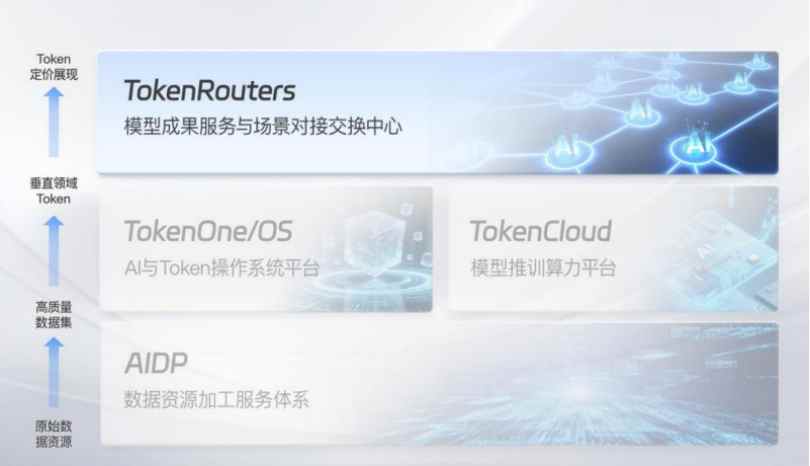
This means that Xunce Technology's strategic layout is being further extended from helping enterprises produce and use tokens to promoting the circulation and value realization of tokens and related intelligent assets. For the company, this is not only an expansion of the product matrix, but also an important step in the evolution of its business model from a single-point service to a platform-based ecosystem service.
From “available resources” to “exchangeable resources”, TokenRouters enters the key link of enterprise AI implementation
As AI applications gradually enter actual business processes such as financial analysis, industrial quality inspection, and intelligent manufacturing, companies' requirements for AI are no longer limited to whether the model can answer questions, but rather pay more attention to whether the model can understand the industry context, accurately process professional data, and operate stably in existing business processes.
Here, two types of tokens need to be distinguished. Generic tokens mainly solve general ability problems such as language understanding, common sense questions and answers, and content generation. The core is “understanding language”. The advantages are strong generalization and low acquisition threshold; however, for enterprises, generic tokens can be purchased, but it is difficult to form differentiated competitiveness. Special tokens are formed from high-quality industry data through governance, processing, and tokenization. They carry industry terms, business rules, process knowledge, and scenario constraints. The core is “understanding the business” and can support more accurate decisions in vertical scenarios such as financial risk control, medical diagnosis, and industrial quality inspection. TokenRouters is not a simple aggregator for generic tokens. Instead, it uses dedicated tokens as the core to exchange assets, so that high-quality vertical tokens can be discovered, compared, matched, circulated, and priced, and this supports the optimization of enterprise models and small enterprise model training and deployment.
Therefore, for enterprises, even if they have sufficient computing power and advanced general models, if they cannot find the right data, match the applicable model, and transform it into an application that can solve actual problems, it is difficult for AI investment to form continuous business value. The main contradiction faced by enterprise AI implementation is gradually shifting from insufficient resources to inefficient resource allocation. In particular, the adaptation efficiency between dedicated tokens and enterprise models is insufficient.
On the one hand, data sets, models, and applications are scattered across different vendors and platforms, making it difficult for enterprises to compare and screen under uniform standards; on the other hand, there are often multiple technical implementation paths for the same business problem, but the model's capability boundaries, degree of data adaptation, and application effects lack intuitive reference, and enterprises have to complete model selection through repeated testing. At the same time, industry experience is usually settled in the hands of project teams or professionals, and there is a lack of reusable scenario references, which further increases the time cost of AI projects from program design to actual deployment.
According to the Zhitong Finance App, TokenRouters is targeting these pain points. The platform is centered around the five major modules of data sets, AI models, AI applications, scenario libraries, and intelligent customer service to establish a complete chain from identifying scenarios, discovering resources, evaluating and adapting, drawing on and verifying, and providing full service.
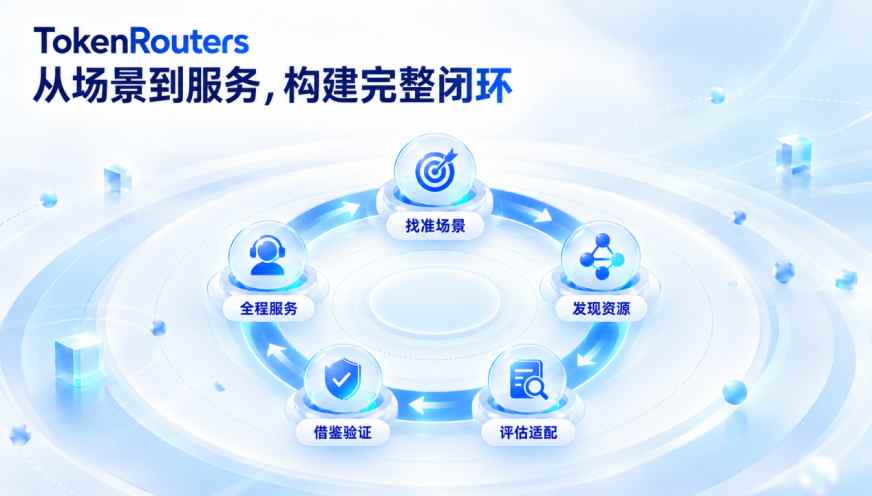
Among them, data sets help enterprises identify and evaluate data resources more effectively through information such as content summaries, technical specifications, and application scenarios; AI models provide references around model capabilities, technical specifications, and application scenarios to promote mutual matching between model capabilities and business tasks; AI applications further link product functions with actual work processes to help enterprises determine what problems specific applications can solve and where they are suitable for deployment.
The significance of this system is not only to centrally display different resources on the same platform. More importantly, it aims to reduce search costs, comparison costs, and decision-making costs in the process of obtaining AI capabilities for enterprises, and make the selection process that originally needed to be completed across platforms and vendors more centralized and transparent. As far as the enterprise model is concerned, this mechanism not only solves the “what to choose” problem, but also provides scenario references for subsequent adaptation, fine-tuning, verification, and deployment. In essence, it continuously optimizes the enterprise model at the platform level.
At the same time, the scenario library and intelligent customer service complement the two aspects of business understanding and service support for resource matching. Among them, the scenario library starts from the actual tasks of the enterprise, breaks down business pain points, explains expected values, and shows how technical capabilities are integrated into the business through system screenshots and architectural diagrams; intelligent customer service provides natural language Q&A, common problem guidance, and historical session management, and reserves manual assistance portals for complex issues.
This kind of product design reflects an important change: the starting point for enterprises to introduce AI can no longer determine a certain technology and then search for application scenarios, but first clarify business problems and then search for suitable data, models, and application resources in reverse. For companies that lack a large AI R&D team, this resource matching method, which starts from business requirements, is expected to lower the exploration threshold for AI applications, and also shift enterprise model optimization from “blind trial and error” to “scenario driven.”
More importantly, TokenRouters incorporates a small enterprise model and dedicated tokens into the overall strategic framework. The general model has extensive knowledge coverage capabilities, but in professional scenarios such as financial risk control and industrial quality inspection, enterprises often need models that can understand specific business rules through industry data training. Vertical domain data that has been governed and refined can be an important foundation for models to adapt to specific businesses, and TokenRouters plays a role in further promoting the discovery, matching, and exchange of these data, tokens, and model capabilities to help enterprises obtain small field models that can be privately deployed at a lower cost and in a shorter cycle.
Of course, in the end, the value of platformization still needs to be verified by the scale of supply and demand, resource quality, actual transactions, and customer usage. The TokenRouters release shows Xunce Technology's strategic judgment on this market opportunity. Its subsequent performance still depends on whether the platform can continue to gather high-quality resources, form effective matches, and establish a service mechanism that enterprises are willing to use for a long time.
From token production to value circulation, accelerate the deployment of a new AI infrastructure ecosystem
If TokenRouters solves the problem of how to connect enterprise AI resources, then judging from the company's overall strategy, its deeper significance is to promote the evolution of Xunce Technology from an AI data infrastructure provider to a Token economic infrastructure operator.
Looking back at the company's business development path, we can see a strategic main line that gradually extends upward: the first stage is data governance, forming high-quality and usable data assets by processing heterogeneous data within and outside the enterprise; the second stage is tokenization, combining enterprise data with specific business scenarios through products such as TokenOS to form scenario tokens for professional tasks; the third stage is token exchange, with the help of TokenRouters connects supply and demand across enterprises, industries, and scenarios; the fourth stage further points to the training and large-scale deployment of small enterprise models, so that AI capabilities can be penetrated into the enterprise's own business processes.
The progressive relationship between the four revolves around the gradual release of data value: data governance solves the problem of whether data can be used, tokenization solves expertise that can be used in models, TokenCloud solves how related models can use computing power to achieve training and inference, while TokenRouters further explores how these capabilities can achieve matching and circulation across organizational boundaries, and continuously optimizes the enterprise model in the process. This also makes TokenRouters not only an extension of the product matrix, but a key fulcrum for building an enterprise AI core platform.
According to the Zhitong Finance App, the business models TokenRouters can explore in the future include token routing fees, token pricing and matching services, compliance circulation and audit services, and value-added services for data assets. Its core logic is to further extend the value originally scattered across data production, model call, and application delivery processes to resource circulation and transaction services.
It should be emphasized that AI cybersecurity and compliance security are the underlying capabilities that Xunce has invested in for a long time. In the process of data governance, tokenization and enterprise services, the company continues to cover data classification, access control, privacy protection, model and token circulation audit, and private deployment security. TokenRouters continues this security compliance approach, embedding network security, data leakage prevention, model access control, and full-process auditing into the dedicated token exchange and matching process, making “exchangeable” based on “auditable, controllable, and compliant”. Previously, Xunze had signed a strategic cooperation agreement with the Shenzhen Data Exchange and signed a cooperation framework agreement with the Beijing International Big Data Exchange, which also reflected its continued layout in terms of compliant circulation and safe use of data elements.
However, the room for imagination in this business model does not mean that platform revenue has already been formed. Whether TokenRouters can actually establish ecological operation capabilities still depends on whether supply-side resources are sufficient, whether demand-side enterprises continue to participate, and whether the platform can establish an effective balance between resource quality, transaction efficiency, data security and compliance requirements. Only if the platform can continue to match real needs with high-quality resources can the scale of circulation be further transformed into sustainable commercial returns.
Today, through its previous business accumulation, Xunce Technology has formed a certain commercialization foundation in data governance, industry solutions, and token business, and has also provided practical support for it to further expand its product system.
There is a clear difference between enterprise-grade AI and general-purpose consumer-grade AI: enterprises need to process complex internal data, follow established business rules, and often place higher demands on data security, deployment methods, and system stability. This determines the competition for enterprise AI infrastructure, not only for technical capabilities, but also for the ability to understand industry needs, implement projects, and adapt to customer business processes.
Previously, Xunce Technology's accumulated data processing experience in financial asset management and other fields, as well as the practice of extending it to the telecommunications, electricity, high-end manufacturing, biomedical and other industries, is expected to provide a foundation for understanding vertical scenarios, organizing professional resources, and adapting promotion models. In addition to this, TokenRouters has the opportunity to further transform resource connections that were originally mainly completed through projects and customer relationships into platform-based discovery, matching, and service processes, and continuously optimize the enterprise model in dedicated token circulation.
Looking forward to the future, as enterprise AI applications move from pilots to wider production deployment, the industry needs not only more computing power and stronger models, but also a set of resource allocation mechanisms that can link data, models, and applications to business requirements. TokenRouters is entering into this gradually emerging market demand.
For Xunze Technology, its strategic value is that the growth logic is expected to extend further from data processing and token call to resource matching, platform services, and small enterprise model deployment. If this system can be continuously improved, the target served by the company will no longer be limited to the data processing needs of a single enterprise, but will have the opportunity to cover a wider AI resource supply and demand network.
From a “data pipeline” to a “token value network,” Xunce is trying to broaden the boundaries of enterprise AI infrastructure. Whether TokenRouters can become the key fulcrum of this transition ultimately depends on the speed of formation of the platform ecosystem, the growth in real transaction demand, and whether the business model can continue to be implemented. What is certain, however, is that when competition in the AI industry shifts from single-point technical capabilities to full-link implementation efficiency, infrastructure platforms that can connect data, computing power, models and applications, it is ushering in a new development window; while Xunce is positioning itself as the core platform for enterprise AI, optimizing the enterprise model as the landing point, and taking security and compliance as the bottom line, it is also seeking a clearer position in this window.