


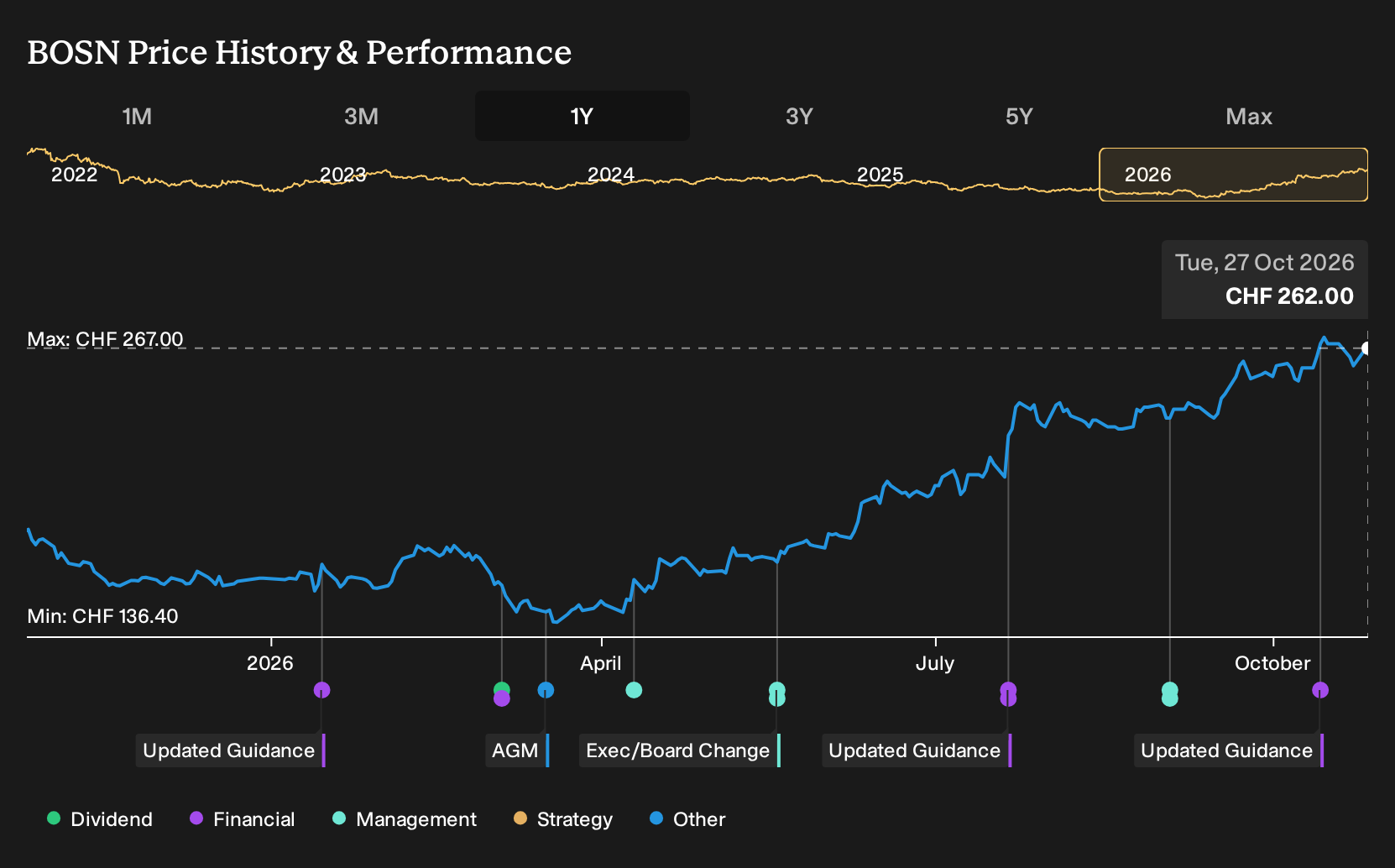
If you had bought Bossard on 27 October 2025 and simply held on, the outcome would have been hard to ignore. Holding Bossard over the past year would have returned 54.4%, including dividends. That is a strong payoff for a business that, at the decision date, sat between bullish hopes on ERP driven efficiency and bearish worries about tariffs, debt, and distributor relevance. Which of those competing stories really deserved more weight at the time?
Bossard has already moved. See which of 195 high quality undervalued stocks still trade below our estimates.
The Two Bossard Stories Investors Had To Weigh
The shares cost CHF179 at the start of the period, and anyone looking at Bossard then had to choose between two very different stories that still felt plausible.
The bullish view pointed to Industry 4.0, ERP integration, and AI as a step change in efficiency, with a Fair Value of CHF247, the price those optimistic assumptions implied, plus an expectation that revenue could rise 7.2% a year and margins reach 8.6% by 2028.
The bearish story saw tariffs, ESG costs, and distributor pressure dominating, with a Fair Value of CHF160 and a focus on risks like manufacturers bypassing Bossard through direct e-commerce, as well as margins edging down from 7.3% to 7.2% even if revenue still grew 4.0% a year.
What The Results Changed For The Bossard Debate
The clearest fresh datapoint for Bossard was the H1 2026 report. Total revenue reached CHF575.719m against CHF546.721m a year earlier, while net income excluding extra items moved from CHF37.372m to CHF53.391m and net margin shifted from 6.8% to 9.3%. That margin expansion lent more support to the optimistic efficiency story than to the cautious tariff and cost thesis, although one period alone did not settle it.
The key lesson is simple. When a bullish case leans on efficiency and technology, focus on what happens to net margin, not just sales. You can apply the same check at other companies by comparing the margin line that was forecast with the margin that actually shows up in interim results.
What Bossard’s Run Leaves You Paying For Today
Bossard now trades at CHF262, and the share move has outpaced the last reported step up in the business. Revenue in H1 2026 reached CHF575.719m against CHF546.721m a year earlier, while net income excluding extra items shifted from CHF37.372m to CHF53.391m.
The clearest change sits in profitability, with net margin moving from 6.8% to 9.3%. The open question is how much of that higher margin level you think the current valuation already assumes as sustainable.
The return is settled. The valuation question is not. Pinpoint what our model says Bossard is worth.
From Bossard To Orbit?
Bossard lives in the nuts and bolts of industry. You can also look at the hardware that gets beyond the factory roof.
Space businesses need repeatable, reliable access to orbit. They also need the electronics and platforms that ride on each mission.
One player is trying to cover both steps, from launch vehicles to the systems that sit inside satellites.
The aim is simple. If it keeps costs low and reliability high, more customers may build crucial services on top of that space backbone.
That argument has a Narrative and a number behind it. → See the company one Narrative values 68% above its price
Have feedback on this article? Concerned about the content? Get in touch with us directly. Alternatively, email editorial-team@simplywallst.com