


VeriSign (VRSN) moved into focus after updating its full year 2026 outlook, pairing fresh revenue and operating income guidance with third quarter results and a newly affirmed cash dividend.
Recent trading has been choppy, with the share price down 1.52% on the day and 0.81% over the past week. However, VeriSign’s 30 day share price return of 5.85% and year to date gain of 26.4% suggest momentum has been building, reflected as well in a 1 year total shareholder return of 28.06% and a 3 year total shareholder return of 55.04%.
Scan beyond VeriSign to see how other high quality operators with pricing power and resilient earnings show up in our 30 resilient stocks with low risk scores.
VeriSign now trades near its recent highs after a solid run, and fresh 2026 guidance is on the table. Does it make sense to pay up today or wait for a cheaper entry point?
Most Popular Narrative: 9.6% Undervalued
Against VeriSign’s last close of $304.04, the most followed narrative anchors on a fair value of $336.40, which implies a modest valuation gap and puts the focus firmly on whether current domain and pricing tailwinds can persist long enough to close it.
The announced wholesale price increases for .com in November 2026 and .net in March 2027, together estimated to add more than US$120 million of annual revenue, are expected to feed directly into operating income and earnings given VeriSign's capital light cost structure.
See why 33 investors see VeriSign as 10% undervalued.
Result: Fair Value of $336.40 (UNDERVALUED)
Still, the VeriSign narrative hinges on contract renewals for .com and .net, and on AI related domain demand not fading, both of which could break the thesis.
Find out about the key risks to this VeriSign narrative.
Another View: Cash Flows Point the Other Way
The fair value narrative around VeriSign focuses on earnings and price targets, yet the SWS DCF model points in a different direction. At $304.04, the shares sit above an estimated future cash flow value of $213.13. This frames the stock as expensive on this basis and raises a simple question: which set of assumptions do you trust more.
For readers who want to see how that conclusion is built line by line, the full SWS DCF model is worth reviewing in detail. Look into how the SWS DCF model arrives at its fair value.
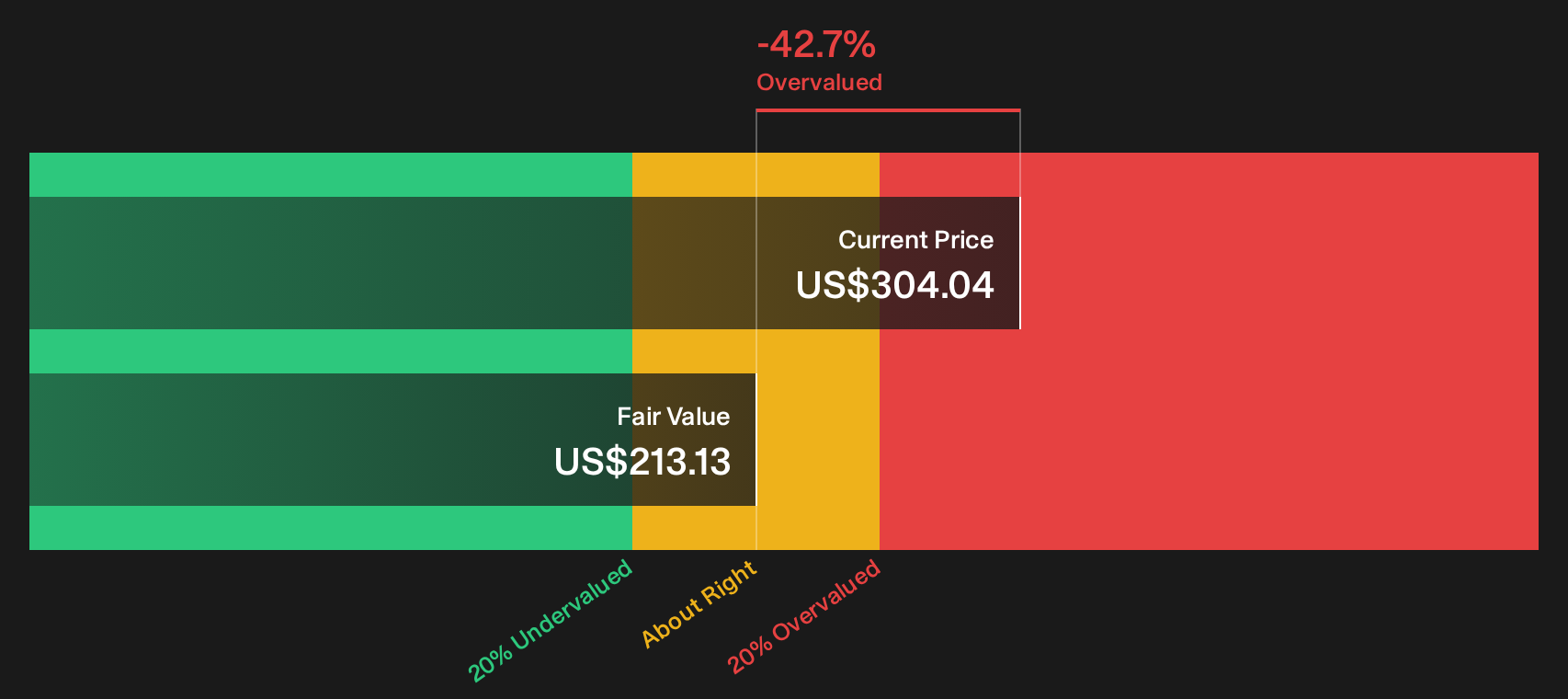
Simply Wall St performs a discounted cash flow (DCF) on every stock in the world every day (check out VeriSign for example). We show the entire calculation in full. You can track the result in your watchlist or portfolio and be alerted when this changes, or use our stock screener to discover 29 high quality undervalued stocks. If you save a screener we even alert you when new companies match - so you never miss a potential opportunity.
Next Steps
Mixed signals around VeriSign’s valuation make this a good moment to look under the hood yourself and not just follow the crowd. If you want a quick way to weigh both the upside arguments and the watchpoints flagged by our models, start with the 2 key rewards and 3 important warning signs.
Looking for more VeriSign sized investment ideas?
If VeriSign has you thinking harder about pricing power and quality, do not stop there. A few minutes with the right screeners can surface opportunities you would otherwise miss.
- Target companies with durable cash flows and balanced financial profiles by scanning our 29 high quality undervalued stocks that combine quality metrics with pricing that still looks reasonable.
- Hunt for stability first, then return, by working through a curated list of solid balance sheet and fundamentals (24 results) that filters for stronger balance sheets and cleaner fundamentals.
- Go beyond the usual tickers and comb through a 21 high quality undiscovered gems that highlights underfollowed businesses with fundamentals worth a closer look.
Have feedback on this article? Concerned about the content? Get in touch with us directly. Alternatively, email editorial-team@simplywallst.com