


- National Energy Services Reunited has outlined plans to spend about US$1b on equipment in Saudi Arabia over five years, targeting large upstream programs in a key MENA market.
- This level of capital spending raises important questions about future capital intensity, project execution risk, and how earnings are valued against regional peers.
- We will now look at how National Energy Services Reunited's investment narrative is shaped by this US$1b Saudi Arabia equipment plan.
Scan 29 high quality undervalued stocks that, like National Energy Services Reunited, combine heavy investment plans with valuations that still reflect execution and capital intensity risk.
National Energy Services Reunited Investment Narrative Recap
To own National Energy Services Reunited, you need to be comfortable with a capital heavy MENA focused oilfield services model where execution on large contracts matters more than anything else. The key near term swing factor is how reliably Saudi and wider regional activity turns that spending into utilisation and day to day cash generation. The new US$1b Saudi equipment plan increases that focus on uptime, contract discipline and pricing.
The biggest risk remains capital intensity getting ahead of actual work, especially with 2026 capex guidance already higher and free cash flow more exposed to project timing. If Saudi or broader Middle East activity slows or shifts, earnings and cash conversion could come under pressure quite quickly.
The new US$1b Saudi Arabia equipment program is the announcement that most clearly connects to current catalysts. It directly feeds into the multi year upstream spending theme across MENA and the Jafurah unconventional gas build out, where four frac fleets are already active and a fifth is in transit. That level of on the ground kit is what underpins future revenue opportunities.
It also ties back to the 3B3 ambition to reach a US$3b revenue run rate within three years. More equipment in a core market can support that plan if tenders convert and utilisation holds up. The flip side is that higher capital expenditure, on top of 2026 guidance of about US$210m to US$215m, raises the bar for execution and keeps the valuation anchored to project delivery and regional spending trends.
What The Analyst Forecasts Assume For National Energy Services Reunited
Analysts sketch a fairly demanding set of numbers for National Energy Services Reunited. The forecasts call for revenue to grow by 27.1% each year over the next three years, with profit margins moving from 5.8% today to 12.9% on their 2029 view. On that timetable, earnings would increase from US$93.4 million today to US$429.3 million by 2029, which is roughly a 4.6x step up in profit for the business.
National Energy Services Reunited's narrative projects US$3.3b revenue and US$429.3 million earnings by 2029. This assumes 27.1% yearly revenue growth and an earnings increase of about 4.6x from US$93.4 million today.
Those earnings projections are not unanimous. Some analysts are using a higher profit outcome of up to US$511.1 million by 2029, which would imply even more of the Saudi Arabia and wider MENA project pipeline converting into net income. There is also an assumption that the share count creeps higher by 0.07% per year over the next three years, so part of the uplift in earnings per share relies on margins and activity rather than just financial engineering.
To line these estimates up with current valuation work, the consensus view assumes National Energy Services Reunited trades on a P/E of 12.1x those 2029 earnings. That would be lower than the current 20.2x multiple and also below the 20.4x figure quoted for the US energy services industry. The logic is simple. Either the share price grows more slowly than earnings over the next few years, which brings the P/E down, or the profit line needs to over deliver relative to the current consensus for the present multiple to hold.
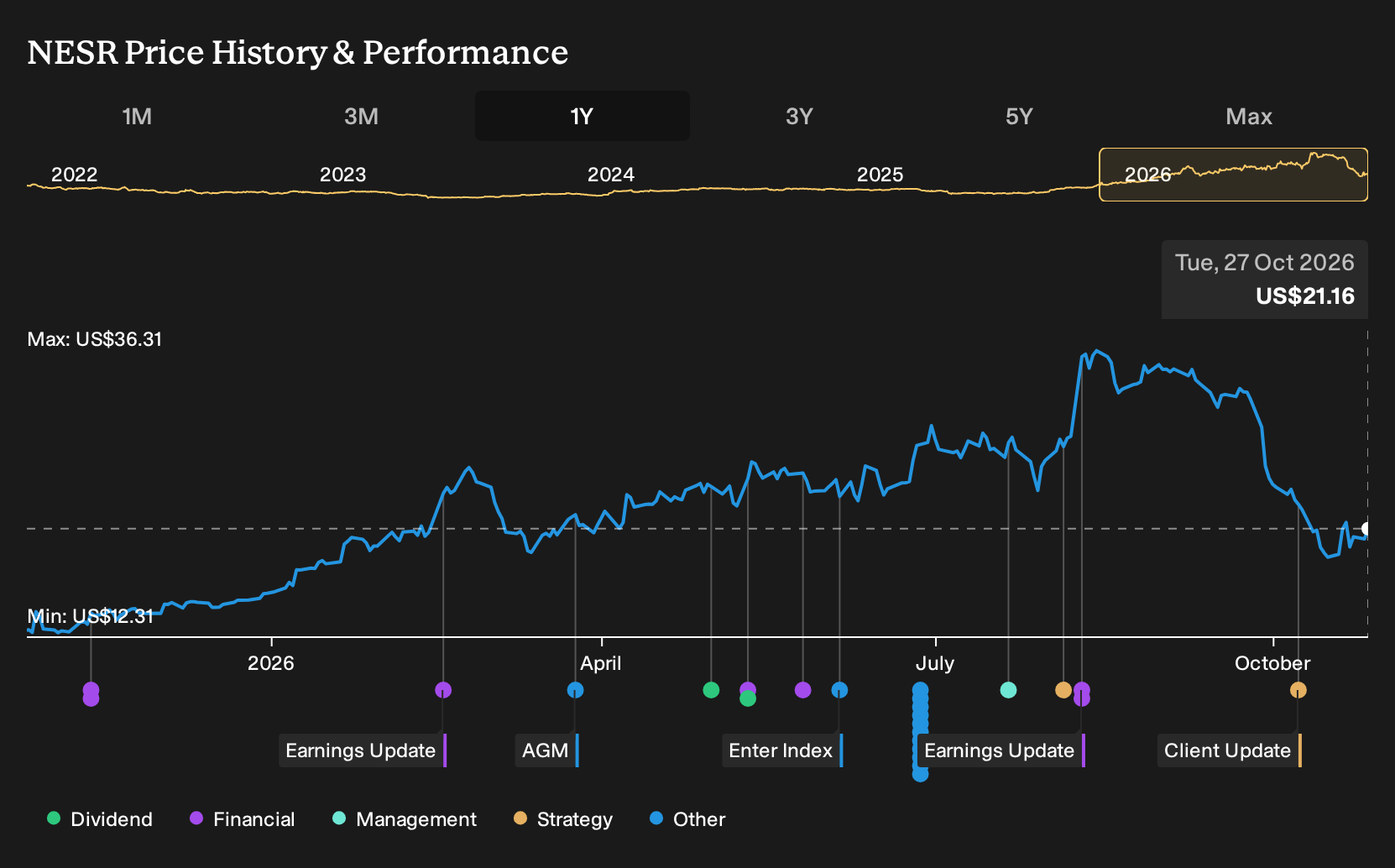
The same set of forecasts anchors the US$41.11 analyst price target that is often quoted for National Energy Services Reunited. At a share price of US$18.73 as of late October 2026, that target sits 54.4% higher, which tells you how much faith is being placed in the 2029 revenue and profit story. There is still a band of opinion underneath that headline figure, with the most cautious target at US$35.00 and the highest at US$46.00.
Uncover why National Energy Services Reunited's fair value indicates a 94% potential upside to its current price, which could narrow quickly.
Exploring Other Perspectives
One alternate angle on National Energy Services Reunited leans heavily on the lithium and Kuwait technology contracts as the real swing factor. Before this Saudi US$1b equipment plan, the most optimistic analysts were already sketching US$3.6b revenue and about US$514.4 million earnings by 2029. That is a much more upbeat story than consensus. Use it as a reminder that reasonable people can look at the same numbers and reach very different conclusions, so explore several views before deciding what this new spending means for you.
Explore 4 other National Energy Services Reunited fair value estimates, including one that suggests as much as 293% upside from the current price.
Form Your Own Verdict
Don't just follow the ticker. Dig into the data and build a conviction that's truly your own.
- A great starting point for your National Energy Services Reunited research is our analysis highlighting 4 key rewards and 2 important warning signs that could impact your investment decision.
- See our latest analysis for National Energy Services Reunited. The report includes a comprehensive fundamental analysis summarized in a single visual, the Snowflake, making it easy to evaluate National Energy Services Reunited's overall financial health at a glance.
Looking For More Investment Ideas Beyond National Energy Services Reunited?
Once you have a view on National Energy Services Reunited, it can help to compare that thesis with other companies that share some of the same themes, whether that is heavy capital spending, balance sheet strength, or income potential. The Simply Wall St Screener is a useful way to do that side by side using consistent data.
- If you want potential mispricing as your starting point, scan a curated set of 29 high quality undervalued stocks where fundamentals and current prices sit in clear tension.
- If capital preservation matters just as much as upside, filter for companies in the 30 resilient stocks with low risk scores and see which businesses pair resilient financial profiles with more measured risk scores.
- If you prefer sturdier finances backing your ideas, work through the list of solid balance sheet and fundamentals (24 results) and focus on companies with balance sheets that can better absorb bumps in the cycle.
Have feedback on this article? Concerned about the content? Get in touch with us directly. Alternatively, email editorial-team@simplywallst.com