


- AutoNation recently added Mark Stewart to its Board of Directors as an independent director, bringing experience from Goodyear, Stellantis, Amazon and multiple global automotive suppliers.
- His background running large scale North American operations and automotive manufacturing could sharpen AutoNation’s execution in aftersales, supply relationships and capital intensive service infrastructure.
- We will now look at how AutoNation’s investment narrative could be influenced by Mark Stewart’s operational and automotive manufacturing experience.
Scan how other auto related operators line up on board quality and balance sheet strength by running the list of solid balance sheet and fundamentals (24 results) alongside your view on AutoNation today.
AutoNation Investment Narrative Recap
To own AutoNation, you need to be comfortable with a story that leans heavily on parts, service and AutoNation Finance to carry profitability while vehicle sales stay more cyclical. The near term swing factor is execution on profitable loan growth and aftersales throughput, not unit volume. Mark Stewart’s appointment looks additive but not a material shift to those immediate levers.
The biggest near term risk still sits in aftersales and regulatory pressure. A slowdown in service work or tighter rules on dealer practices could bite into high margin products, just as AutoNation is using its balance sheet and cash generation to fund growth, M&A and buybacks. Stewart’s background may help operational discipline rather than redefine those risks.
Recent dealership acquisitions in the San Francisco Bay Area and a high volume Toyota store in Georgia are the announcements most connected to this board change. Those deals add an estimated US$600m of annual revenue and increase market density, which puts more weight on execution in premium luxury, service absorption and customer finance penetration across a larger platform.
Viewed alongside those acquisitions, Mark Stewart’s operating track record in large, complex auto networks gives AutoNation another set of eyes on integration, supply coordination and capital intensive service infrastructure. For you as a shareholder, the key question is whether this mix of footprint expansion and operational oversight can support the existing catalysts without amplifying debt and compliance risks.
AutoNation's current analyst narrative points to revenues of US$29.9b and earnings of US$807.3m by 2029, based on an assumed 2.9% yearly revenue growth rate and an earnings increase of about US$32.6m from US$774.7m today.
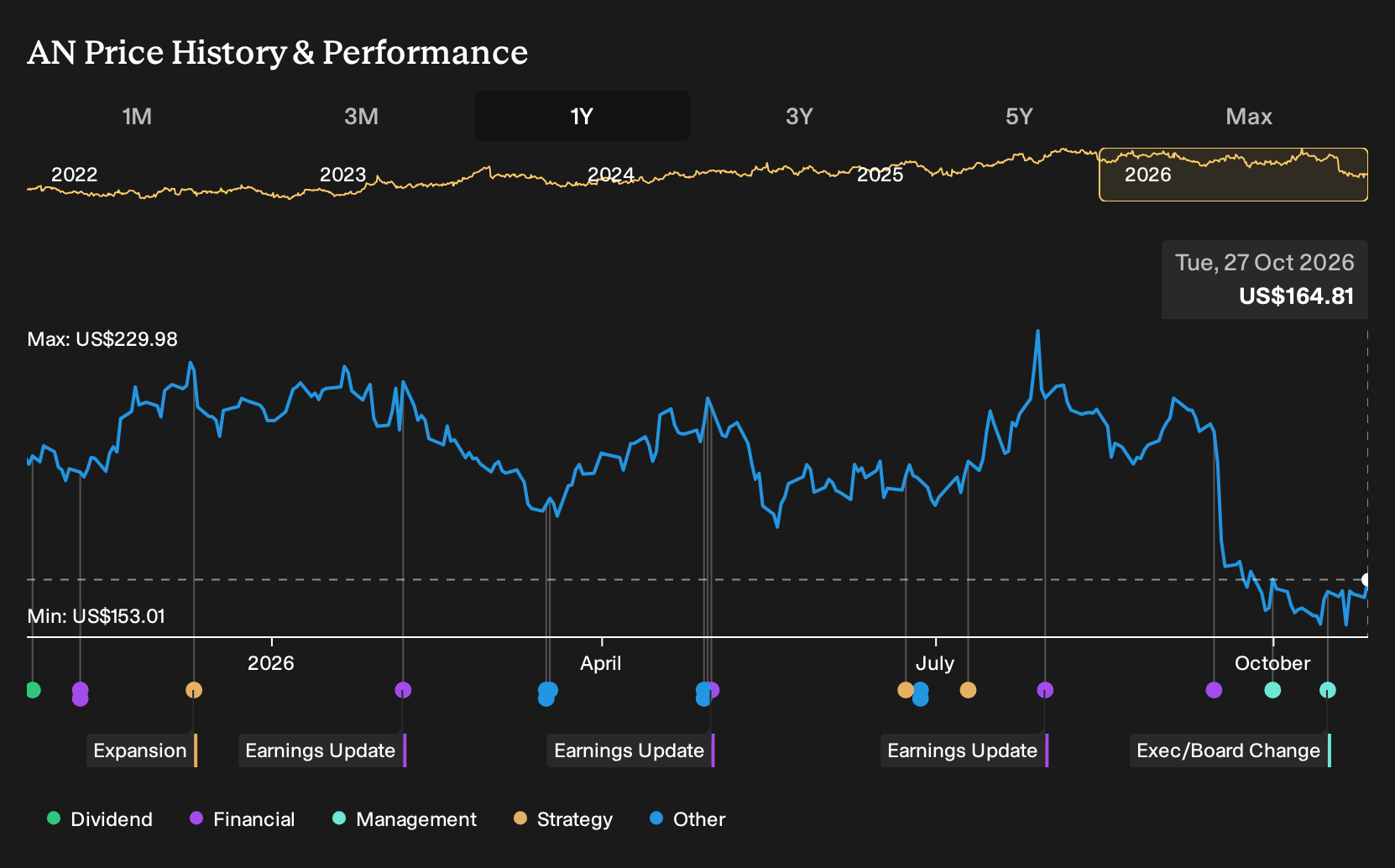
Discover how AutoNation's fair value indicates a 35% potential upside to its current price that may not be available for long.
Exploring Other Perspectives
Some of the most optimistic analysts focus less on regulatory risk and more on AutoNation’s ability to ramp AutoNation Finance and aftersales. They were already modeling revenue of about US$31.6b and earnings near US$881.5m by 2029 before this board news. You can now ask whether Mark Stewart’s appointment nudges those expectations higher, leaves them unchanged, or prompts a rethink altogether.
Explore another AutoNation fair value estimate, including one that suggests there could be as much as 95% upside from the current price.
Form Your Own Verdict
Don't just follow the ticker. Dig into the data and build a conviction that's truly your own.
- A great starting point for your AutoNation research is our analysis highlighting 3 key rewards and 1 important warning sign that could impact your investment decision.
- See our latest analysis for AutoNation. The report includes a comprehensive fundamental analysis summarized in a single visual, the Snowflake, making it easy to evaluate AutoNation's overall financial health at a glance.
Looking for more investment ideas beyond AutoNation?
Once you have a view on AutoNation, it can help to compare it with other stocks that fit different risk and return profiles using the Simply Wall St Screener.
- For investors hunting for potential value opportunities with quality fundamentals, scan through a 29 high quality undervalued stocks that might warrant a closer look.
- If capital preservation and steadier profiles matter more to you right now, filter for companies in the 30 resilient stocks with low risk scores and see how they compare on volatility and financial strength.
- When income is the focus, take a look at a curated 5 dividend fortresses that concentrate on higher yielding businesses.
Have feedback on this article? Concerned about the content? Get in touch with us directly. Alternatively, email editorial-team@simplywallst.com