


Bank First (BFC) drew fresh attention after reporting higher third quarter net interest income and net income year over year, along with increased earnings per share, a larger quarterly dividend, and ongoing share repurchases.
Against that backdrop, Bank First’s share price has moved to US$148.73, with the stock easing over the past month but still showing a strong year to date share price return of 23.29% and very robust 3 year and 5 year total shareholder returns of 103.65% and 130.24%. This suggests longer term momentum remains intact even as investors reassess the latest earnings, dividend increase, and buyback activity.
Compare Bank First’s latest move on earnings, dividends, and buybacks with a curated 5 dividend fortresses that also combines income potential with solid business profiles.
After that run in Bank First shares and a richer dividend, the real tension now is simple. Does the current price still leave enough upside to justify the risk you are taking on the bank’s earnings profile?
Price-to-Earnings of 19x: Is it justified for Bank First?
Valuation now hinges on what you are willing to pay for Bank First’s earnings stream, because the stock trades on a P/E of 19x while peers in the US Banks industry sit closer to 11.5x and the estimated fair P/E for BFC specifically is 15.3x.
P/E compares the current share price to per share earnings, so a higher ratio means investors are paying more today for each dollar of profit. For a regional bank like Bank First, that usually reflects expectations around future earnings growth, perceived balance sheet strength, or confidence in management’s ability to keep compounding profit.
Here, the market is assigning a much richer P/E than the sector average, even though the fair P/E estimate points to a lower level that the valuation could gravitate toward over time. That premium may line up with factors such as BFC’s 23.1% earnings growth over the past year and forecasts that earnings could grow 25.32% per year with revenue expected to rise 17.6% per year. However, the model suggesting a fair P/E of 15.3x indicates limited room for error at today’s price.
Compared with the broader US Banks industry, where the average P/E is 11.5x, Bank First’s 19x multiple is materially higher and signals investors are paying a clear markup to own this stock instead of a typical bank peer.
Explore the SWS fair ratio for Bank First.
Result: Price-to-Earnings of 19x (OVERVALUED)
Still, Bank First’s richer P/E could be vulnerable if earnings growth underwhelms, or if investors start favoring cheaper regional bank alternatives.
Find out about the key risks to this Bank First narrative.
Another View on Bank First’s value
The SWS DCF model points in the same direction as the earnings multiple. Bank First trades at $148.73 while the model estimates future cash flow value at $143.54. That gap is small, yet it still raises a practical question. How much premium are you comfortable paying for a regional bank’s growth story?
Look into how the SWS DCF model arrives at its fair value.
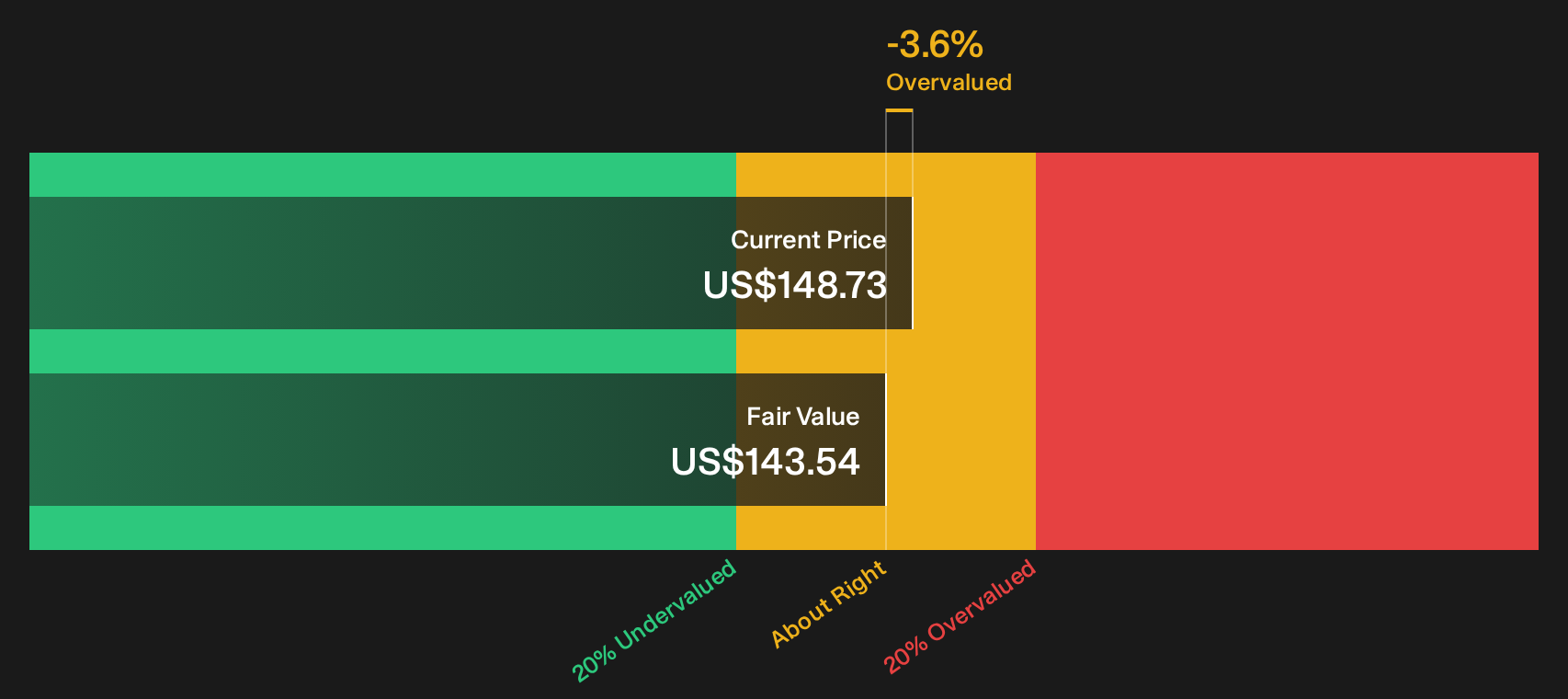
Simply Wall St performs a discounted cash flow (DCF) on every stock in the world every day (check out Bank First for example). We show the entire calculation in full. You can track the result in your watchlist or portfolio and be alerted when this changes, or use our stock screener to discover 29 high quality undervalued stocks. If you save a screener we even alert you when new companies match - so you never miss a potential opportunity.
Next Steps
Mixed signals around valuation and growth potential do not have to be confusing, especially if you dig into both sides of the story yourself and weigh the trade off between risk and reward for Bank First. To frame that decision with more context on both the upside and the concerns flagged by the data, take a moment to review the 3 key rewards and 1 important warning sign.
Looking for more investment ideas beyond Bank First?
You do not have to stop with Bank First. Put the same disciplined thinking to work across a broader watchlist and let data do the heavy lifting.
- Target resilient balance sheets and steady fundamentals by scanning a list of solid balance sheet and fundamentals (24 results) that keeps financial strength front and center.
- Hunt for quality at a reasonable price with a focused 29 high quality undervalued stocks that zeroes in on stocks where fundamentals and valuations still line up.
- Spot potential early-stage opportunities by reviewing a curated 7 elite penny stocks with strong financials before the crowd pays attention.
Have feedback on this article? Concerned about the content? Get in touch with us directly. Alternatively, email editorial-team@simplywallst.com