


Oil and gas giant Chevron Corporation (CVX) has delivered a solid performance in 2026, with rising oil prices and persistent geopolitical tensions providing a favorable backdrop for energy stocks. Uncertainty surrounding global energy supplies has kept oil markets in focus, creating potential tailwinds for producers such as Chevron. However, the company’s investment appeal extends beyond fluctuations in crude prices.
Chevron’s integrated business model spans the entire energy value chain, from upstream oil and natural gas exploration and production to midstream transportation and downstream refining and chemicals. This diversified footprint allows the company to participate in multiple stages of the energy business, although its earnings remain sensitive to commodity prices, refining margins, and operating conditions. Its global presence and strong balance sheet also provide financial flexibility, while a longstanding dividend track record and attractive yield continue to appeal to income-focused investors.
As the energy giant prepares to release its fiscal 2026 third-quarter results before the market opens on Friday, Oct. 30, investors will be looking for clues about how oil price movements, production levels, and refining performance have shaped its latest financial results. So, ahead of this report, here’s a closer look at CVX stock.
About Chevron Stock
Founded in 1879, Chevron Corporation has grown from a California oil company into one of the world’s leading integrated energy giants. Headquartered in Houston, Texas, Chevron operates across the global energy value chain, exploring for and producing crude oil and natural gas, transporting energy resources, refining crude into fuels, and manufacturing petrochemicals, lubricants, and fuel additives. Its portfolio also includes liquefied natural gas (LNG), renewable fuels, and lower-carbon energy solutions.
With operations spanning multiple continents, Chevron combines large-scale energy production with refining, marketing, and distribution, giving it exposure to several stages of the energy industry. The company’s long operating history and diversified business model make it a major player in meeting global energy demand. With a market capitalization of approximately $455.11 billion, Chevron Corporation has emerged as a standout performer in the energy sector, comfortably outpacing the broader market in 2026.
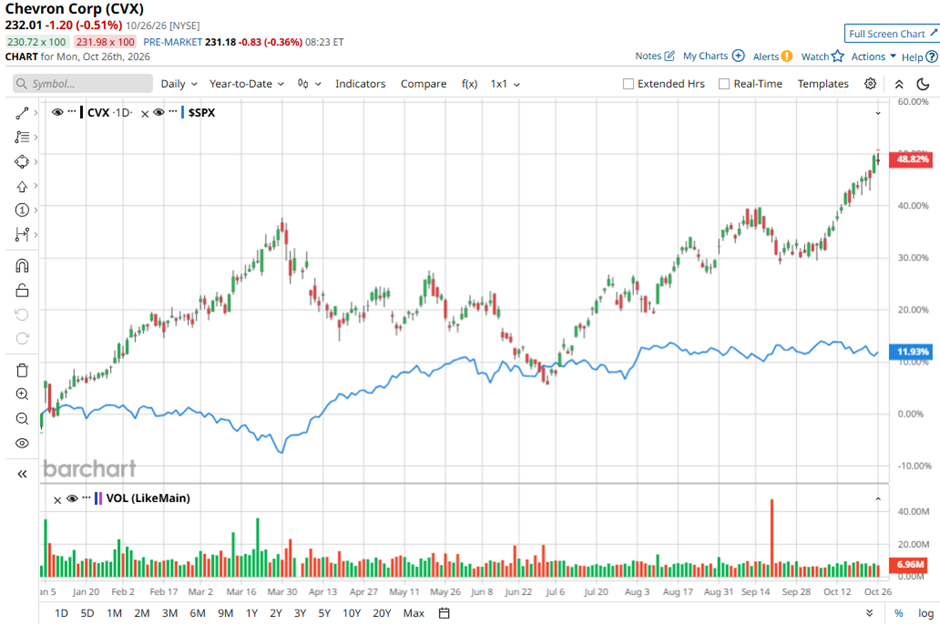
The oil and gas giant’s shares have climbed 49% over the past year and surged 52% year-to-date (YTD), significantly outperforming the S&P 500 Index’s ($SPX) respective gains of 12.2% and 12.8%. Chevron’s upward momentum has also brought the stock close to its 52-week high of $234.08, reached on Oct. 26, with shares continuing to trade near that level. As the company approaches its upcoming quarterly earnings report, investors will be watching to see whether its latest financial results and outlook can support the stock’s impressive run.
Chevron continues to stand out for its long-standing commitment to shareholder returns. The company’s latest quarterly dividend of $1.78 per share brings its forward annual payout to $7.12 per share, translating to a yield of approximately 3.14%. With 38 consecutive years of annual dividend increases and a record of uninterrupted cash dividend payments dating back to 1912, Chevron has established a strong dividend track record. This consistency has earned the energy giant a place among the S&P 500 Dividend Aristocrats, a group of companies recognized for their sustained dividend growth.
Chevron’s Q2 Earnings Snapshot
Chevron delivered a powerful second-quarter performance in fiscal 2026, with revenue surging, earnings climbing sharply, and cash generation reaching impressive levels. The energy giant reported net income of $12.1 billion, or $6.11 per diluted share, compared with $2.5 billion, or $1.45 per diluted share, in the year-ago quarter. Adjusted earnings came in at $6.06 per share, reflecting a favorable operating environment supported by higher oil realizations and robust global energy demand. The bottom line topped the consensus estimate of $5.57.
A favorable commodity-price environment played a significant role in Chevron’s strong results, with the average Brent spot price reaching $104 per barrel. The company also benefited from disciplined cost management across its global operations, helping boost its return on capital employed (ROCE) to 21.4%, up sharply from 6.2% in the same quarter last year. Revenue growth was equally striking.
Total revenue jumped 56.3% year-over-year (YoY) to $70.06 billion, comfortably surpassing Wall Street’s consensus estimate of $60.38 billion. Both major operating segments contributed to the strong performance. Upstream earnings more than tripled to $8.18 billion, driven by higher liquids realizations and additional volumes from acquired assets. Downstream earnings soared to $4.87 billion from $737 million a year earlier, reflecting stronger refining performance.
U.S. refineries operated at 97% capacity utilization, achieving record crude-unit throughput and capitalizing on favorable refined-product margins. The strong operating performance also translated into substantial cash generation. Cash flow from operations reached $22.6 billion, while free cash flow climbed to $18.1 billion, highlighting Chevron’s ability to generate significant cash amid favorable market conditions.
Beyond its traditional energy operations, Chevron is also positioning itself to participate in the growing demand for AI infrastructure. CEO Mike Wirth highlighted the company’s efforts to support U.S. AI leadership and generate resilient cash flows by leveraging its existing capabilities. During the quarter, Chevron signed a 20-year power purchase agreement with Microsoft (MSFT) to supply 2.67 gigawatts of behind-the-meter power for the technology giant’s data center in West Texas, adding a new dimension to its long-term growth strategy.
How Do Analysts View CVX Stock?
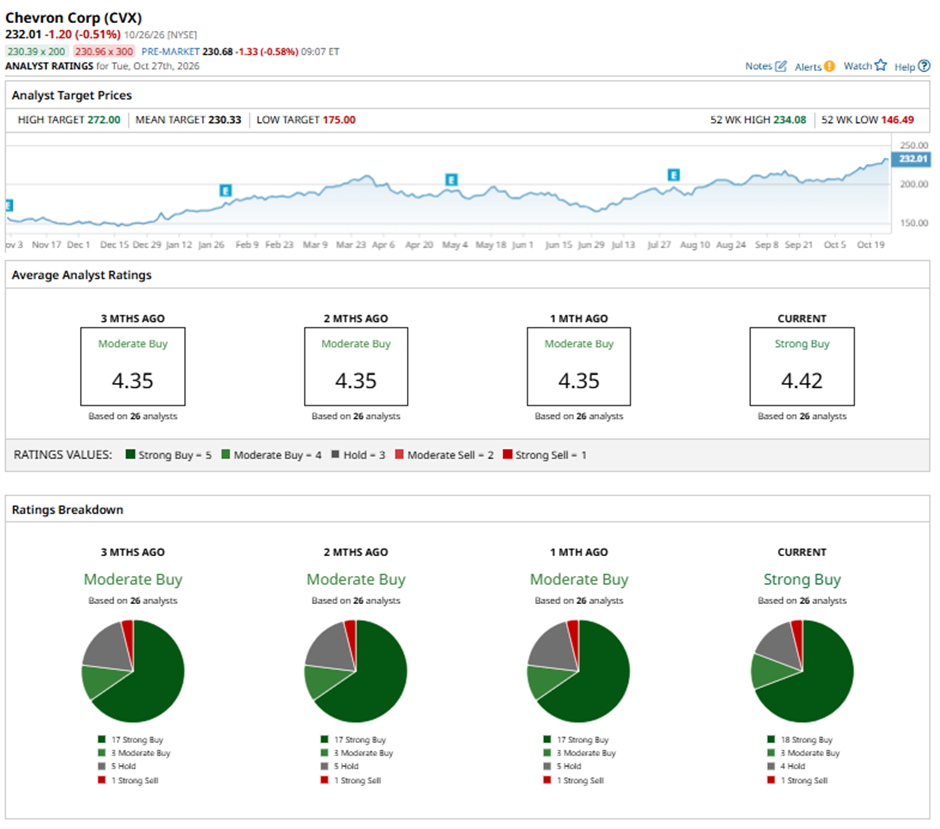
As Chevron approaches its fiscal third-quarter earnings report, Wall Street sentiment remains firmly bullish, with analysts assigning the stock a consensus “Strong Buy” rating. Of the 26 analysts covering CVX stock, 18 recommend a “Strong Buy,” three favor a “Moderate Buy,” four maintain a “Hold,” and one issues a “Strong Sell.” Despite shares already surpassing the average price target of $230.33, the Street-high target of $272 points to a potential further upside of 17.2%, suggesting some analysts see room for the rally to continue.
On the date of publication, Anushka Mukherji did not have (either directly or indirectly) positions in any of the securities mentioned in this article. All information and data in this article is solely for informational purposes. For more information please view the Barchart Disclosure Policy here.