


When the CEO of the world's biggest company by market capitalization says that demand is "off the charts" for a sector, the market takes note. Shares of neocloud providers have been under pressure of late, but artificial intelligence (AI) leader and Nvidia (NVDA) CEO Jensen Huang has opined that funding is the problem, not demand.
“What is missing in the middle is the working capital to fuel that growth," Huang said in an interview with CNBC, on the sidelines of Nvidia's conference in Berlin, Germany. “There’s just so much demand across so many sectors of AI, there’s a scarcity of capital,” he said.
This would come as welcome news for CoreWeave (CRWV), the world's second-largest neocloud by market cap. Shares of CRWV stock are down 15% on a year-to-date (YTD) basis. However, it should be mentioned that CoreWeave and Nvidia are inextricably linked, with Nvidia being a key supplier, customer, and shareholder of the company.
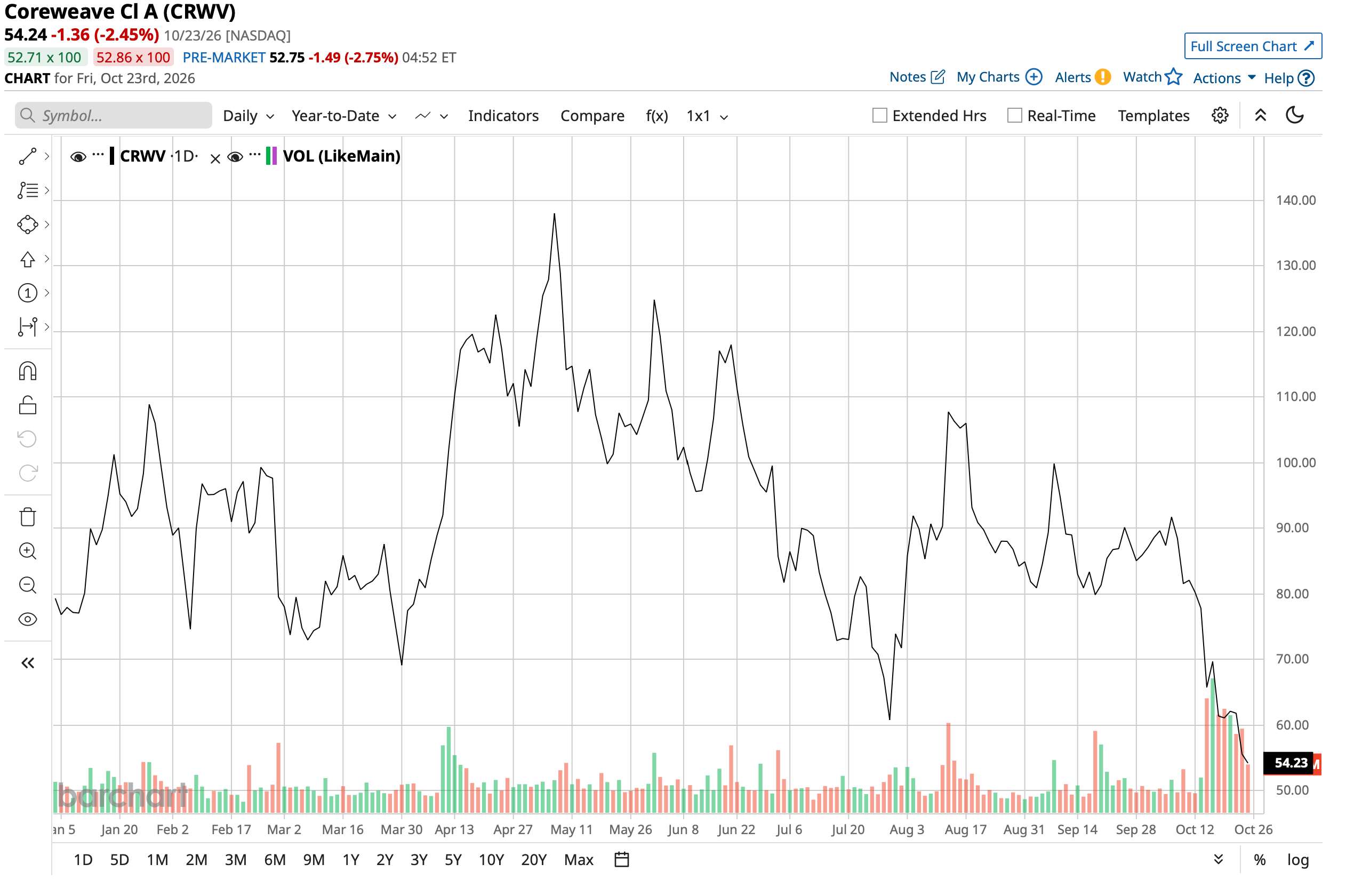
About CoreWeave Stock
Founded in 2017 as a cryptocurrency-mining business, CoreWeave occupies the vaunted position of being one of the foremost AI infrastructure companies in the world. CoreWeave provides enormous amounts of specialized computing power to companies developing and running AI. The company operates data centers containing large clusters of Nvidia GPUs, with the overall objective of making thousands of GPUs behave as a single high-performance computing system. CoreWeave is also concentrating on building a software stack, with its capabilities launching in 2026 to connect training, inference, observability, reinforcement learning, and autonomous agent improvement.
CoreWeave currently commands a market cap of about $25.3 billion.
So, what is the true picture when it comes to CoreWeave? Is the recent commentary from Huang soothing enough for a turnaround in CRWV stock? Let's take a closer look.
Only Time Can Tell
CoreWeave has ambitions to reach capacity of 3 gigawatts by 2027 and 8 GW by 2030. According to UBS, the firm is also estimated to expend about $35 billion to $40 billion for each gigawatt of its AI infrastructure buildout. That would imply capital expenditures of about $245 billion in four years, considering that the company already has 1.5 GW of live capacity. To put that in context, the company's net cash flow from operating activities rose by just 11% year-over-year (YOY) to about $3 billion in 2025.
So, cash flows alone will not be enough to fund the buildout. Consequently, the company has raised debt with varying amounts due in the coming years. All of this has resulted in CoreWeave's credit default spreads widening recently. On Oct. 15, CoreWeave's five-year credit default swap (CDS) spreads surged above 1,100 basis points, reaching an intraday high of approximately 1,194.5 basis points. At the same time, yields on some CoreWeave bonds have climbed to around 15% to 16%.
Overall, investors have grown worried about CoreWeave's heavy debt burden, massive capital expenditures, and whether revenues will eventually be material enough to justify such a huge monetary layout.
CoreWeave Reports Q2 Earnings
CoreWeave's most recent quarterly results suggest that the company still has a lot to accomplish financially. In the second quarter of 2026, CoreWeave generated revenue of $2.58 billion, up 112% YOY and exceeding Wall Street's expectations.
Adjusted operating income margin declined to 5% from 16% a year ago. The company also posted a net loss of $1.14 per share. While this result was better than the consensus estimate loss of $1.47 per share, it was nearly double the $0.60 loss recorded in the prior-year period.
Interest expenses increased to $640 million from $267 million a year ago. By comparison, Nebius Group (NBIS) — CoreWeave's closest competitor — recently saw interest expenses climb at a steeper pace to $119.1 million from just $4.8 million a year earlier. CoreWeave’s interest expense as a percentage of revenue stood at around 24%, higher than Nebius' roughly 20%.
Backlog reached $104 billion as of June 30, 2026, up 246% YOY. Management noted that the figure excluded an additional $25 billion in newly secured customer commitments. Agreements signed during the quarter carried terms five to ten percentage points more favorable than those from the prior period. Combined with the ongoing production ramp, this improvement is generating meaningful operating leverage.
Cash flow trends improved as well. Net cash from operating activities totaled $679 million compared with an outflow of $251 million in the year-ago quarter. CoreWeave ended the period with $5.5 billion in cash, still below its short-term debt of approximately $8 billion.
For Q3, CoreWeave guided revenue between $3.45 billion and $3.6 billion. The midpoint of that range implies YOY growth of 158%. Meanwhile, analysts forecast revenue of $3.54 billion for Q3. On the Q2 earnings call, management also raised its full-year capex guidance to a range of $35 billion to $39 billion.
The company now expects to finish the calendar year with active power capacity of 1.85 GW, higher than the previous target of 1.7 GW. CEO Michael Intrator said that CoreWeave remains on track to reach at least 8 GW by 2030.
Finally, on valuation, CRWV stock appears reasonably positioned to an extent. The forward price-to-sales (P/S) ratio of 4.8 times is higher than the sector median, while the price-to-cash flow (P/CF) multiple of 14.4 times is lower than the sector median of 19.6 times.
What Do Analysts Think of CRWV Stock?
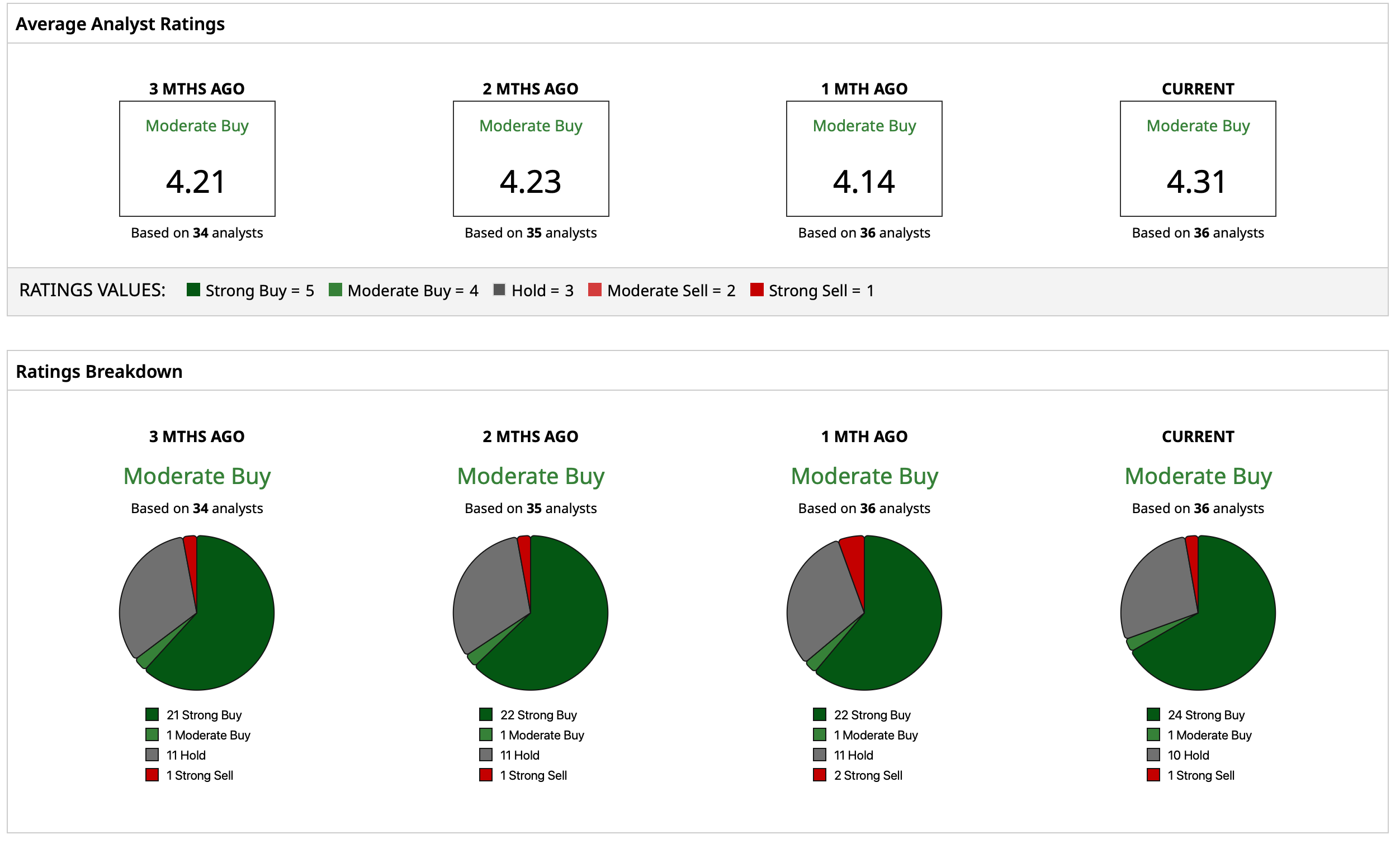
Overall, analysts have a consensus “Moderate Buy” rating for CoreWeave stock. Out of 36 analysts covering the stock, 24 have a “Strong Buy” rating, one has a “Moderate Buy” rating, 10 have a “Hold” rating, and one analyst has a “Strong Sell” rating. The mean target price of $$128.57 indicates potential upside of 105% from current levels.
On the date of publication, Pathikrit Bose did not have (either directly or indirectly) positions in any of the securities mentioned in this article. All information and data in this article is solely for informational purposes. For more information please view the Barchart Disclosure Policy here.