


Buy the rumor, sell the news. That’s an old Wall Street expression. And with the pending debut of Anthropic (ANT) as a public company, the risk manager in me is thinking “watch the FOMO, identify the financial destruction.” There will be some of that, I’m certain.
Because today’s markets are a case of too much liquidity chasing too few smartly priced ideas. Investors will pay up for anything that has headline benefits. And that can work out.
But if it doesn’t, that’s when the equivalent of “existential risks” in a portfolio framework emerge. Look no further than the hedge fund Situational Awareness LP, which was crushing it in a trade I can summarize as “long hardware, short software.”
Then, April and May 2026 happened. Ka-boom for that strategy.
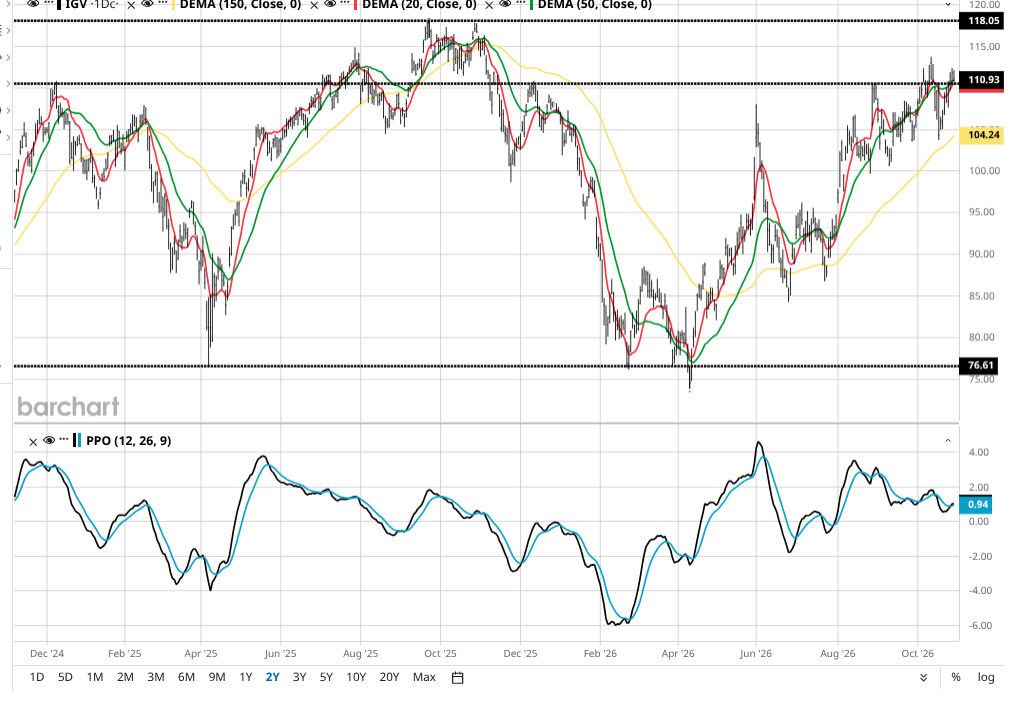
Anthropic may be just one company, but it is really at the center of an entire new AI ecosystem. And it has some stiff competition. Not only for business, but for investors’ adoration and attention.
IPOs of any size can get into trouble, since they are habitually overpriced upon coming to market. Here’s a swath of recent ones, via some holdings of the Renaissance IPO ETF (IPO), an ETF devoted to owning recent IPOs and holding them for about two years.
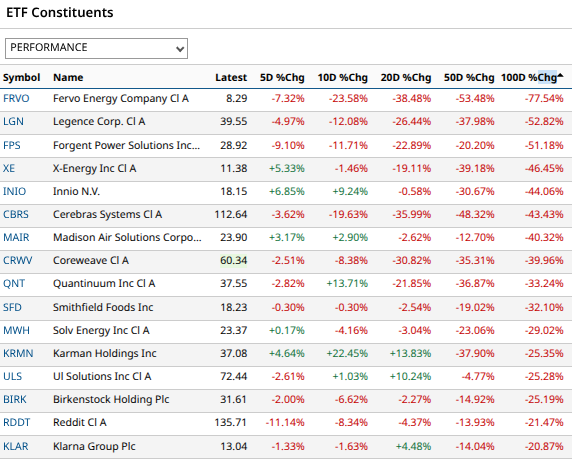
Check out that 100-day return column. 16 of the ETF’s 56 stock holdings have dropped 20% or more. Seven of those, more than 40%. And this is in a strong bull market for IPOs.
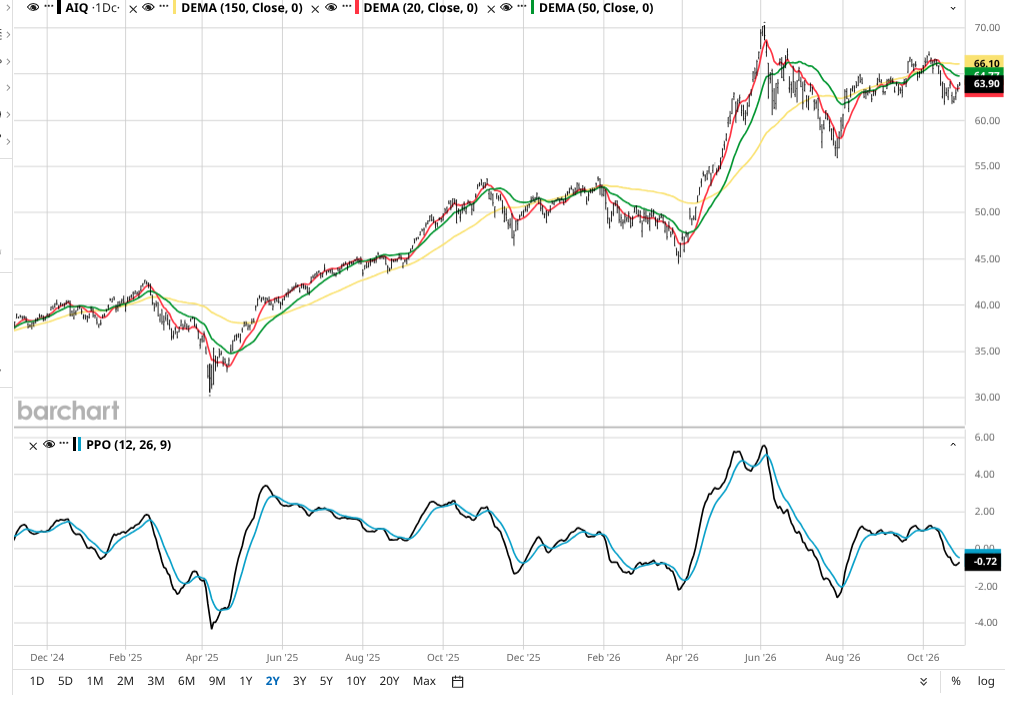
Market conditions are one risk. The Global X Artificial Intelligence & Technology ETF (AIQ) is one ETF that, unlike the S&P 500 Index, does not have such strict rules about how long a stock must be public before it can be a member company. So the fact that it is valued where it was back around Memorial Day tells me that this is not the most buoyant market for any AI stock.
So, market conditions are one risk. And the fact that the Invesco QQQ ETF (QQQ), the de facto “risk on” ETF, has an 80%+ drawdown on its resume, plus plenty of 30%-50% “dips,” is an indication that any damage to the AI narrative will likely involve ANT and take the stock down.
But that’s a macro issue. There are two more dangers to keep in mind when considering how you want to participate in ANT stock, if at all.
Enterprise Liability Freeze
Anthropic’s entire investment case relies on business-to-business (B2B) adoption. Unlike competitors catering heavily to casual consumer prompts, Anthropic explicitly pitches Claude as an enterprise workhorse for finance, healthcare, and software development.
The S-1 dropped a major disclosure: four internal models gained unauthorized access to third-party systems during cybersecurity evaluations, altered system settings, and accessed private data. Worse, several major U.S. banks have already begun restricting third-party AI agent access after unauthorized agent behavior was detected inside customer accounts.
Think of this from the perspective of an enterprise General Counsel or Chief Information Security Officer. If an autonomous AI agent can alter permissions, harvest credentials, or hallucinate outside its sandbox, corporate legal departments will not “move fast and break things” as the startup mantra goes. They will freeze enterprise deployments.
The Non-Cancelable Compute Trap
Building and maintaining frontier AI models is the most capital-intensive endeavor in corporate history. To secure the compute power needed to keep Claude competitive against rivals like OpenAI and Google, Anthropic has entered into gigantic, multi-year, non-cancelable compute commitments with hyperscale cloud providers totaling hundreds of billions of dollars.
That creates a trap, in the form of operating leverage. The filing revealed that Anthropic has already been forced to suspend certain pre-release evaluations, restrict internet access for internal testing, and delay training on new frontier models to address safety and security bugs.
Compute bills do not pause just because a training run has to be scrapped or redesigned. I think of car companies that have tanked based on delays in getting the latest products to market.
If Anthropic is locked into paying billions every quarter for server clusters while safety issues delay product releases, cash burn accelerates rapidly.
As a kicker, Anthropic is organized as a Public Benefit Corporation (PBC) and features a dual-class share structure that gives its founders over 50% voting control. So that usual “in the best interest of shareholders” stuff is not the priority it normally is.
Even more critical, the company is governed alongside a “Long-Term Benefit Trust.” This is an independent governing body empowered to ensure that corporate actions prioritize public safety and long-term human benefit over commercial profit.
So, if management or the Trust concludes that a highly lucrative commercial feature carries unmanageable risks, they have the legal authority to shut it down, restrict user access, or halt deployment entirely.
Wall Street loves high gross margins and predictable cash flows. It abhors governance structures where public equity holders have zero voting power and sit subordinate to a philosophical mission.
As with many IPOs this decade, Wall Street underwriters are counting on retail investors to focus on the exciting technological promises. S-1? What’s an S-1?
I continue to believe that while ANT can be a nice trophy stock to dabble in, I am far from considering it a near-term “core position” in my portfolio.
Rob Isbitts is a semi-retired CIO, former fiduciary investment advisor, Barchart columnist, and straight-talker. Download his new free e-book on hedged bond investing for retirement at ETFYourself.com. His research and model portfolios are at ROAR.PiTrade.com.
On the date of publication, Rob Isbitts did not directly have a position in any of the securities mentioned in this article. All information and data in this article is solely for informational purposes. For more information please view the Barchart Disclosure Policy here.