


Investors who held J.K. Cement over the past year are down 21.0%, including dividends. That is a painful outcome for anyone who read bullish research in late 2025 highlighting revenue growth of 12.2%, a margin lift to 10.6%, and a future P/E of 47.3x as sufficient to justify a higher valuation over three years. If that was your starting point, which parts of that original case did not fully account for high debt, expiring subsidies, and the paints division losses?
Narratives are how investors here put a case on the record, with explicit assumptions about revenue, margins and the multiple. Those assumptions imply an estimated Fair Value.
The easy part of this move is behind J.K. Cement. Zero in on 199 high quality undervalued stocks for companies trading below our estimates.
The Two J.K. Cement Stories Investors Had To Weigh
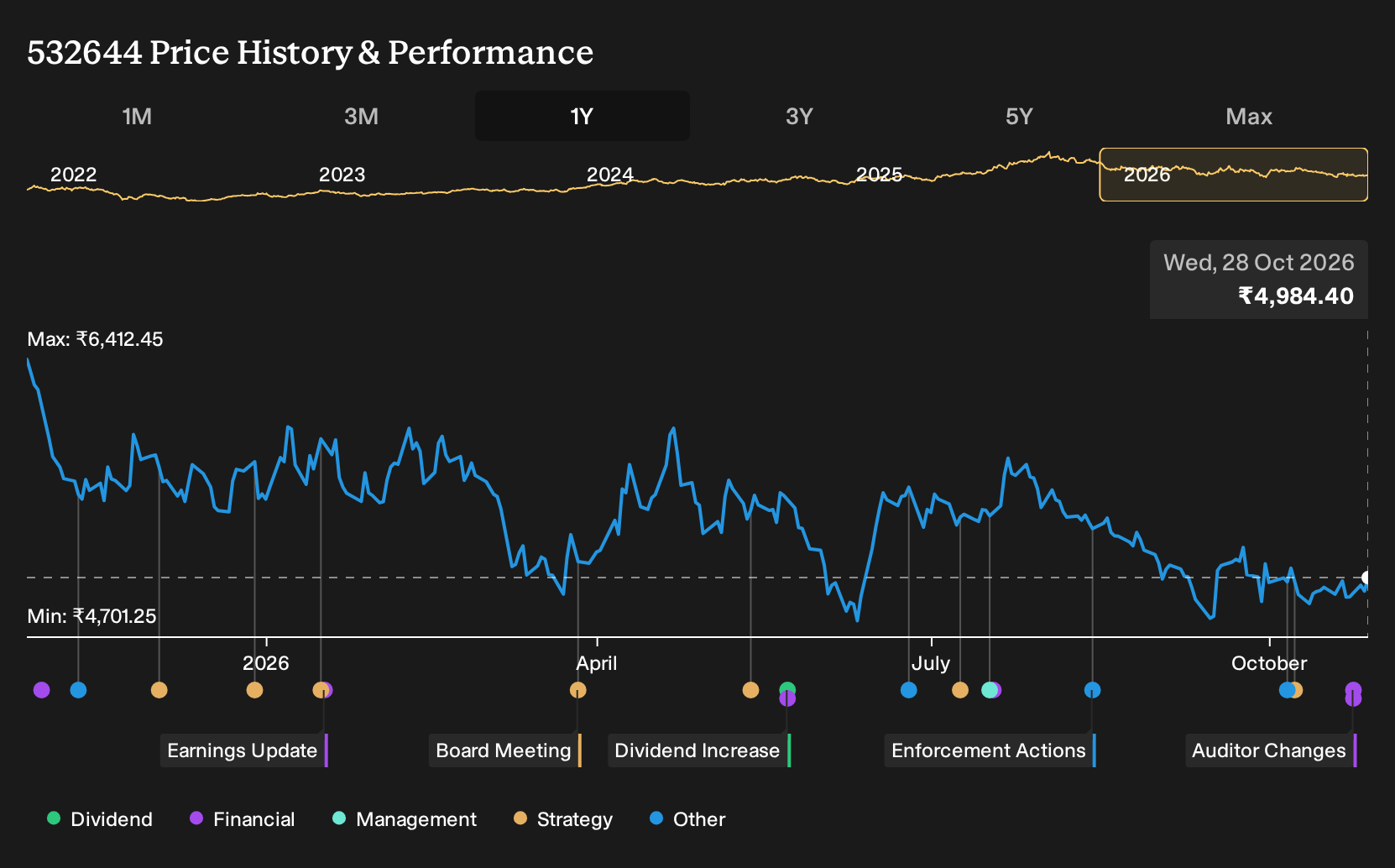
The shares cost ₹6,412 at the start of the period, and J.K. Cement sat between two sharply different but reasonable stories.
The bullish narrative put Fair Value at ₹6,750. It leaned on assumptions of 12.2% annual revenue growth, a profit margin rising to 10.6%, and a future P/E of 47.3x over three years.
The bearish view set Fair Value at ₹3,350. It focused on overcapacity risk, elevated debt, and the chance that expiring government incentives could strain earnings and returns.
What The Results Changed For J.K. Cement
The clearest update came from J.K. Cement’s Q2 2027 figures. Total revenue and net income were both higher than in Q2 2026, yet net margin slipped from 5.3% to 4.6%. That mix of higher scale and thinner profitability challenged the bullish view that margin expansion would comfortably outpace the drag from debt, subsidies rolling off, and paints losses. Overall, the evidence cut both ways.
The practical lesson is simple. When a thesis leans on margin improvement, keep checking whether profit as a percentage of sales is actually rising, not just whether revenue and earnings are bigger in rupee terms.
What J.K. Cement’s Lower Price Asks You To Believe
With J.K. Cement now at ₹4,984, the selected Narrative’s Fair Value sits above the current price and treats the recent fall as a mismatch between execution potential and what the market is willing to pay today.
An investor at this level would need to believe J.K. Cement can deliver on its capacity, energy and diversification plans while keeping net debt, fuel and payroll pressures contained.
"The key requirement is effective execution on large capex and energy transition plans while keeping net debt and the earnings impact from higher fuel and employee costs under control. The current valuation implies the share price does not fully reflect this narrative, which views JK Cement as undervalued in the context of its capacity additions, portfolio diversification and energy and fuel initiatives."
Not everyone reads the same price the same way. → See the higher figure this Narrative lands on, and how it gets there
Go Straight To The Source
Passing on this one could have spared you a loss. Where might you find the opposite surprise? Start looking for companies whose prices leave room for a better outcome than investors expect. These three trade below our estimated value.
- Company 1 - 32% below our estimate - focuses on expanding nutrition products into more outlets and export channels.
- Company 2 - 26% below our estimate - shifts toward higher-margin adult and oral probiotics sold through owned channels.
- Company 3 - 36% below our estimate - builds AI-driven hiring and services platforms that automate more of each transaction.
That is three of the list. See every one of the 206 solid balance sheet companies →
Have feedback on this article? Concerned about the content? Get in touch with us directly. Alternatively, email editorial-team@simplywallst.com