


The Zhitong Finance App learned that with signs of a recovery in domestic demand in Japan and a more favorable policy environment enhancing the appeal of high yields, global fund managers are once again showing interest in the Japanese bond market.
T. Rowe Price Group Inc. cut its exposure to Japanese government bonds earlier this year and now favors long-term bonds. Allianz Global Investors (Allianz Global Investors) is selectively increasing its holdings of medium- and long-term bonds, while BNP Paribas Asset Management (BNP Paribas Asset Management) has established ultra-long-term bond exposure.
This shift in attitude is in stark contrast to earlier this year. Previously, even higher yields were not enough to dispel investors' concerns: the market feared that the Bank of Japan's interest rate hikes would be slow, fiscal spending would push up the supply of treasury bonds, and traditional local buyers continued to wait and see. Now, the market expects that the Bank of Japan will continue to raise interest rates, insurance institutions will re-enter the market to buy bonds, and fund managers will be more emboldened to seize current high-yield opportunities.
“Our view on the long-term term of Japanese treasury bonds has become more positive, and we have been selectively increasing our exposure, especially on the medium- to long-term end of the yield curve,” said Mark Tay, chief fixed income investment officer at Allianz Global Investments Asia Pacific. The company manages 653 billion euros in assets. “Real returns are more attractive, and we are seeing more evidence of a return in domestic demand and a rise in overseas interest, which should help support the market.”
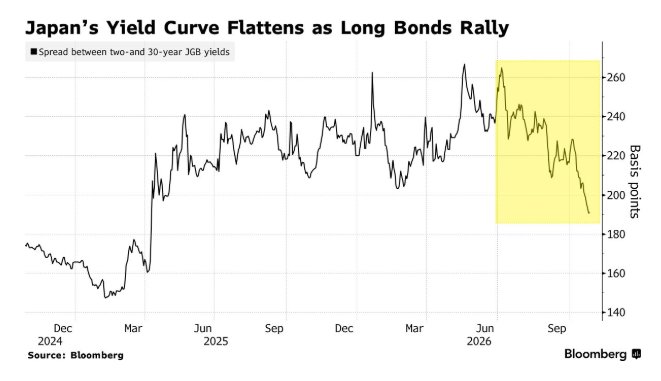
This shift in tone coincided with a recovery in long-term bonds. The 30-year Japanese Treasury yield has fallen nearly 40 basis points from its peak of 4.25% earlier this month, despite continued volatility in the global bond market. Since July, the difference in yield between 2-year and 30-year Japanese treasury bonds has narrowed by about 70 basis points.
Japan will hold a two-year government bond auction on Thursday, and demand is expected to remain steady.
Shoki Omori, chief Japanese fixed income strategist at Deutsche Securities, said that as 10-year yields rose above 3% earlier this year and 30-year terms reached 4% — levels not seen in decades — valuations have become increasingly attractive.
He estimates that about two-thirds of these yields reflect term premiums — the additional compensation required by investors holding longer-term debts. Omori believes that once the outlook for the Bank of Japan's austerity cycle comes to an end, the premium is expected to narrow, making long-term performance superior to other periods, even if interest rate hikes continue.
Buy-back
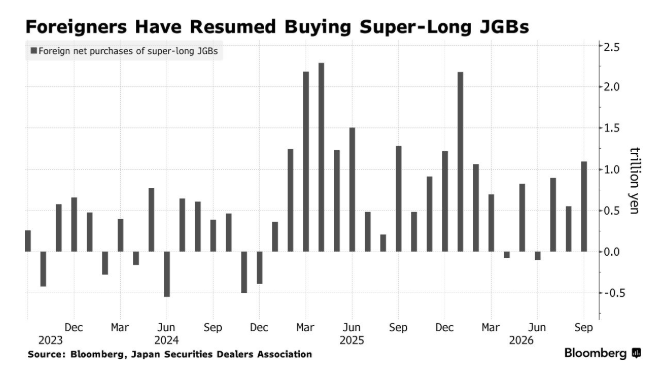
There are already signs of improving demand. Japanese life insurance companies have made net purchases of ultra-long-term government bonds in the past four months, and some companies have given signals that they plan to maintain or increase domestic bond purchases. According to data from the Japan Securities Association, overseas investors have also been net buying ultra-long-term Japanese treasury bonds for three consecutive months, reversing the net sales trend in April and June.
T. Rowe Price portfolio manager Vincent Chung is currently optimistic about long-term bonds and is betting that the yield curve will flatten in an environment where the Bank of Japan raises interest rates. This marks a shift from earlier this year — when he bought Japanese treasury bonds in January (which had been undervalued for the previous year) and cut his exposure just a month later due to heightened fiscal concerns.
Chung now believes that supply and demand will be more balanced before the end of the year, thanks to recent retail purchases and the prospect of additional demand if proposed tax incentives are introduced. Potential changes in the allocation of the Japanese Government Pension Investment Fund (GPIF) may provide another source of support, but he said any decision will depend in part on global market performance.
BNP Paribas Asset Management is also increasing its exposure. James McAlevey, head of global comprehensive and absolute returns, said the company has increased its long-term Japanese treasury bond position from a “very small” position earlier this year to a “medium size,” favoring 20- and 30-year bonds.
The financial test
Fiscal policy remains the biggest obstacle to a further continuous rebound in the bond market. The 2027 treasury bond issuance plan will test the bond market sentiment that has just picked up. Investors are closely watching how the Japanese government is raising funds for food consumption tax relief and defense spending expansion.
Pryce's Chung said that if the budget plan fails to clarify the source of funding, he is betting that the logic of a flattening curve will be at risk. Omori of Deutsche Securities warned that if a larger supplementary budget is introduced, or if the bond issuance plan fails to further reduce the supply of ultra-long-term treasury bonds, the recent narrowing of interest spreads on long-term bonds may be reversed.
Brandywine Global Investment Management cut its exposure to Japanese treasury bonds and sold its 30-year holdings earlier this year, and has yet to buy it again. Portfolio manager Carol Lye said that Takaichi Sanae's cabinet downplay of re-inflation will help stabilize yields, but investors are still waiting for a credible funding plan. As the 10-year yield falls below 3%, she also believes there is a possibility that demand will slow down.
The Bank of Japan will provide another test at Friday's policy meeting. Officials generally expect interest rates to remain unchanged, and investors will focus on Governor Ueda Kazuo's guidance on the pace of austerity and how far interest rates are from their final peak.
For BNP Paribas's McAlevey, further confidence will require a “relatively restrained fiscal response” from the government and continued austerity of the Bank of Japan. He said that the central bank doesn't necessarily need to raise interest rates this week, but the December action and continued “relatively hawkish” communication are enough.