


Why Phillips Edison’s latest earnings are drawing fresh investor focus
Phillips Edison (PECO) moved into the spotlight after reporting third quarter 2026 results that showed higher sales, revenue, and net income, along with an upgraded earnings outlook for the full year.
The recent guidance upgrade and fresh US$350 million term loan have arrived after a mixed price stretch, with the share price down 11.2% over 90 days while delivering a 14.9% total shareholder return over one year. This suggests that longer term momentum has held up better than the recent pullback might imply.
Spot fresh momentum in grocery-anchored real estate by lining up Phillips Edison’s earnings story alongside a hand-picked 19 high quality undiscovered gems that share strong fundamentals but still fly under most investors’ radar.After a strong guidance lift yet a 90 day share price pullback, Phillips Edison now sits in that awkward middle ground. Is patience for a deeper dip worth the risk of missing the current valuation gap?
Most Popular Narrative: 13% Undervalued
Against Phillips Edison’s last close at $37.72, the most followed narrative pins fair value closer to $43.31. This frames the recent pullback as a valuation gap rather than a verdict on the business.
Capital recycling where assets sold around a 5.9% initial yield are redeployed into properties bought around a 6.6% to 6.7% yield and underwritten at roughly 9% unlevered IRRs can create a positive spread that has the potential to lift net margins and FFO per share over time.
See why 5 investors see Phillips Edison as 13% undervalued.
Result: Fair Value of $43.31 (UNDERVALUED)
Still, the Phillips Edison narrative leans on assumptions that could crack if e commerce erodes foot traffic or if higher rates keep refinancing and acquisition spreads under pressure.
Find out about the key risks to this Phillips Edison narrative.
Another view on Phillips Edison’s valuation
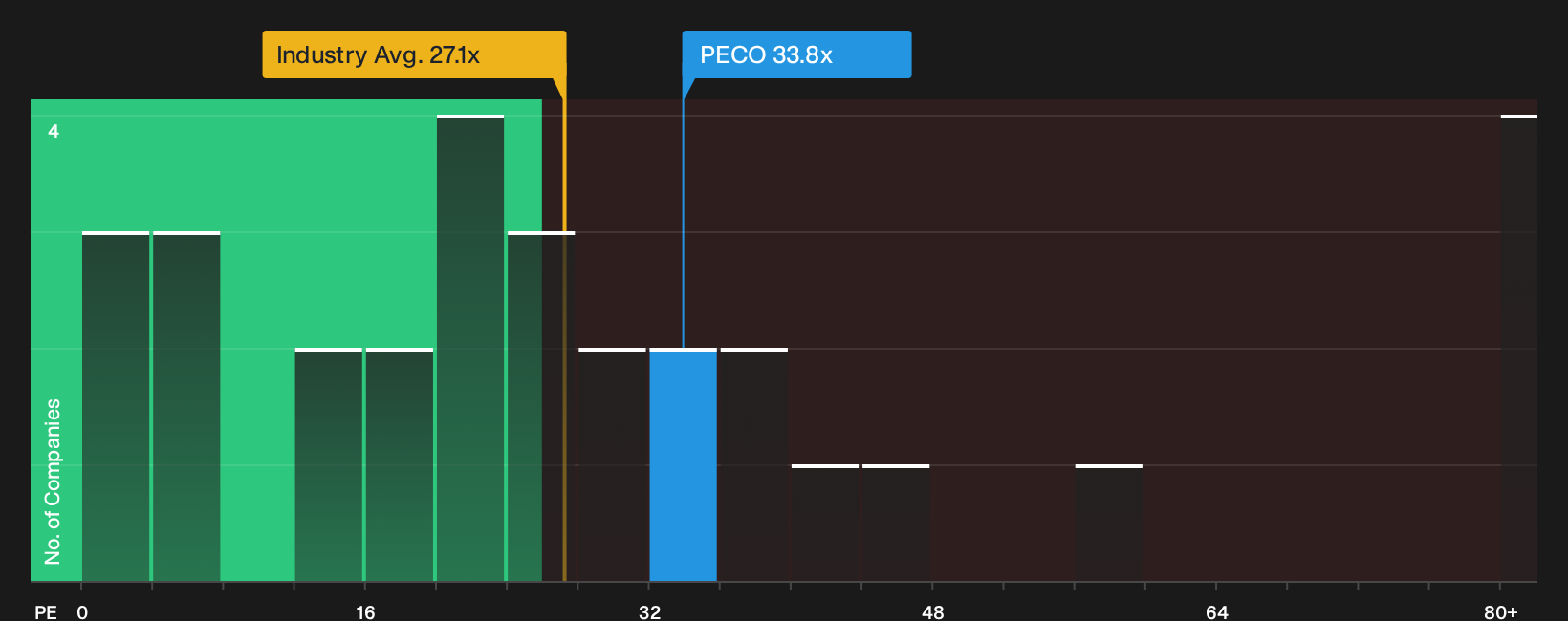
Look past the narrative fair value of $43.31 and Phillips Edison screens very differently on simple earnings metrics. The stock trades on a P/E of 33.8x, which is higher than its own fair ratio of 30.7x and well above both peer averages and the broader US Retail REITs industry.
That gap hints at valuation risk if investors eventually steer the P/E closer to the 30.7x fair ratio or towards peers on 22.1x and sector levels near 27.1x. The key issue is whether you treat the richer multiple as a premium worth paying or as a margin of safety that has already been used up.
See what the numbers say about this price — find out in our valuation breakdown.
Next Steps
Mixed messages around valuation and momentum can pull you in opposite directions, so move quickly past the headlines and test your own thesis using the 2 key rewards and 2 important warning signs.
Looking for more Phillips Edison sized opportunities?
If you stop with Phillips Edison, you might miss other ideas that fit your style just as well, or even sharpen your overall portfolio mix.
- Target resilience first and stress test your portfolio with a focus on capital protection using a 32 resilient stocks with low risk scores that filters out fragile balance sheets.
- Stack potential upside by scanning a curated 26 high quality undervalued stocks built around stronger fundamentals than the market currently prices in.
- Lock in income ideas by lining up payout focused holdings sourced from a carefully filtered 6 dividend fortresses.
Have feedback on this article? Concerned about the content? Get in touch with us directly. Alternatively, email editorial-team@simplywallst.com