


It looks like Colgate-Palmolive (India) Limited (NSE:COLPAL) is about to go ex-dividend in the next 3 days. The ex-dividend date generally occurs two days before the record date, which is the day on which shareholders need to be on the company's books in order to receive a dividend. It is important to be aware of the ex-dividend date because any trade on the stock needs to have been settled on or before the record date. In other words, investors can purchase Colgate-Palmolive (India)'s shares before the 2nd of November in order to be eligible for the dividend, which will be paid on the 21st of November.
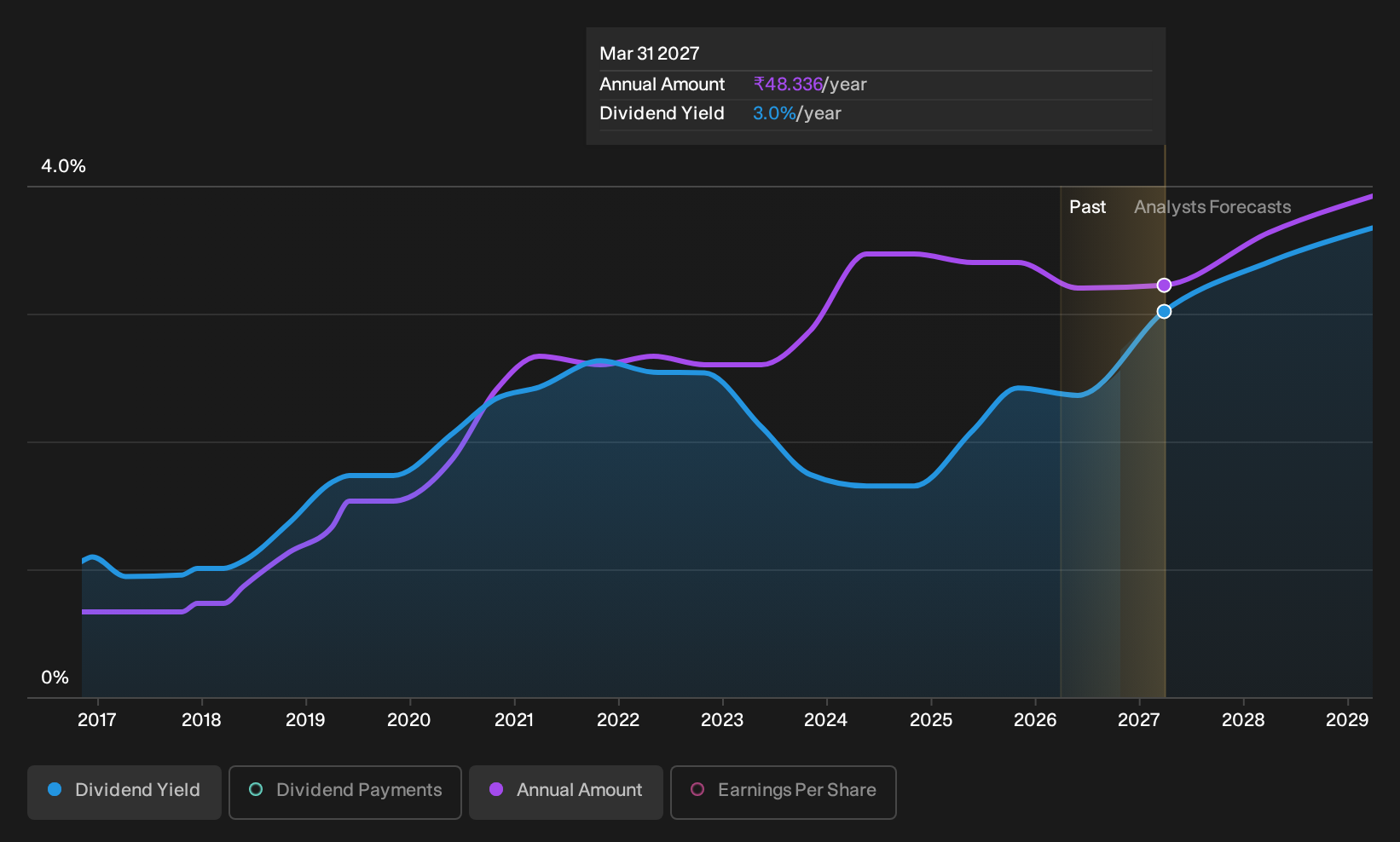
The company's next dividend payment will be ₹24.00 per share. Last year, in total, the company distributed ₹48.00 to shareholders. Based on the last year's worth of payments, Colgate-Palmolive (India) has a trailing yield of 3.0% on the current stock price of ₹1601.60. If you buy this business for its dividend, you should have an idea of whether Colgate-Palmolive (India)'s dividend is reliable and sustainable. So we need to check whether the dividend payments are covered, and if earnings are growing.
Dividends are usually paid out of company profits, so if a company pays out more than it earned then its dividend is usually at greater risk of being cut. Last year, Colgate-Palmolive (India) paid out 96% of its income as dividends, which is above a level that we're comfortable with, especially if the company needs to reinvest in its business. A useful secondary check can be to evaluate whether Colgate-Palmolive (India) generated enough free cash flow to afford its dividend. Over the last year, it paid out more than three-quarters (84%) of its free cash flow generated, which is fairly high and may be starting to limit reinvestment in the business.
It's good to see that while Colgate-Palmolive (India)'s dividends were not well covered by profits, at least they are affordable from a cash perspective. Still, if this were to happen repeatedly, we'd be concerned about whether the dividend is sustainable in a downturn.
Check out our latest analysis for Colgate-Palmolive (India)
Click here to see the company's payout ratio, plus analyst estimates of its future dividends.
Have Earnings And Dividends Been Growing?
Companies with consistently growing earnings per share generally make the best dividend stocks, as they usually find it easier to grow dividends per share. If earnings fall far enough, the company could be forced to cut its dividend. With that in mind, we're encouraged by the steady growth at Colgate-Palmolive (India), with earnings per share up 5.6% on average over the last five years.
The main way most investors will assess a company's dividend prospects is by checking the historical rate of dividend growth. Colgate-Palmolive (India) has delivered an average of 9.1% per year annual increase in its dividend, based on the past 10 years of dividend payments. We're glad to see dividends rising alongside earnings over a number of years, which may be a sign the company intends to share the growth with shareholders.
The Bottom Line
Should investors buy Colgate-Palmolive (India) for the upcoming dividend? Earnings per share have not grown all that much, and the company is paying out an uncomfortably high percentage of its income. Fortunately it paid out a lower percentage of its cash flow. With the way things are shaping up from a dividend perspective, we'd be inclined to steer clear of Colgate-Palmolive (India).
With that in mind though, if the poor dividend characteristics of Colgate-Palmolive (India) don't faze you, it's worth being mindful of the risks involved with this business. For example - Colgate-Palmolive (India) has 1 warning sign we think you should be aware of.
A common investing mistake is buying the first interesting stock you see. Here you can find a full list of high-yield dividend stocks.
Have feedback on this article? Concerned about the content? Get in touch with us directly. Alternatively, email editorial-team (at) simplywallst.com.