


The Zhitong Finance App learned that the latest research report released by Nomura cross-asset strategist Charlie McEligot shows that trading topics surrounding AI are breaking out of the previous round of fears about AI computing power and technology growth amplified by surging AI financing costs, overcrowded positions, and the accelerated deleveraging process of hedge funds.
The top Wall Street strategist from Nomura emphasized that large-scale AI financing was accepted, semiconductor giants and the two major cloud computing giants generally handed over strong results, and the disclosure of Anthropic's listing application, which together mitigated the “AI growth panic” that continued for two weeks. The clearance of crowded positions and excessive leverage also created conditions for market recovery.
Semiconductor giants that have received large-scale financing and are closely related to the AI computing infrastructure process, and the two major cloud computing leaders, Microsoft and Alphabet, handed over strong results. Coupled with Anthropic's updated listing application documents, the market re-evaluated the previous pessimistic deduction that “rising capital costs will inevitably cause AI expansion to stall.” At the time of the statistics reported by the Nomura strategist, Nasdaq-related volatility has declined markedly for three consecutive trading days; the long and short mix of “becoming the beneficiaries of AI infrastructure and shorting hyperscale cloud vendors” has rebounded 8% in the past week, although falling 11% during the month — Nomura said this also highlights that capital is beginning to re-recognize the profitability of upstream suppliers and repair previously depressed valuations driven by a frenzy of centralized deleveraging and de-congested warehouses.
Meta equity financing, Broadcom and SpaceX related equipment financing responded to “who will pay for the expansion of computing power”, and the subsequent announcement of a 48% increase in Microsoft Azure and a 103% increase in Alphabet and Google Cloud combined with SK Hynix's strong profits to verify the commercialization of AI demand. As the volatility of technology stocks declined and credit spreads for some AI companies narrowed, the market began to re-evaluate growth prospects under financing pressure. As a result, the AI computing power theme received dual support from capital acceptance and profit growth, further strengthening the semiconductor-led technology stock counterattack narrative.
The pressure is relieved after AI transactions are “cleaned”! Nomura signals the end of the “two-week AI growth and credit panic”
Charlie McEligot, a cross-asset strategist at Nomura, said that after a fierce two-week major sell-off, the global stock market finally breathed a sigh of relief: a wave of financing in the global technology sector, the performance of semiconductor leaders focusing on AI computing power infrastructure far exceeded expectations, and Anthropic's fully updated S-1 listing filing documents, all together broke the pessimistic narrative that “AI computing power infrastructure investment completely collapsed.”
This relief of pressure was particularly evident in the derivatives trading business unit. Over the past three trading days, the volatility of NASDAQ-related assets was “drastically reduced” from what McEligot described as “extremely tight” last week; at the same time, the “go long to benefit AI infrastructure companies and short hyperscale cloud vendors” deals, which were hit hard before, have fallen 11% so far this month, but they have bottomed out strongly and rebounded by about 8% in the past week alone. At the time of this transformation, the financial reports of hyperscale cloud computing vendors such as Alphabet (GOOG.US), Microsoft (MSFT.US), and Amazon (AMZN.US), as well as the performance of semiconductor giants such as Samsung, Intel (INTC.US), and AMD (AMD.US), are becoming the focus of market attention. Currently, the financial reports released by Microsoft, Alphabet, and Facebook's parent company Meta last week strongly prove that the monetization path of AI applications dominated by AI agents is becoming more clear and AI-related revenue generation data is getting stronger.
In a report to clients, McEligot wrote that the initial public offering (IPO) filing by Anthropic (ANT.US), a global AI superleader, on Monday “played an extremely important role” in restoring market confidence in the expansion of demand for AI computing power infrastructure and the commercial economy of AI.
The capital market is also strengthening this investment logic. McEligot pointed out that Meta will eventually reach a total equity issue of 98 billion US dollars, and the first batch of sales has already been accepted by the market; Broadcom and Anthropic have reached a $63 billion chip deal; and SpaceX and Apollo Asset Management have reached a 40 billion US dollar equipment finance lease deal. Overnight, SK Hynix, the world's largest memory chip leader, announced extremely strong quarterly results — revenue up 328% year over year, operating margin reached 80%, and management announced that the company's production capacity “was sold out until 2029” — driving its stock price up by double digits.
The strategist sees the recent pullback in momentum trading and the clearance of hedge funds' trading units (Pods) as a natural result of crowded positions. He pointed out that multi-strategy funds are still the most important capital investment for asset allocators, but high leverage and “ongoing risk of position congestion” will trigger cyclical cleaning.
“All of this will eventually pass,” McEligot wrote. “Subsequently, changes in performance will play an important positive role in removing excessive positions and leverage from the system.”
From “who will pay” to re-acceptance of capital: AI financing pressure has substantially eased
One of the most critical changes in this round of rebound is that capital markets have begun to provide enforceable funding arrangements for AI expansion. For example, McEligot cited Meta's plan to accept the first batch of equity financing with a total scale of about 98 billion US dollars, the 63 billion US dollar chip financing arrangement by Broadcom for Anthropic, and the 40 billion US dollar equipment finance lease between SpaceX and Apollo. The three are each investing through equity, asset financing, and leasing support to ease the pressure on enterprises to raise all construction capital at once.
Among them, the Broadcom transaction purchases AI accelerators and network equipment through special purpose carriers (SPVs) and then leases them to Anthropic, and delivery is expected to begin in 2027; its most direct positive significance for the semiconductor and AI computing power industry chain is to improve the feasibility of converting customer procurement budgets into equipment delivery and supplier revenue.
The credit market is also beginning to respond. According to Markit data, CoreWeave's five-year credit default swap (CDS) spread narrowed to 1,041.4 basis points in the intraday period on October 27, the lowest level in more than a week; CNB's latest C report shows that after Meta announced equity financing, its CDS spread also declined somewhat. The underlying operating mechanism behind these dynamics is clearly — increasing equity capital and lowering the market's expectations of issuing huge bonds in the immediate future can simultaneously improve the capital structure and the supply and demand of credit bonds.
As a result, the current change that is more noteworthy is that while financing costs are still high, the availability of capital is improving, and market concerns about AI projects being forced to shrink are beginning to cool down. This also explains why stocks can be traded and profits recovered first, while the bonds of companies with different credit qualifications remain clearly divided.
As Wall Street financial giant Goldman Sachs won a $210 billion financing order, the US semiconductor sector continued last Friday's rebound trajectory and the market began trading the “capital relay” logic, Wall Street institutional investors' concerns about the AI computing infrastructure financing crisis have clearly abated.
The sharp sell-off of semiconductors and a wide range of technology stocks in the US stock market that occurred last week is because market participants are generally constantly questioning “who will bear the huge costs associated with the construction of trillion-dollar AI computing power infrastructure.” The news released this week answered Wall Street questions to a certain extent: semiconductor giant Broadcom and Anthropic finally reached a $63 billion AI chip deal, Meta equity financing, SpaceX leases large-scale AI computing power equipment resources, and Anthropic is an IPO financing. These all highlight that AI capital expenditure is expected to continue to receive strong market capital support. What can be deduced from this is that the market is re-evaluating the possibility that the procurement process of AI computing power resources will slow down and large-scale orders for core AI infrastructure hardware such as AI chips will be postponed due to financing pressure. This is the core mechanism of “financial relay” supporting the recent counterattack in the global semiconductor sector.
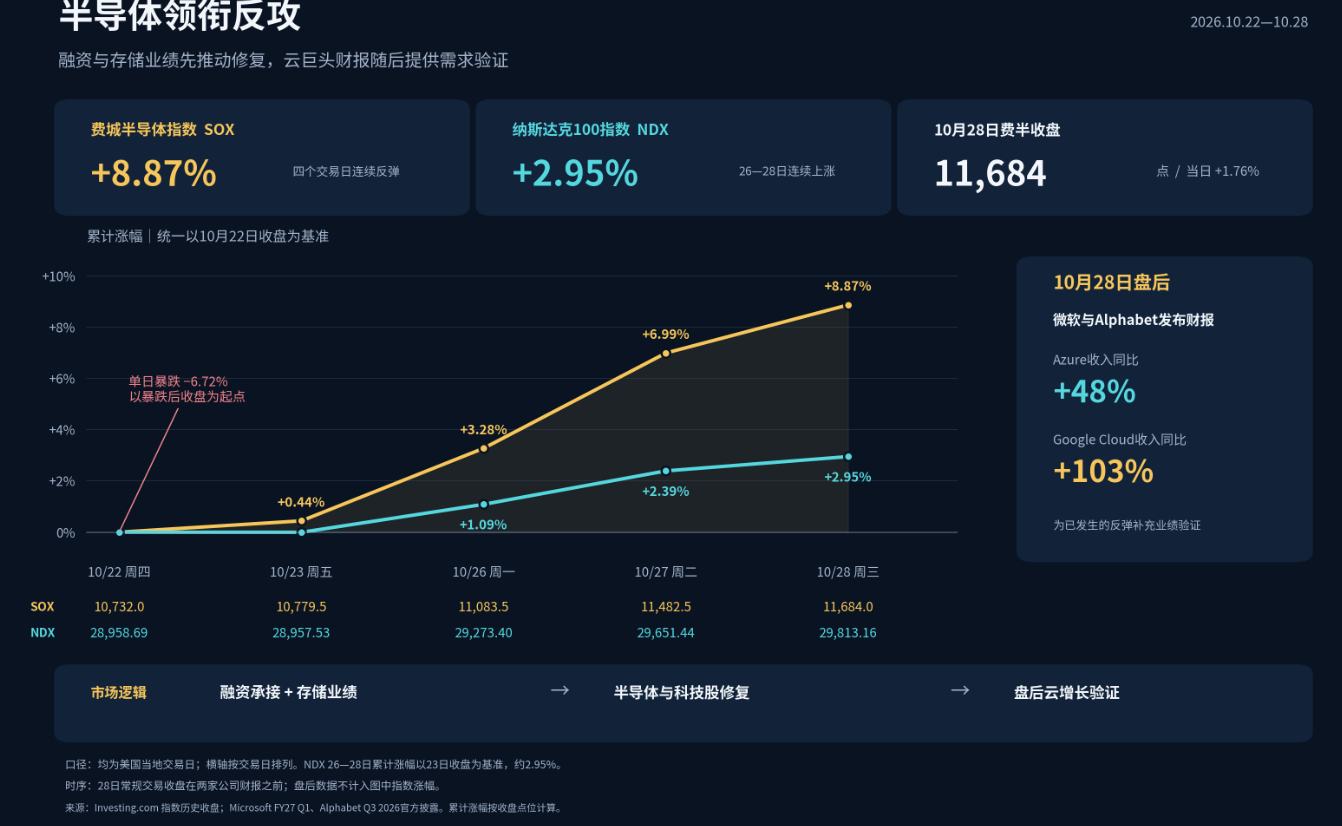
The market also provides direct confirmation: after plummeting 6.72% on October 22, the Philadelphia Semiconductor Index rebounded for four consecutive trading days, closing at 11,684 points on the 28th, with a cumulative increase of about 8.87% from the close of the 22nd; the NASDAQ 100 Index continued to rise from the 26th to the 28th, with a cumulative rebound of about 2.95%. Financing and storage performance first helped stabilize the market, then Microsoft and Alphabet financial reports released after the 28th market session further provided evidence of cloud business growth for this restoration. Looking at the trading mechanism, falling crowded positions can easily trigger fund risk limits, stop-loss, and simultaneous position reduction; when additional benefits improve profit expectations and volatility decreases, forced selling pressure has an opportunity to be reduced, and fundamentals are once again an important basis for pricing.
Mutual Verification of Cloud Revenue and Storage Profits: “AI Faith” Begins to Get Strong Support from AI Application Management Results
Strong growth in the cloud computing business of Microsoft and Alphabet and a series of positive developments from leaders in the AI computing power industry chain, such as SK Hynix, Seagate, TSMC, etc., have added more weighty commercialization evidence to Nomura's emotional healing judgment.
Microsoft Azure cloud computing revenue increased 48% year over year, and the overall cloud computing business — that is, Microsoft Cloud revenue reached US$63.9 billion, an increase of 30%; the company's management expects Azure to grow 49% to 50% in the next quarter, and the free cash flow of about US$18.6 billion for the quarter was also significantly better than market expectations. In the third quarter, Alphabet's cloud computing business unit, Google Cloud's revenue reached US$30.709 billion, an increase of 103%. Enterprise AI infrastructure, AI solutions, and core cloud services contributed to the growth, and sales of TPU systems also constituted an important increase. The two financial reports jointly support the judgment that AI investment is generating measurable business revenue, and Microsoft's cash performance has further strengthened the market's confidence in the ability of large cloud vendors to continue to invest.
The upstream side, on the other hand, provides cross-validation of profits and orders. HBM and SK Hynix, the leader in server DRAM, had third-quarter revenue of 104.62 trillion won, up 328% year on year; operating profit of 83.33 trillion won, up 632% year over year, operating margin reached 80%, and long-term agreements signed by the company with 14 major customers covered more than half of production capacity from 2027 to 2028; management's judgment on “substantial sold out” of production capacity up to 2029 also took into account signed agreements and ongoing negotiations.
Looking at industrial mechanisms, when smart bodies perform more tasks, they will increase the demand for model reasoning, tool call, context processing, and data retention, and drive the consumption of computing, memory, storage, and interconnection resources; when demand is transformed into cloud revenue, long-term procurement arrangements, and supplier profits, the semiconductor bull market has obtained a more complete basis than simply increasing capital expenditure. What really enhances the resilience of AI transactions is the mutual support gradually formed between the accelerated expansion of the AI commercialization process around cloud computing services, continued capital acceptance, and scarce supply profits.
Furthermore, bullish views on Wall Street are converging at different levels. Goldman Sachs's “GOAL Kickstart” maintained a 3-month and 12-month stock overallocation when the risk appetite index fell to about -0.5, based on profit resilience, declining valuation, and declining position congestion; previously, technology stocks concentrated on reducing positions, creating a more flexible trading environment for new profits. Morgan Stanley Wilson maintained the S&P 500 target of 8,000 points by the end of the year, and listed AI financing, midterm elections, and Federal Reserve liquidity as important catalysts for the end of the adjustment; the acceptance of new financing is responding to the capital supply issues. Deutsche Bank, on the other hand, provides a seasonal dimension: of the past 23 midterm election years, 21 recorded gains in the three months after the beginning of October. These judgments correspond to valuations and positions, event digestion, and historical seasonality, respectively, and the latest cloud business and storage performance added realistic profit support to the bullish narrative at the end of the year.
The storage sector's counterattack logic focuses more on the gap between scarce supply and pessimistic valuations. Goldman Sachs lowered the KOSPI target from 12,000 points to 9,000 points, but it still corresponds to about 62% space compared to the reporting reference point, and believes that the 65% decline in earnings for the following year implied by Korea Semiconductor's stock price is too pessimistic. Meanwhile, the TrendForce expert meeting organized by Goldman Sachs predicts that the DRAM price increase may continue until the first half of 2028, and the average HBM hybrid price will rise 122% year over year in 2027; restrictions on clean rooms, equipment delivery, and product upgrades make it difficult to immediately transform new investment into effective supply. Reports that Ali, Tencent, and ByteDance are seeking long-term DRAM contracts also show that demand to lock in supply is expanding to larger cloud computing vendors around the world.
Funding, on the other hand, has begun to optimistically express their judgment on the resurgence of AI trading frenzy: from October 1 to 23, Korean retail investors made a net purchase of 315.4 billion won in leveraged products related to Samsung and SK Hynix; as of the 22nd, South Korean investors had net purchases of SOXL (that is, tracking three times the Philadelphia Semiconductor Index, looking at multi-leveraged ETFs — the US stock code “SOXL”), accounting for about 73.9% of net purchases of US stocks during the same period. The core driving storage revaluation is that order visibility and profit performance are expected to be better than the previously implicit contraction in stock prices, and the return of capital can be described as significantly amplifying this recovery in positive growth and expansion expectations.