


China Travel Hong Kong and Macau Cultural Tourism Holdings Limited (abbreviation: Hong Kong and Macau Cultural Tourism), a travel service provider with a history of over 70 years, is about to enter the Hong Kong stock market.
The Zhitong Finance App learned that according to the Hong Kong Stock Exchange's disclosure on October 26, Hong Kong and Macau Cultural Tourism passed the Hong Kong Stock Exchange's main board listing hearing and plans to be listed on the main board of the Hong Kong Stock Exchange Limited through an introduction. China Galaxy International is its sole sponsor.
According to the prospectus, as of October 20, Hong Kong and Macau Cultural Tourism is a direct wholly-owned subsidiary of Hong Kong China Travel. Since the distribution will be carried out by distributing all of the company's issued share capital to eligible Hong Kong China Travel shareholders according to their shareholding ratio in Hong Kong China Travel on the record date, the company will no longer be a subsidiary of China Travel Hong Kong, and the controlling shareholders of the company will include China Travel Group, China Travel (Group), CTS Asset Management, and Hong Kong New Travel. The proposed listing does not involve any public sale of company shares or any other securities for purchase or subscription.
An “established” travel service provider in the Greater Bay Area
According to the prospectus, the Hong Kong and Macau Cultural Tourism subsidiary can be traced back to 1954, and the company has become a travel service provider focusing on the Greater Bay Area. The company operates a cross-border passenger transport platform covering sea and land networks in the Greater Bay Area. The company's two main cross-border passenger transport brands provide cross-border transportation services: “TurboJET” and “China Travel Bus”.
As of April 30, 2026, Hong Kong and Macau Cultural Tourism TurboJET operates the Hong Kong and Macau ferry routes, with 22 ships licensed by the government; China Travel Bus mainly operates cross-border road passenger services. The company's fleet has 221 tourist buses and 44 commercial vehicles, and the routes cover Hong Kong, Macau and nine other cities in the Greater Bay Area. In addition, Hong Kong and Macau Cultural Tourism operates a combination of three unique hotel brands (Metroview, Ruijing and Park View).
As of October 20, Hong Kong and Macau Cultural Tourism operated six hotels under the Weijing brand, one hotel under the Ruijing brand, and one serviced apartment under the Park Jingxuan brand. The hotel is ideally located in key commercial areas and tourist hotspots in Hong Kong, Macau and Beijing. These hotels operate in commercial and chain formats, and target customers in the middle and high-end markets. Hong Kong and Macau Cultural Tourism has also been appointed by China Travel Service (Group) to provide travel document entrustment services in Hong Kong, with a view to providing more convenience to the public.
Hong Kong and Macau Cultural Tourism provides a wide range of tourism-related services and operates through three business segments: passenger transport, hotel business, travel documents and related services. In 2025, passenger transport and hotel businesses accounted for 86.2% of revenue.
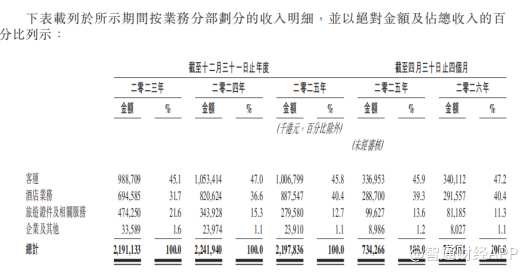
Specifically, in terms of passenger transportation, Hong Kong and Macau Cultural Tourism uses the “TurboJET” brand to provide cross-border ferry transportation services. Hong Kong and Macau cultural tourism connects major ports in Hong Kong, Macau and Shenzhen through regular high-speed ferry services with fixed routes and timetables. Hong Kong and Macau Cultural Tourism's ferry transportation services are supported by service products, including ticketing, reservation and supporting customer services provided through multiple sales channels. Hong Kong and Macau Cultural Tourism also operates cross-boundary bus services connecting Hong Kong and Macau with mainland Chinese cities in the Greater Bay Area, as well as local passenger services in Hong Kong, Zhuhai and Shenzhen.
In terms of hotel business, Hong Kong and Macau Cultural Tourism operates eight lodging properties in Hong Kong, Macau and Beijing, including seven hotels and one serviced apartment. Through its three brands, we provide customers with accommodation options from high-end to affordable prices, mainly targeting the middle and high-end markets. Hong Kong and Macau cultural tourism properties are all located at the core of major city centers, providing services for business travelers and tourists seeking convenient access to major commercial, leisure and transportation hubs.
In terms of travel documents and related services, the company's travel document entrustment service mainly involves assisting individual applicants in processing cross-border travel documents, including receiving travel permit applications and related data, preliminary checks whether the required data has been provided in complete, and submitting such information for further processing. Hong Kong and Macau Cultural Tourism provides the above services under an arrangement with China Travel (Group). According to this, Hong Kong and Macau Cultural Tourism has been appointed as the exclusive agent for China Travel (Group) to provide travel document entrustment services in Hong Kong until June 30, 2047.
The scale of business is stable, and rising costs limit profit growth
In terms of performance, in the first four months of 2023, 2024, 2025, and 2026, Hong Kong and Macau cultural tourism achieved revenue of approximately $2.191 billion (HK$2,242 million, $2,198 million, and $721 million), respectively. Over the same period, the company achieved annual/period profit of approximately $479 million, $194 million, $117 million and $23 million, respectively.
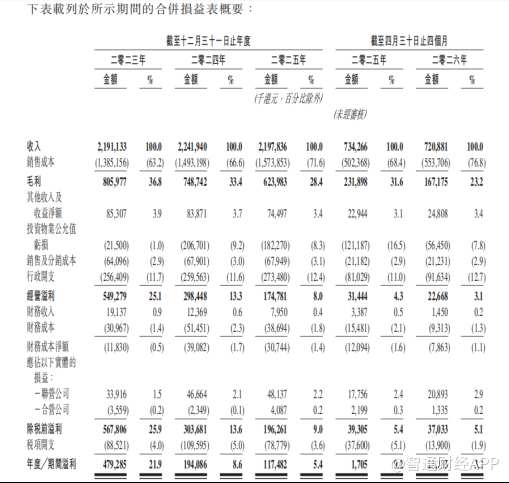
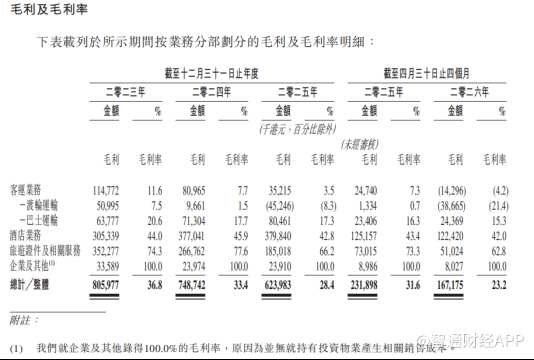
Since 2023, the revenue scale of cultural tourism in Hong Kong and Macau has remained stable, but the net profit margin fell from 21.9% in 2023 to 3.2% in the first four months of 2026. One of the main reasons for the decline in profit margins was the rise in sales costs, which led to a drop in gross margin from 36.8% in 2023 to 23.2% in the first four months of 2026.
According to the prospectus, the sales costs of cultural tourism in Hong Kong and Macau include employee costs, fuel costs, depreciation expenses, supplies and consumables, maintenance and repair costs, and other direct costs. The company stated in its prospectus that when the above costs grow faster than price adjustments, utilization rates, or product portfolio optimization, gross profit and gross margin will decrease.
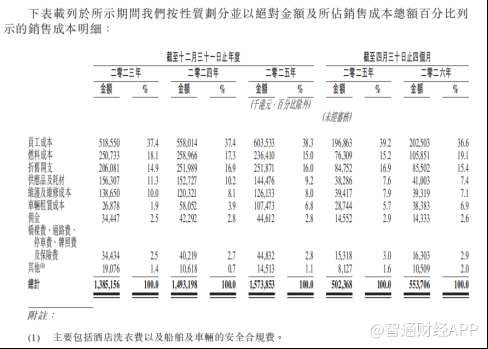
It is worth noting that the cultural tourism business in Hong Kong and Macau relies on a stable supply of fuel, electricity and other energy resources at commercially reasonable prices. The company's passenger transportation business requires large amounts of fuel and energy to operate ferries, buses and related transportation facilities, while the hotel business consumes electricity, gas and other energy resources for guest rooms, catering services, air conditioning systems, lighting and other hotel facilities. In 2023, 2024 and 2025, and the first four months up to 2026, the company's fuel costs accounted for 18.1%, 17.3%, 15% and 19.1% of sales costs for the same period, respectively. Affected by rising fuel costs, the gross margin of the company's passenger transport business fell to -4.2% in the first four months of 2026.
Hong Kong and Macau Cultural Tourism pointed out that looking forward to the future, the company's performance will depend on changes in sales costs compared to revenue. The company aims to limit cost pressure through productivity improvement measures, the use of technology to optimize operations, strategic procurement, active leasing and contract management, and strict capital and maintenance planning. However, if costs increase faster than revenue growth, profit margins may continue to shrink.
Passenger flow in the Greater Bay Area is expanding, and the scale effect is expected to fix profit levels
The Zhitong Finance App notes that with the continued implementation of the Guangdong-Hong Kong-Macao Greater Bay Area connectivity policy, demand for cross-border business travel and “one trip, multi-stop” travel is steadily picking up, which will open up room for long-term growth in Hong Kong and Macao cultural passenger transportation and hotel businesses.
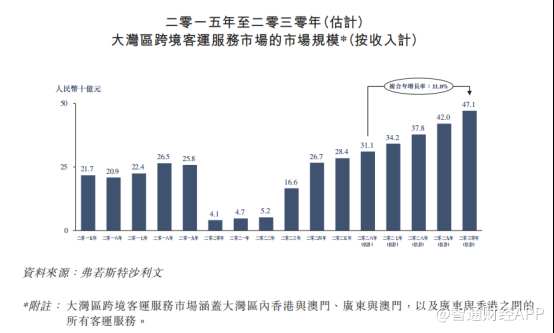
According to Frost & Sullivan data, the Greater Bay Area cross-border passenger services market will maintain a compound growth rate of 11% from 2026-2030, and the market size is expected to reach 47.1 billion yuan in 2030. The most direct benefit of increasing passenger flow is the dilution of the fixed costs of the passenger transport business. Currently, the company has sufficient vehicle and ship capacity, but the passenger utilization rate is insufficient, and rigid expenses such as fuel, ship depreciation, and fleet maintenance cannot be fully shared. This is also the core reason for the decline in passenger gross margin in recent years. As customs efficiency continues to improve in the Bay Area and the normalization of Hong Kong people traveling north and the mainland to Hong Kong and Macau, the passenger capacity of jet jet ferries and Chinese travel buses is expected to rise steadily. Fuel and depreciation costs per unit capacity will continue to decline, and marginal costs will gradually decrease, driving the passenger sector's gross profit recovery.
At the same time, cross-border passenger traffic will also continue to feed back the Hong Kong and Macau Cultural Tourism hotel sector. The company's Weijing, Ruijing, and Park Jingxuan series of hotel properties are located in the core business districts of Hong Kong, Macao and Beijing. They focus on high-end business and tourist groups, and can accommodate cross-border travelers imported by passenger transportation. In the upward cycle of industry demand, hotel occupancy rates and average housing prices are expected to improve; by compounding plans to improve the quality of the company's existing properties and explore asset-light management and output, the hotel business is expected to continue its growth trend and hedge against profit fluctuations in the passenger transport sector. The business synergy of passenger drainage+hotel accommodation will further amplify Bay Area travel dividends.
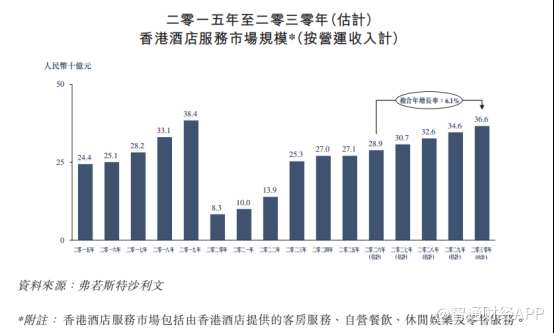
According to Frost & Sullivan data, driven by a recovery in inbound passenger traffic, improved cross-border connectivity in the Greater Bay Area, and the gradual resumption of exhibition and business activities, the size of the Hong Kong hotel service market is expected to grow steadily. It is expected to grow to RMB 36.6 billion at a compound annual growth rate of 6.1% in 2026-2030; during the same period, the size of the Macau hotel service market will grow at a CAGR of 12.9% to RMB 688 billion.
In the long run, demand for cross-border tourism and business travel in the Greater Bay Area has sufficient potential for growth. With the support of land and sea passenger transport networks, core hotel assets and China Travel Group resources, Hong Kong and Macau Cultural Tourism is expected to continue to enjoy passenger flow dividends, rely on scale effects to dilute rigid costs, and promote gradual profit recovery. However, under opportunities, challenges coexist. Factors such as fluctuations in fuel prices, diversion of other modes of transportation, and increased competition in the hotel market will still limit the pace of profit improvement. Subsequent performance still requires continuous observation of passenger flow recovery and cost control results.