


The Zhitong Finance App learned that economists generally expect the Bank of Japan to keep the benchmark interest rate unchanged on Friday, while indicating that underlying inflation has finally reached and is above its fixed target of 2% for a long time. This milestone will reinforce the reasons for further rate hikes.
In a recent Bloomberg survey of global economists, all economists interviewed who have been observing the Bank of Japan's policy path for a long time predicted that at the end of this week's two-day meeting, the central bank will keep the policy interest rate unchanged. The Bank of Japan raised interest rates to 1.25% last month.
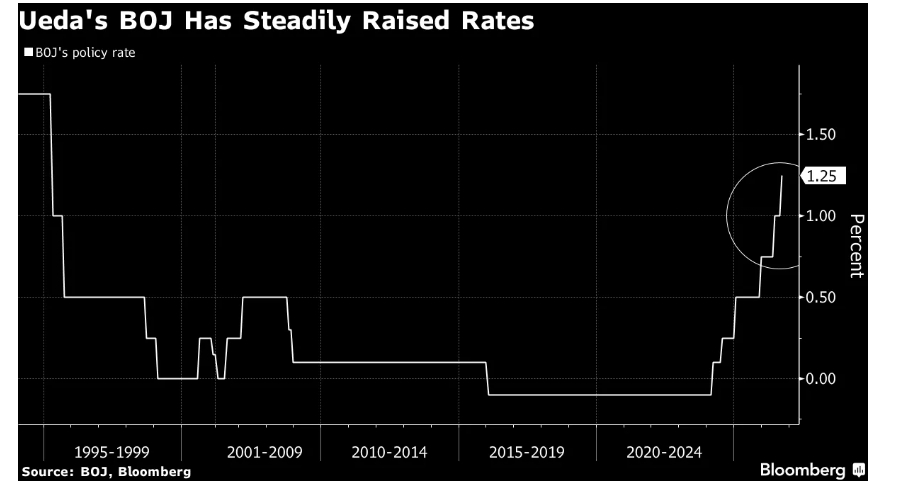
As shown in the above chart, the Bank of Japan, led by Kazuo Ueda, is still steadily advancing the process of raising interest rates.
A key focus on Friday is whether the Bank of Japan will say that underlying inflation has roughly reached the 2% target. This will be the first time since the target was set in 2013, and it looks like this outcome is likely to happen. This will reinforce the rationale for further interest rate hikes, as Japan's borrowing costs are still relatively low and have a stimulating effect.
Ryutaro Kono, Japan's chief economist at BNP Paribas, said, “The Bank of Japan is likely to judge that underlying inflation has now reached around 2%. The Bank of Japan may think it is necessary to raise interest rates to a neutral level as soon as reasonably practicable, but the risk of upward inflation is not enough to force it to raise interest rates for two consecutive sessions.”
The Federal Reserve kept its policy settings unchanged overnight before the Bank of Japan met. The decision weighed on the US dollar and pushed the yen to about 157.84 yen per dollar in Tokyo on Thursday morning.
Although the Bank of Japan has always been relatively vague about the actual level of underlying inflation, many indicators have shown over the years that inflation is taking root in Japan. In March of this year, the Bank of Japan began announcing a new set of price indicators to capture changes in core inflation after excluding the effects of mainly temporary factors.
Raising the basic inflation assessment will lay the foundation for another rate hike at the December meeting. More than 80% of the economists surveyed expect central banks to act at that time. The Bank of Japan adjusted the benchmark interest rate in September, the second rate hike in three months, marking the fastest pace of interest rate hikes in 36 years.
People familiar with the matter told Bloomberg earlier this month that given current price trends and the central bank's belief that interest rate hikes have had limited impact on the economy so far, the Bank of Japan may continue to raise interest rates at roughly the same pace.
Kazuo Ueda has increasingly said that underlying inflation is “very close” to 2% and appears to be preparing investors for a wording adjustment in Friday's quarterly outlook report. Earlier this month, he said that the Bank of Japan will not allow underlying inflation to rise further sharply from current levels.
Acknowledging that underlying inflation has reached the target will cause the market to pay more attention to how much interest rates need to be raised before the policy is no longer stimulating. The Bank of Japan estimates that the neutral interest rate is between 1.1% and 2.5%, while stressing that it is difficult to determine accurately. Institutions such as J.P. Morgan Securities and BNP Paribas expect the terminal interest rate to reach 2.5% in this cycle.
Excluding fresh food, the inflation index has always been an important indicator that the Bank of Japan is concerned about. As of March of this year, the indicator has surpassed the central bank's target for four consecutive fiscal years; if the central bank's latest forecast is accurate, it will be higher than the target for six consecutive fiscal years. Some economists believe that the Bank of Japan is too cautious in admitting this transformation and faces the risk of falling behind the situation in dealing with inflation.
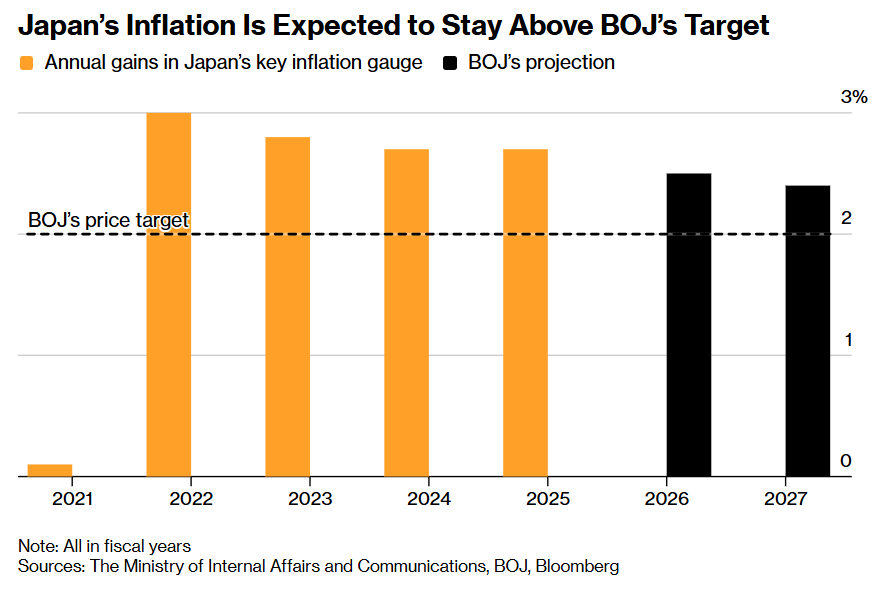
The above chart shows that Japan's inflation is expected to continue above the 2% target point anchored by the Bank of Japan. Note: All are calculated on a fiscal year basis.
Kameda Seisei, a former economist at the Bank of Japan and current executive economist at Sompo Institute Plus, said, “Five or six years is basically enough for a first-year elementary school student to advance to middle school. If anyone claims that inflation that has continued throughout this period is not a trend, it is hard to imagine that people would accept this statement.”
Recent economic data and early signals ahead of next year's wage negotiations suggest that inflationary pressure is still stable. Last month, the Bank of Japan's basic inflation index jumped to 3.2%, the highest level in three years. After three consecutive years of historically high wage increases, Japan's largest trade union organization plans to seek a larger wage increase in the next round of negotiations. It is expected that the relevant negotiations will reach an agreement in March.
Bloomberg Economic Research economist Taro Kimura said, “Prior to next year's annual wage negotiations, early signals from labor and management leaders suggest that wage growth in Japan may accelerate in 2027. This may further drive up inflation and increase the risk that the Bank of Japan will raise the benchmark interest rate above the level of about 2% terminals currently priced in the market.”
The differences between the nine members of the Bank of Japan's policy committee on the outlook for inflation were reflected in last month's vote of 7 to 2. This result left the yen weak even after the rate hike. Investors will be watching Friday's vote to look for signs of further momentum to raise interest rates.
The price target reaching this milestone will mark the end of a policy action that began in 2013. At the time, the Bank of Japan initiated large-scale monetary easing with the goal of achieving 2% inflation in about two years. However, Japan actually experienced nearly a decade, and only experienced a continuous rise in prices, driven by the impact of global inflation after Russia invaded Ukraine.
In March 2024, as the Bank of Japan became more confident that the underlying inflation target was being achieved, the bank ended the last negative interest rate policy in the world and its yield curve control plan. Ueda Kazuo has raised interest rates six times so far, making him the most number of interest rate hikes by a single Bank of Japan governor in at least half a century.
In a recent podcast, Hiroshi Nakazo, the former vice governor of the Bank of Japan for nearly 40 years, emphasized this long-awaited economic transformation. Previously, after the asset bubble burst in the 1990s, Japan experienced “lost 30 years” and about 200 financial institutions went out of business.
“Japan is back,” said Hiroshi Nakazo. “Deflation is finally a thing of the past, and the economy is shifting to an inflationary system.”
However, reaching the target does not mean that inflation has succeeded unreservedly. The rise in prices has been accompanied by record corporate profits, nominal gross domestic product, and tax revenues, but it has also heightened concerns about the cost of living, particularly among Japan's rapidly aging population. Nearly 30% of Japanese people are 65 years old or older, and about 40% of elderly families rely entirely on pensions to earn income.
Nakazeng Hong once said that when the central bank achieves its price target, he will open a bottle of champagne to celebrate. He stressed that after the Bank of Japan achieves its goals, it is still necessary for the government to develop a strong growth strategy.
Nakazenghong said, “This necessity has not diminished at all.”
The Bank of Japan's “hawkish suspension” is approaching: 2% inflation milestone, continuing to pave the way for subsequent interest rate hikes
The most important potential change in the Bank of Japan's current meeting is that while maintaining the 1.25% policy interest rate, it clearly acknowledged for the first time that basic inflation has roughly reached the 2% target, thereby strengthening the policy basis for continuing to withdraw from easing.
The basic inflation (inflation) here is the central bank's judgment on a continuous price trend after excluding temporary factors. It is not equivalent to the consumer price index for a given month. Japan's inflation target, which excludes fresh food, has been above 2% for many years, but the central bank has been waiting to provide fuller evidence of sustainability in wages, service prices, and corporate pricing behavior. In the Bloomberg survey, all surveyed observers expect it to be suspended this week. More than 80% of the economists surveyed expect interest rate hikes in December; early signs of wage negotiations mean that wage growth in 2027 may still increase inflationary stickiness. Thus, suspending and raising inflation assessments can occur simultaneously: the former reflects the pace of interest rate hikes, and the latter determines the direction of austerity.
This change also pushes the market focus from “whether to raise interest rates this week” to where the terminal interest rate actually stops. The Bank of Japan estimates the neutral interest rate range of 1.1% to 2.5%. Institutions such as J.P. Morgan Securities and BNP Paribas expect the current terminal interest rate to reach 2.5%, which is about 2% higher than the current market price. As far as yen and Japanese treasury bonds are concerned, what really has the power to reassess is the final interest rate level and speed of arrival: if the central bank confirms that basic inflation has been met and maintains a faster pace of interest rate hikes, short-term yields and yen will receive policy support; if there is an increase in the number of members supporting interest rate hikes at the same time, the signal will be stronger than a suspension that has already been fully anticipated.
The return to long-term inflation is not only a favorable driving factor — rising prices raise the nominal income and tax revenue of enterprises, while reducing the purchasing power of pension-dependent households over a long period of time. Therefore, normalization of monetary policy still requires support from productivity and actual income growth.
On October 28, with 10 votes in favor and 2 against, the Federal Reserve maintained the federal funds rate target range of 3.75% to 4%; both Cook and Hamack advocated an immediate interest rate hike of 25 basis points. The Federal Reserve's latest monetary policy statement describes economic activity as expanding at a “strong pace”, emphasizing productivity growth, capital investment, and domestic spending resilience, while confirming that inflation is still high.
The key point of Walsh's remarks at the press conference was that after the interest rate hike in September, financial and credit conditions for some businesses and households have been tightened, but he is still unwilling to define the overall conditions as “austerity.” This means that the recent rise in financing costs has played a transmissive role, but it is not enough to automatically prove that there is no need for further policy adjustments. At the same time, he stressed the need to stop the rise in relative prices such as energy from spreading to the entire economy and keep inflation expectations stable.
Walsh did not directly equate strong growth with an overheated economy. He believes that productivity improvements may allow the economy to grow at a faster rate without having to stabilize prices by reducing activity and increasing unemployment; however, he also pointed out that the productivity improvements that have been observed largely predate the current AI boom and cannot all be attributed to AI. For December, he continued to emphasize the importance of additional information and made it clear that politics and elections were not involved in this decision. As a result, the market showed repricing for different periods: some forward rate hikes were weakened, but the December rate hike was still highly priced. The Reuters market closing report quoted CME data as saying that the probability of a 25 basis point rate hike is about 85%.
A pause does not mean the end of austerity! The Federal Reserve retains the option to raise interest rates, and the Bank of Japan is likely to follow
Walsh announced that one of the Federal Reserve's eight FOMC monetary policy meetings in 2027 will be dedicated to discussing broad monetary policy strategies. It is not expected that interest rate voting or policy statements will be issued like traditional FOMC monetary policy meetings; it is expected that two strategy meetings and six policy setting meetings will be scheduled in 2028. Furthermore, the proposals of the Federal Reserve Balance Sheet Working Group under the leadership of Walsh are expected to be submitted for discussion at the beginning of the first quarter of next year. Currently, Walsh is not announcing the immediate adoption of a new Federal Reserve downsizing action.
As far as the outlook for global financial market portfolio strategies is concerned, the suspension of the two major central bank systems in the US and Japan does not mean the simultaneous loosening of the financing environment: the safe-haven yen exchange rate depends on the expected interest spreads and capital flow between the two countries, and rising yields on Japanese treasury bonds may increase the relative attractiveness of local assets. Furthermore, the market focus will immediately shift from “whether to raise interest rates this week” to where the terminal interest rate actually stops — the Bank of Japan estimates the neutral interest rate range of 1.1% to 2.5%. Institutions such as J.P. Morgan Securities and BNP Paribas expect the current round of terminal interest rates to reach 2.5%, which is about 2% higher than the current market price.
For AI computing power transactions, policies affect capital costs through risk-free interest rates, corporate credit spreads, and exchange rates, and energy prices also affect project costs through electricity, transportation, and equipment manufacturing; large-scale model training, continuous reasoning, and intelligent task expansion can increase computing power requirements, but what ultimately supports valuation is the transformation of these needs into revenue, profit, and cash that can be used for reinvestment. Currently, a more clear investment line is to identify companies that can continue to expand with strong AI commercialization growth, technical efficiency, and balance sheet strength in an environment where interest rates are still high.