


Higher inflation, a possible RBA rate hike and pressure on borrowers have pushed Australian bank stocks back into the spotlight. Some businesses exposed to rising interest rates may see earnings drivers shift in their favour, while others face tougher loan demand and credit risks. This article explains how that backdrop links to three Australian Bank Stocks screener picks and outlines why each stock could deserve a closer look right now.
The three stocks below are only a starting sample from this idea. The full screen surfaced 5 more Australian lenders with equally compelling stories that are not covered here. If you want to quickly identify which banks line up with your own risk and income goals, head straight into the Australian Bank Stocks (Beneficiaries of Higher Interest Rates) screener
Bendigo and Adelaide Bank (ASX:BEN)
Overview: Bendigo and Adelaide Bank is a regional Australian lender providing everyday banking, lending and financial services to households and small businesses.
Operations: The bank generates about A$1.23b from Consumer banking, A$689 million from Business & Agribusiness and A$114 million from Corporate activities, entirely in Australia.
Market Cap: A$6.0b
Bendigo and Adelaide Bank fits this higher-for-longer rates theme because its regional retail and SME lending book is closely linked to domestic borrowing costs. As a result, the current rate backdrop puts the focus squarely on how it manages funding, costs and customer demand from here.
"Higher investment spend and increasing operating expenses, particularly in technology and risk management, may still suppress net margins and earnings in the near term."
The real swing factor is how a single, slow moving shift in its funding mix ultimately feeds through to margins and dividend headroom.
That slow funding shift is exactly what the full narrative for Bendigo and Adelaide Bank unpacks in full, including how cost pressures and margin trends could be quietly decoupling beneath the surface.

Bank of Queensland (ASX:BOQ)
Overview: Bank of Queensland provides retail and business banking across Australia, offering loans, deposits and digital services to households and smaller enterprises.
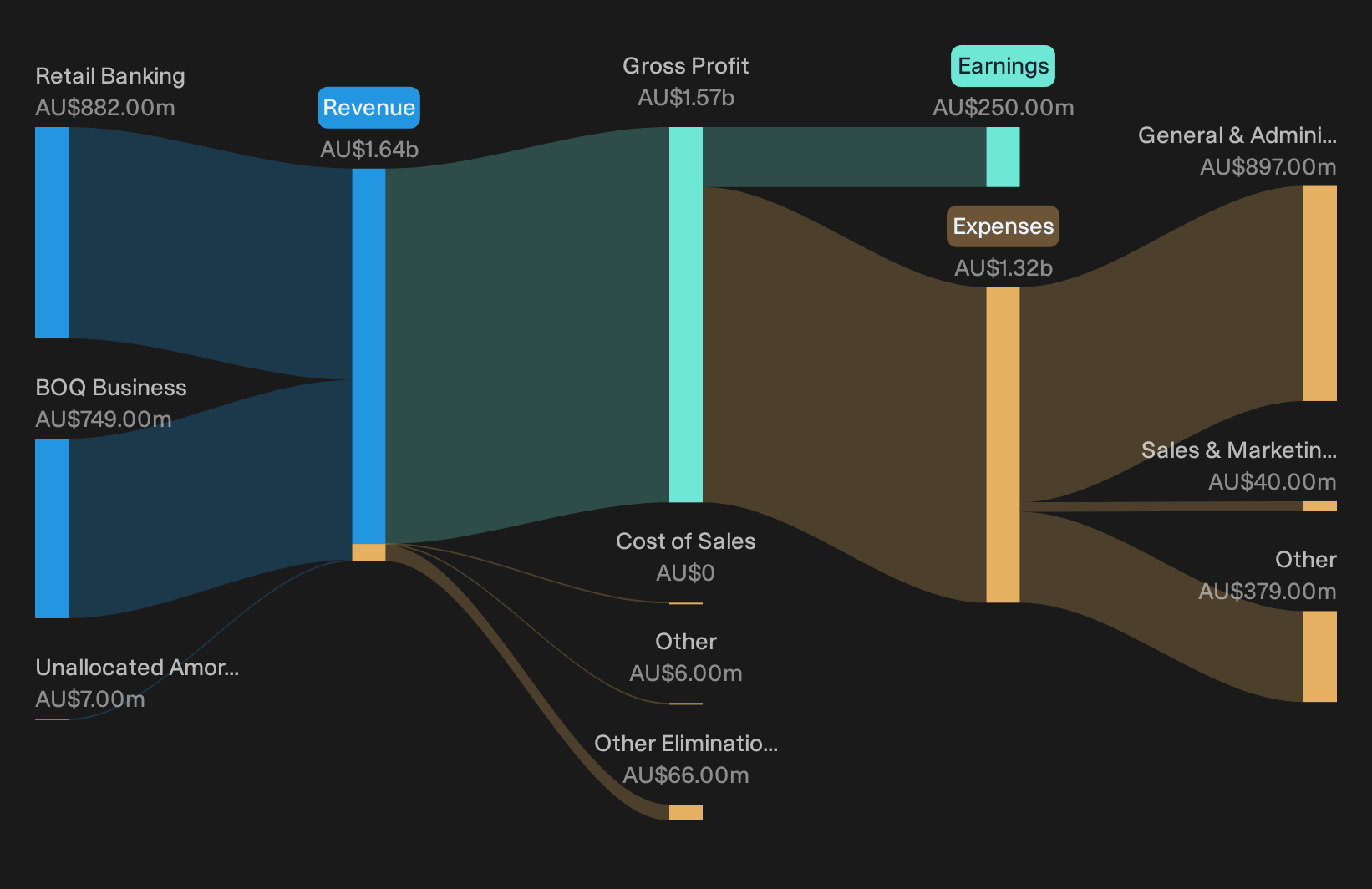
Operations: Bank of Queensland generates A$882 million from Retail Banking and A$749 million from BOQ Business, with minor contributions and adjustments elsewhere.
Market Cap: A$4.5b
Bank of Queensland sits squarely in the higher-rate theme, with a loan book anchored in Australian households and small firms that ties earnings closely to domestic interest settings and the cost of term deposits.
"The transformation of BOQ into a simpler, specialist bank with enhanced digital capabilities is expected to deliver improved customer experiences and efficiencies, which could drive higher revenue and margins."
What happens to those margins, and the appeal of Bank of Queensland as a higher-rate play, now hinges on one quiet shift in its profit mix.
That quiet shift is exactly what the full narrative for Bank of Queensland breaks down, revealing where Bank of Queensland’s earnings mix could be accelerating or quietly stalling in the periods ahead.
National Australia Bank (ASX:NAB)
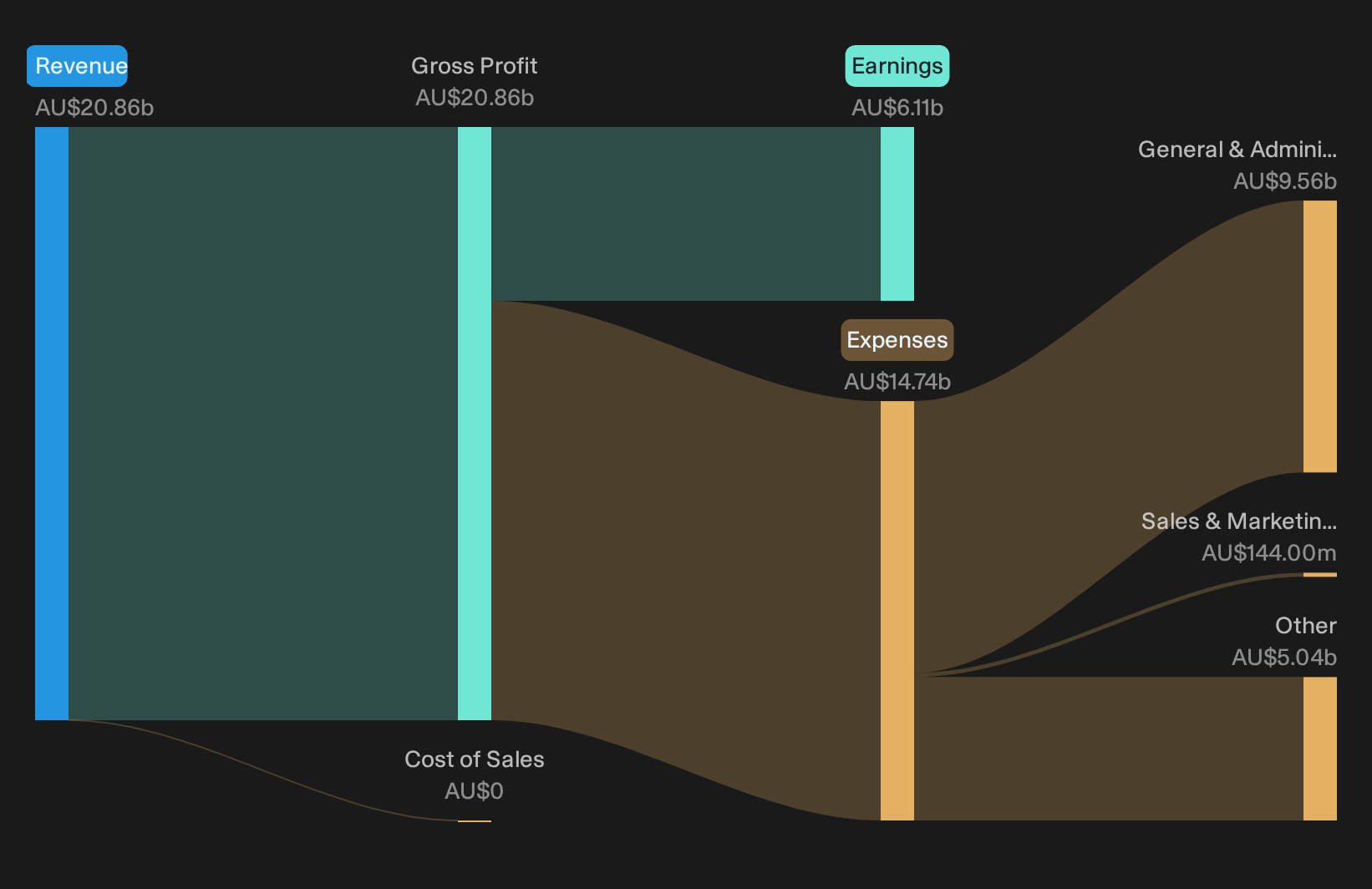
Overview: National Australia Bank is a large Australian-headquartered lender whose broad retail and business banking provides direct exposure to higher RBA interest rates.
Market Cap: A$124.7b
National Australia Bank gives this higher-rate screen its scale, with a large loan book and deposit base that can respond quickly as the cash rate stays elevated. The key question is how effectively its digital and funding projects turn that backdrop into earnings power.
"Accelerating shift toward digital payments and banking is driving substantial investment in National Australia Bank’s real-time payments engine and cloud-based transaction switch, including migration of all payments to the new platform and planned migration of all card transactions by FY 2027."
What happens to margins and dividend capacity now depends largely on how one less visible cost-efficiency push actually feeds through the income line.
That hidden efficiency push is exactly what the full narrative for National Australia Bank unpacks, separating short term noise from longer term earnings for National Australia Bank.
Seeking Alternatives Before The Crowd
Fresh opportunities move fast. Breakout stories gain momentum, quiet winners stop flying under the radar and falling laggards get caught late. Scan what matters while it still counts and get in early.
- Target resilient income streams by reviewing a curated 5 dividend fortresses that focus on payout strength and balance sheet support before yields drop under pressure.
- Spot early breakthroughs in automation by checking the hand picked 96 robotics and automation stocks that could benefit as factories, warehouses and logistics upgrade their systems.
- Track the build out of tomorrow's energy backbone through a filtered 44 power grid technology and infrastructure stocks featuring businesses tied to grid upgrades, transmission tech and reliability projects.
Have feedback on this article? Concerned about the content? Get in touch with us directly. Alternatively, email editorial-team@simplywallst.com