


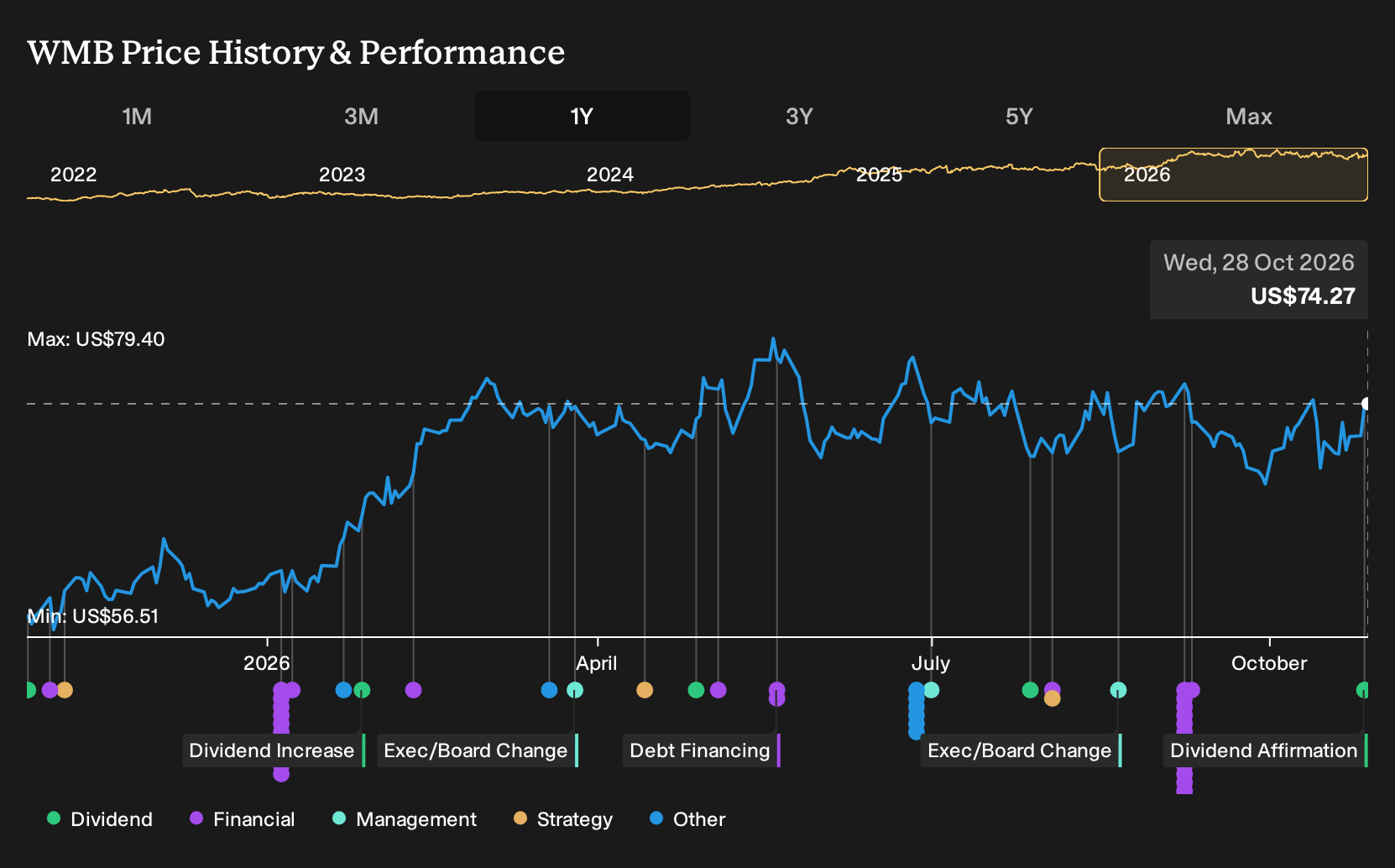
- Williams Companies' board approved a regular quarterly dividend of $0.525 per share, or $2.10 annualized, payable on December 28, 2026 to shareholders of record on December 11, 2026, following a long history of quarterly payouts dating back to 1974.
- The 5% uplift from the prior $0.50 quarterly dividend highlights management’s focus on returning cash while relying on fee based midstream assets to support distributions.
- The discussion now turns to how this higher regular dividend shapes Williams Companies' broader investment narrative around cash flow and growth.
Scan for other dividend focused infrastructure plays with resilient cash generators by checking out our hand picked list of 6 dividend fortresses alongside Williams Companies.
Williams Companies Investment Narrative Recap
To own Williams Companies, you need to be comfortable with a business that leans on long haul natural gas pipelines, Gulf Coast infrastructure and contracted power projects tied to LNG and power demand. The key near term swing factor remains execution on large projects like Shelby Connector, Delta Access and Neo while keeping leverage around the intended 3.5x to 4.0x range.
The higher regular dividend does not change that core thesis. It reinforces that management is prioritizing cash returns even as growth capex and debt push financial metrics tighter. The main risk stays the same, that volumes or project timing disappoint, or that debt and free cash flow coverage remain under pressure if cash generation lags expectations.
The fresh quarterly dividend of US$0.525 per share, or US$2.10 annualized, sits squarely in that context. Williams Companies is effectively affirming that its fee based infrastructure and long duration contracts, including Power Innovation projects like Neo and Socrates, are expected to support both a growing payout and a heavy project backlog.
For you as a shareholder, the relevant question is how that dividend interacts with known pressure points. Debt is flagged as not well covered by operating cash flow and the dividend is described as not well covered by free cash flow. That means the catalyst list, Haynesville related expansions, LNG linked pipelines and contracted power projects needs to translate into steadier cash generation to keep this higher payout and the balance sheet comfortably aligned.
What Analysts Are Baking Into Williams Companies' Dividend Story
For anyone tracking Williams Companies, the higher payout only really makes sense when lined up against what analysts think the next few years look like. The current narrative leans on revenue that analysts expect to grow about 11.9% a year over the next 3 years, with profit margins nudging up from 24.9% today to 25.4% by around 2029. The thesis backing the dividend is that a larger, fee based pipeline and power platform can support that extra cash return while funding projects like Shelby Connector, Delta Access, Neo and further phases of Socrates.
Earnings sit at about US$3.1b today, with consensus forecasts pointing to roughly US$4.4b by around 2029. That is an increase of about US$1.3b in profit over a few years, even before considering the spread between the most bullish US$5.0b estimate and the more cautious US$3.6b call. For dividend focused investors, the key point is not just that analysts are looking for higher earnings, but that those estimates assume large capital projects reach completion broadly on time and on budget, and that contracted volumes flow as expected.
Valuation assumptions tie directly into this backdrop. On the current numbers, Williams Companies trades on a P/E of about 27.1x. Analysts use a higher 29.6x multiple on those 2029 earnings to frame their US$85.61 consensus price target against a US$67.97 share price. That future P/E sits well above the 12.3x quoted for the broader US Oil and Gas industry in the same report. Investors deciding how much weight to put on the dividend need to judge whether a fee based model, LNG linked volumes and Power Innovation contracts justify that kind of premium multiple.
Balance sheet and funding assumptions also matter for the payout discussion. Growth capex of roughly US$7.3b for 2026, funding for Neo and related projects, and the recent US$2.75b in senior notes all push leverage toward about 4.1x, just outside management’s target band. Analysts still expect shares outstanding to tick up only modestly, at about 0.16% a year over the next 3 years, which limits equity dilution but places more weight on cash generation and debt markets to support both projects and distributions.
For income orientated holders, the gap between dividend ambitions and free cash coverage stays central. The report flags that debt is not well covered by operating cash flow and that the dividend is not well covered by free cash flow today. That means the cash engine behind Williams Companies, mostly contracted midstream assets and long term power deals, needs to perform as modeled so that a higher regular payout does not come at the expense of flexibility if project timing slips or volumes soften.
Williams Companies' narrative projects US$17.2b revenue and US$4.4b earnings by 2029. This assumes revenue will grow at about 11.9% a year and earnings will rise about US$1.3b from US$3.1b today.
Uncover why Williams Companies' fair value indicates a 15% potential upside to its current price, which could narrow quickly.
Exploring Other Perspectives
One bullish twist you may want to explore is how some analysts frame leverage as a catalyst rather than just a risk. The most optimistic group was already pencilling in about US$18.7b of revenue and US$5.0b of earnings by 2029, before this dividend uplift. That more upbeat Williams Companies narrative could shift again as fresh information lands.
Explore 4 other Williams Companies fair value estimates, including one that suggests potential upside of up to 301% from the current price.
Reach Your Own Conclusion
Don't just follow the ticker. Dig into the data and build a conviction that's truly your own.
- A great starting point for your Williams Companies research is our analysis highlighting 3 key rewards and 2 important warning signs that could impact your investment decision.
- See our latest analysis for Williams Companies. The report includes a comprehensive fundamental analysis summarized in a single visual, the Snowflake, making it easy to evaluate Williams Companies' overall financial health at a glance.
Looking For More Investment Ideas Beyond Williams Companies?
If you want to put Williams Companies in context and broaden your opportunity set, it helps to scan other businesses with different income profiles and balance sheet strengths. The Simply Wall St Screener gives you a quick way to line up alternatives that match the kind of risk, return and dividend profile you care about most.
- Target income streams by reviewing a curated mix of higher yielding stocks through the 6 dividend fortresses.
- Focus on capital preservation by assessing companies that score well on financial stability using the 32 resilient stocks with low risk scores.
- Look for underfollowed opportunities with strong fundamentals by checking the 19 high quality undiscovered gems.
Have feedback on this article? Concerned about the content? Get in touch with us directly. Alternatively, email editorial-team@simplywallst.com