


If you had looked at Bayer in late October 2025, the conversation was dominated by slow growth worries, Roundup lawsuits and a divided analyst view on what the shares were worth. Holding Bayer over the past year would have returned 67.5%, including dividends. If you had chosen to buy or stay away at that point, what did that decision really hinge on: legal relief, new drugs, or something else in the business story?
A Narrative on Simply Wall St is one investor's written case for a company, with its growth, margin and multiple assumptions spelled out. Those assumptions imply an estimated Fair Value.
This theme extends beyond Bayer. See which of 130 healthcare AI stocks may still merit a closer look.
The Two Bayer Narratives Investors Had To Weigh
The shares cost €27.45 at the start of the period, and the argument around Bayer split into two clear stories that both sounded plausible.
On the optimistic side, the Narrative put Fair Value at €39, or 42% above the start price. Supporters focused on faster uptake of drugs like Nubeqa and Kerendia, and on stronger margins in Crop Science if cost cuts and productivity gains arrived earlier than many expected.
The cautious view set Fair Value at €23, or 16% below the start price. That camp focused on heavy Roundup and PCB litigation, plus more restrictive crop protection regulation, as ongoing strains on cash flow and profitability.
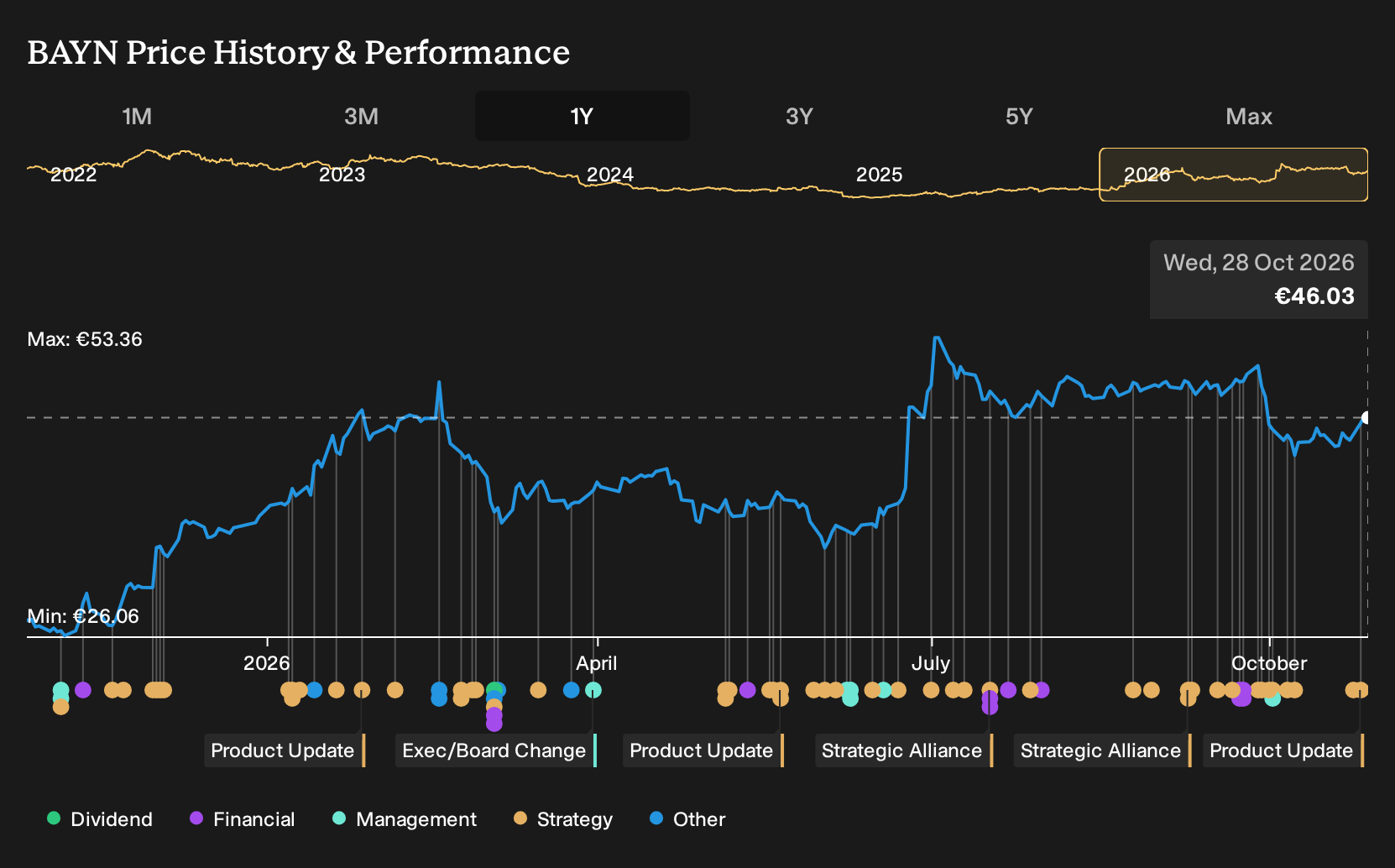
What The Evidence Did To The Bayer Argument
The biggest swing factor for Bayer turned out to be the U.S. Supreme Court decision that blocked tens of thousands of Roundup warning cases. This supported the more optimistic view that legal risk could ease. At the same time, Q2 2026 results showed revenue at €10,872m and net income at €219m, with net margin at 2.0%, so profitability improved but remains modest.
The lesson is clear. When a thesis depends on litigation and new medicines, it is useful to track court outcomes and reported net margin side by side rather than relying on narrative alone.
What Bayer’s One Year Run Now Asks You To Believe
Today Bayer trades at €46.03, after a 67.5% gain over the past year. The selected Narrative’s Fair Value sits below that level, which frames the price as already crediting meaningful progress on restructuring, the product pipeline and litigation containment.
The core bet now is that Bayer converts its projects and cost cuts into steadier profit growth. The selected Narrative asks how heavy Roundup related cash outflows and execution on planned efficiencies will shape that outcome.
"Os litígios relacionados ao glifosato (Roundup) continuam a ser um fardo significativo nas finanças da Bayer, com impactos que se estendem a 2026. Em 2025, a empresa adicionou cerca de €1,2-1,37 bilhões em provisões para cobrir custos legais, elevando o total gasto para mais de US$10-11 bilhões desde a aquisição da Monsanto."
One Narrative disagrees with today's price. → See where this Narrative says Bayer should trade
Another angle on Bayer’s world
Bayer leaves you thinking about medicines, pricing power and legal drag. Nearby sits a business targeting a different pressure point.
Here the focus is obesity and diabetes treatments that patients can take easily. Management is intent on scaling newer therapies, particularly pills that fit daily routines.
This group also relies on treatments for rare blood and hormone disorders. Those therapies aim to spread earnings across more than one drug family.
The link back to Bayer is straightforward. Healthcare investors weighing litigation, pipelines and pricing might wonder how a diversified obesity and diabetes specialist reshapes that landscape.
The case is on the record, with the assumptions it rests on. → See the Narrative that values this company 17% above its price
Have feedback on this article? Concerned about the content? Get in touch with us directly. Alternatively, email editorial-team@simplywallst.com