


Transocean (RIG) has drawn fresh attention after winning two ultra-deepwater contracts in the U.S. Gulf of Mexico, adding roughly $550 million in firm backlog and pairing that with recently improved earnings expectations.
Investors have responded quickly to the contract wins and higher earnings expectations, with Transocean’s share price up 3.87% over the last day. This has contributed to a 27.08% 1-month share price return and a 58.25% year-to-date share price move that aligns with a 75.20% 1-year total shareholder return and indicates that momentum has been building rather than fading.
Scan beyond Transocean and compare other offshore and energy contractors with firm backlogs and active order books using our hand-picked 19 high quality undiscovered gems
Bulls see Transocean’s fresh backlog and improving earnings expectations as validation of the rebound, while bears point to ongoing losses and revenue pressure. Which side does the current valuation actually support?
Most Popular Narrative: 25% Undervalued
At a last close of $6.71 and a narrative fair value of $9.00, the most followed view on Transocean argues that the recent rally still leaves upside on the table and leans heavily on how the rig fleet and balance sheet could look after the proposed Valaris merger.
In 2008 the market paid $48 billion for a worse fleet with more debt on the way. Today it pays $6.5 billion for this one and calls it risky.
Half the rigs. Better rigs. No new rigs coming. And a balance sheet two years away from flipping the switch.
See why 9 investors see Transocean as 25% undervalued.
According to Cannibal_Stocks, this storyline leans on three pillars. First, the combined Transocean and Valaris rig portfolio is framed as higher quality than the 2008 version despite a smaller count. Second, industry supply of ultra deepwater units is described as constrained, with no newbuilds reported in more than a decade. Third, the author focuses on the path of net debt to EBITDA and argues that a lower leverage profile could shift how institutions view the equity.
The same narrative also challenges current consensus models that still treat Transocean as a standalone operator and not a merged entity. That disconnect is presented as a key reason why a fair value of $9.00 sits above both the $6.71 share price and the $6.56 analyst target, even while traditional metrics like P/S and DCF point to a tighter range.
Result: Fair Value of $9.00 (UNDERVALUED)
Still, the narrative breaks quickly if the Valaris deal is delayed or blocked, or if weaker offshore demand undercuts rig utilization and dayrate assumptions.
Find out about the key risks to this Transocean narrative.
Another View On Transocean’s Valuation
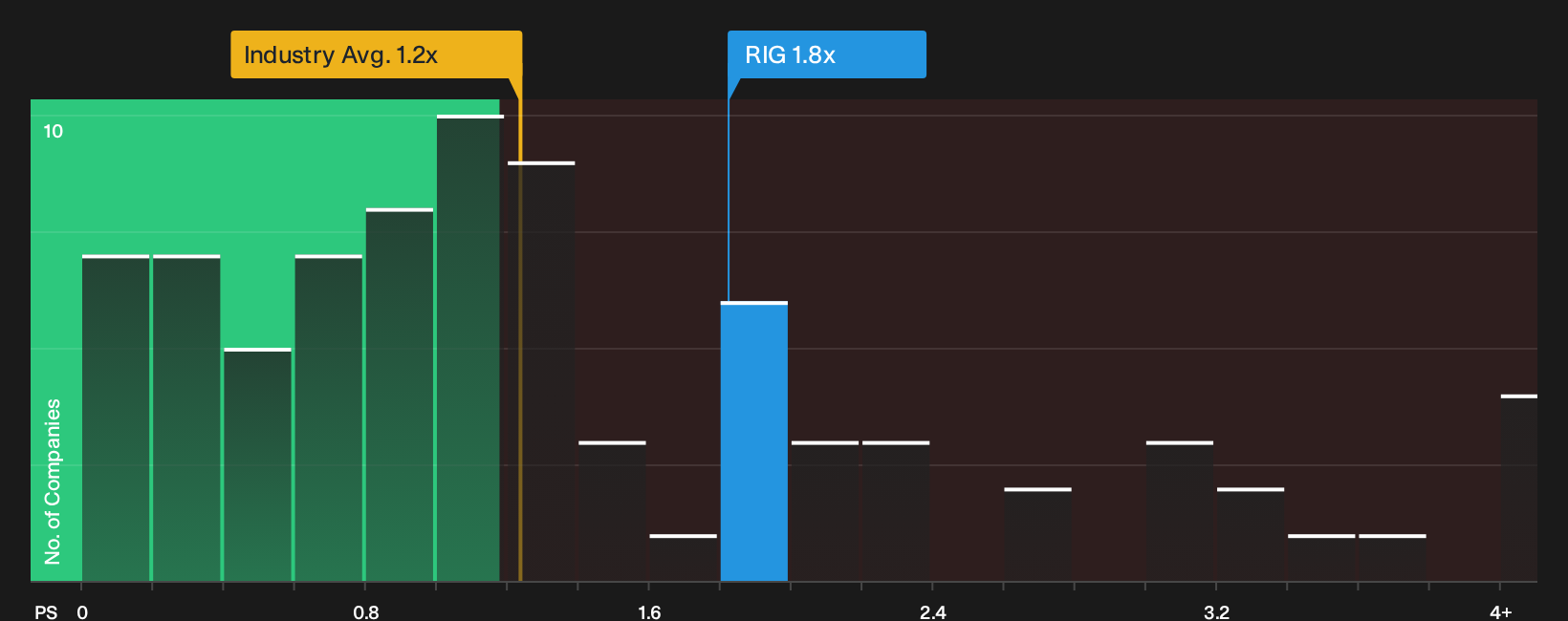
Transocean’s story looks very different once the focus switches from narrative fair value to the plain P/S line. At 1.8x sales, the stock trades richer than the US Energy Services industry on 1.2x and above its own fair ratio of 1.3x, which points to less of a bargain and more valuation risk if sentiment cools.
For investors who lean on simple multiples instead of long narratives, that kind of premium can matter a lot when expectations reset, especially for a business that is still loss making and forecast to see revenue decline over the next few years. The key question is how much confidence investors really have in the story implied by $9.00.
See what the numbers say about this price — find out in our valuation breakdown.
Next Steps
If sentiment in this Transocean debate feels split, that is exactly why you should move fast and stress test the numbers yourself. To see what optimistic investors are focusing on, review the 1 key reward.
Looking for more investment ideas beyond Transocean?
Do not stop at Transocean. The real edge comes from lining it up against other opportunities and seeing where risk, quality, and price truly differ.
Use the Simply Wall Street Screener to quickly compare potential ideas and avoid guessing in a market that constantly tests your conviction.
- Target resilient opportunities that aim to protect your downside by starting with a 32 resilient stocks with low risk scores that is built to hold up when sentiment cools.
- Hunt for quality at a reasonable price by working through a curated 26 high quality undervalued stocks that filters for stronger fundamentals and attractive valuations.
- Strengthen your core holdings by leaning on a list of solid balance sheet and fundamentals (24 results) so you focus on businesses with sturdier finances backing their stories.
Have feedback on this article? Concerned about the content? Get in touch with us directly. Alternatively, email editorial-team@simplywallst.com