


The Zhitong Finance App learned that the ECB will announce the interest rate decision at 9:15 Beijing time on Thursday. The market generally expects the bank to stand still to balance the impact of turmoil in the French bond market and another rise in energy costs.
According to the survey, with the exception of one person, the rest of the economists expect the ECB to keep deposit interest rates at 2.5% on Thursday. Economists predict that the ECB will raise interest rates for the third and last time in December. At that time, new economic forecasts will guide consumer price trends until 2028, while the Iran war continues to further disrupt oil and gas supplies.
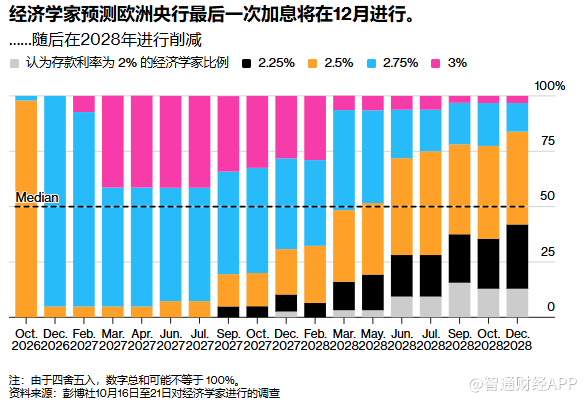
Although inflation is close to double the 2% target, since inflation is still mainly concentrated in the energy sector, policymakers have more room to maneuver when considering next steps. Meanwhile, the eurozone's economy, which has so far been resilient, is losing momentum.
Officials warned that the recent spike in sovereign bond yields would slow economic growth, although it would also help curb inflation. However, due to high budget deficits and street turmoil, France is facing more severe market pressure.
The plight of the Eurozone's second-largest member country is reminiscent of the European debt crisis more than 10 years ago, triggering speculation about whether the ECB will intervene, or whether it will be more inclined not to further tighten monetary policy. This week, the Federal Reserve chose to keep interest rates unchanged, and the European Central Bank and the Bank of Japan are expected to remain on hold.
ECB President Lagarde will hold a press conference at 2:45 p.m. Frankfurt time (that is, 30 minutes after the policy statement is issued) to answer questions from reporters about the above issues and his visit.
Interest rate path
Some ECB officials have signalled that further action is more likely as inflation approaches 4%. Staying on hold this week and raising interest rates in December not only maintains the pace of quarterly tightening, but also shows that policy makers are not panicking.
Lagarde and others said they still believe “careful” adjustments are the best approach. However, they also stressed that the situation is still uncertain, and consumer price prospects largely depend on the development of the situation in the Middle East.
ECB Governing Council member Pierre Weinsch said this month: “Market pricing reflects that we may have to take more steps. This seems like a reasonable benchmark scenario, but we're still in a very uncertain world.”
Currently, interest rates are at the upper end of the so-called neutral interest rate range. To significantly raise it above this threshold, evidence of a second round of effects, such as rising wage requirements, may be needed, indicating that inflation is becoming more stubborn.
Since the last meeting in September, data has been relatively scarce, and a new batch of data will not be released until Friday — at that time, Eurostat will release the third-quarter economic growth report, and the four major economies will also release inflation data for October.
France's dilemma
Investors are closely watching how Lagarde will deal with the turbulence in the French bond market, especially considering that the turmoil has spread to other countries such as Italy. The yield on French 10-year treasury bonds has recently surged to a 15-year high, and the country is struggling to cope with budget gaps, political divisions, and social unrest.
This situation may present the ECB with a dilemma, because its crisis response tools are not intended to address excessive deficits in EU member states. ECB officials have refuted claims that so-called “transmission protection tools” (TPIs) may have to be used. The tool was created in 2022 to allow the ECB to make unlimited bond purchases in the event of unfounded and disorderly market fluctuations.
Another option is to pause quantitative tightening. The ECB has been cutting back on bonds purchased during periods of low inflation. So far, there is no indication that the move will be supported by the Governing Council.
“The threshold for action will be very high,” said Nanette Heckle-Feidherbe, chief investment officer for Europe, Middle East, and Africa at LONG-O Bank. “Unless there is a real risk of contagion, leading to financial market chaos or tightening liquidity across the EU, I don't think the ECB will use tools such as TPI.”
Lagarde is going to stay
Rumors about Lagarde stepping down early as ECB president continue to ferment, especially after she confirmed that she was considering leaving office “a few months” before her term ends in October next year.
Other interest rate makers are increasingly looking for her to clarify the situation, and it is widely believed within the Eurozone that she will leave office in January next year. This means she must make an announcement soon so EU leaders have enough time to choose a successor.