


The Zhitong Finance App learned that investors are hotly debating whether a new round of debt crisis will break out in the Eurozone, and this time it is France, not Greece, that is on the cusp.
This month, an indicator measuring the risk of French bonds soared to its highest level since the end of 2011, at the height of the Greek crisis. The violent protests on October 17 made people fearful, and a divided parliament blocked the French government's debt reduction plan. With only six months left until the general election, France has become the biggest pain point in the European market, just like Greece 15 years ago.
These sensational claims aside, France's plight has little in common with the Greek crisis that endangered the entire Eurozone. But investors are not relieved — they warn that France is putting an even more severe stress test on the EU: it is the EU's second-largest economy, with a debt of 3.6 trillion euros (about 4.0 trillion US dollars), and its bonds are widely held by international investors.
How serious is the French bond sell-off?
French bonds have been hit hard this year, causing investors more losses than any other major government bond market. The 10-year French Treasury yield hit 5% this month, the first time since 2002. This trend is partly due to energy shocks that forced the ECB to raise interest rates, but it also reflects the deterioration of investors' confidence in France.
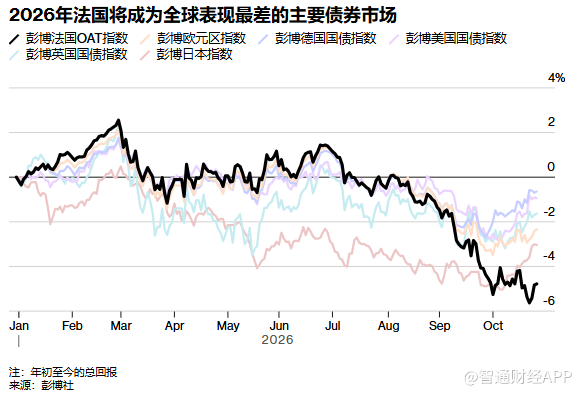
The current situation is still far from what it was when Greece's fiscal problems came to light back then. The additional yield required by investors holding French bonds compared to German bonds soared to 1.78 percent this month. The peak of similar indicators in Greece was over 35 percentage points. Moreover, while Greece was turned away from the bond market back then because buyers were deterred, France was still able to issue new bonds.
How does France's debt burden compare to Greece back then?
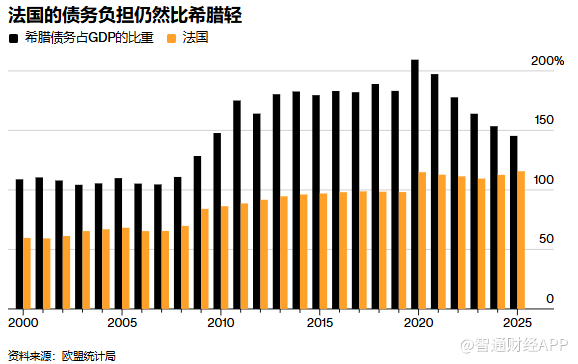
Relative to the size of the economy, France's debt burden is smaller. At the beginning of the 2009 crisis, Greece's debt was equivalent to about 129% of its GDP; it soared over the next few years, peaking at over 200% during the COVID-19 pandemic. But that ratio is falling rapidly, while France's rate is rising — currently at 119 percent, well above the Eurozone average of 87 percent.
The key difference is the size of the debt. France's influence in the global bond market far exceeds that of Greece back then, which is one reason why investment institutions such as Franklin Templeton are worried that a new round of crises may be more serious. France's debt of 3.6 trillion euros is about 10 times that of Greece in 2011. About 60% of bonds are held by investors outside of France, which means that the impact of the bond crisis will spread globally.
How does France's budget compare to Greece's?
France's deficit is significantly lower than it was at the beginning of the Greek crisis. The Athenian side's erroneous report on the size of the deficit shook investor confidence back then.
Although there is no evidence that France has misrepresented its challenges, the country has repeatedly failed to meet its public finance goals in recent years due to falling short of expectations, slowing growth, and difficulties for minority governments to obtain support to implement austerity measures.
Even the target of narrowing the deficit slightly to 5% of economic output this year (5.1% in 2025) has been abandoned; the French government currently expects a deficit rate of around 5.4%. France's tax revenue as a share of national output is among the highest in Europe, which means there is less room than elsewhere for further tax increases without compromising growth. Moreover, unlike France, Greece had widespread and systematic tax evasion problems back then, so restructuring tax collection and administration could bring greater potential for revenue growth.
Thus, France's focus is on spending — it accounts for 57% of economic output, second only to Finland in Europe. However, due to structural factors such as an aging population and rising medical costs, spending is on the rise, making it difficult to control.
Cutting welfare spending is also difficult due to political resistance. Last year's social security budget barely passed in Parliament, but the deficit far exceeded expectations, and the government suspended reforms to raise the retirement age.
Rodrigo Valdes, head of the International Monetary Fund's financial affairs department, said this month: “At the end of the day, France needs to discuss pension reform and, more broadly, how large-scale public services the government can provide.”
How do the economies of the two countries compare?
At the beginning of the Greek debt crisis, the economy depended heavily on tourism, shipping, and agriculture; the French economy was much larger and more diversified, covering high-profit industries such as luxury goods, aerospace, and finance. According to BNP Paribas, France is also a European leader in logistics and technology, which has led to a surplus in its trade in services.
Overall, France's current account — a broad measure of global trade and income flows — is close to balance. In 2009, Greece's current account deficit was about 12% of GDP.
France is also less dependent on fossil fuels than other countries, and most of its electricity comes from nuclear energy and renewable energy. The International Monetary Fund predicts that France's long-term growth rate will stabilize at around 1%, which will help offset fiscal challenges.
Is the French banking system more stable than Greece back then?
France's soaring sovereign risk has raised concerns about the health of its banks, as French banks usually hold large amounts of government debt. Falling bond prices may directly affect the solvency and financial strength ratios of lenders. But the Bank of France is more diversified, more resilient, more well-regulated, and has a strong capital buffer to protect its balance sheet in the event of losses.
This is quite different from the situation where Greece fell into a “vicious circle” back then. Greek banks used to hold large amounts of their government debt, and losses on these positions during the sovereign debt restructuring period almost exhausted their capital base. As a result, their ability to lend to businesses and households declined, and a deep recession led to a surge in non-performing loans, and the entire banking system required large-scale recapitalization.
What tools does the EU have to deal with the French crisis?
Compared to the sovereign debt crisis, the evolution of the Eurozone's structure is one of the most significant differences. Back then, when countries such as Greece were in trouble, governments created bailout mechanisms for the Eurozone from scratch, including the European Stability Mechanism (ESM). The mechanism has been used by Ireland, Portugal, Cyprus, and Greece, and can still provide loans in exchange for economic reforms, in addition to other tools.
The other line of defense is the European Central Bank. Then-President Mario Draghi made history by announcing in 2012 that the ECB would “do whatever it takes” to save the euro. This promise was later transformed into an unlimited bond-buying program called “Direct Currency Transactions” (OMT), although the program was never used and came with strict conditions.
After the COVID-19 pandemic, the ECB Governing Council introduced another similar tool. At the time, the ECB was preparing to raise interest rates, and Italian treasury yields soared and surpassed those of similar countries. This mechanism, called the “Transmission Protection Tool” (TPI), allows central bank officials to buy sovereign debt when they determine that market trends lack fundamental economic support and hinder the transmission of monetary policy.
Until now, the ECB has denied speculations that it is about to step in, and emphasized that it is France's responsibility to resolve the issue.
What are the similarities at the political level?
Although the chronology is different, there are political similarities between France in 2026 and Greece in 2009. In both countries, financial problems came as established parties disintegrated and populists prepared to take power.
In Greece, the traditional centre-right party was overthrown by left-wing activist Tsipras in 2015. In the final stages of the crisis, his confrontation with other EU member states almost forced Greece to leave the eurozone, and he eventually accepted drastic spending cuts as a condition for the third and final bailout plan. In France, far-right nationalist Le Pen is considered a popular candidate to succeed Macron in next year's general election, and many polls show that far-left leader Melanchon is in second place.