


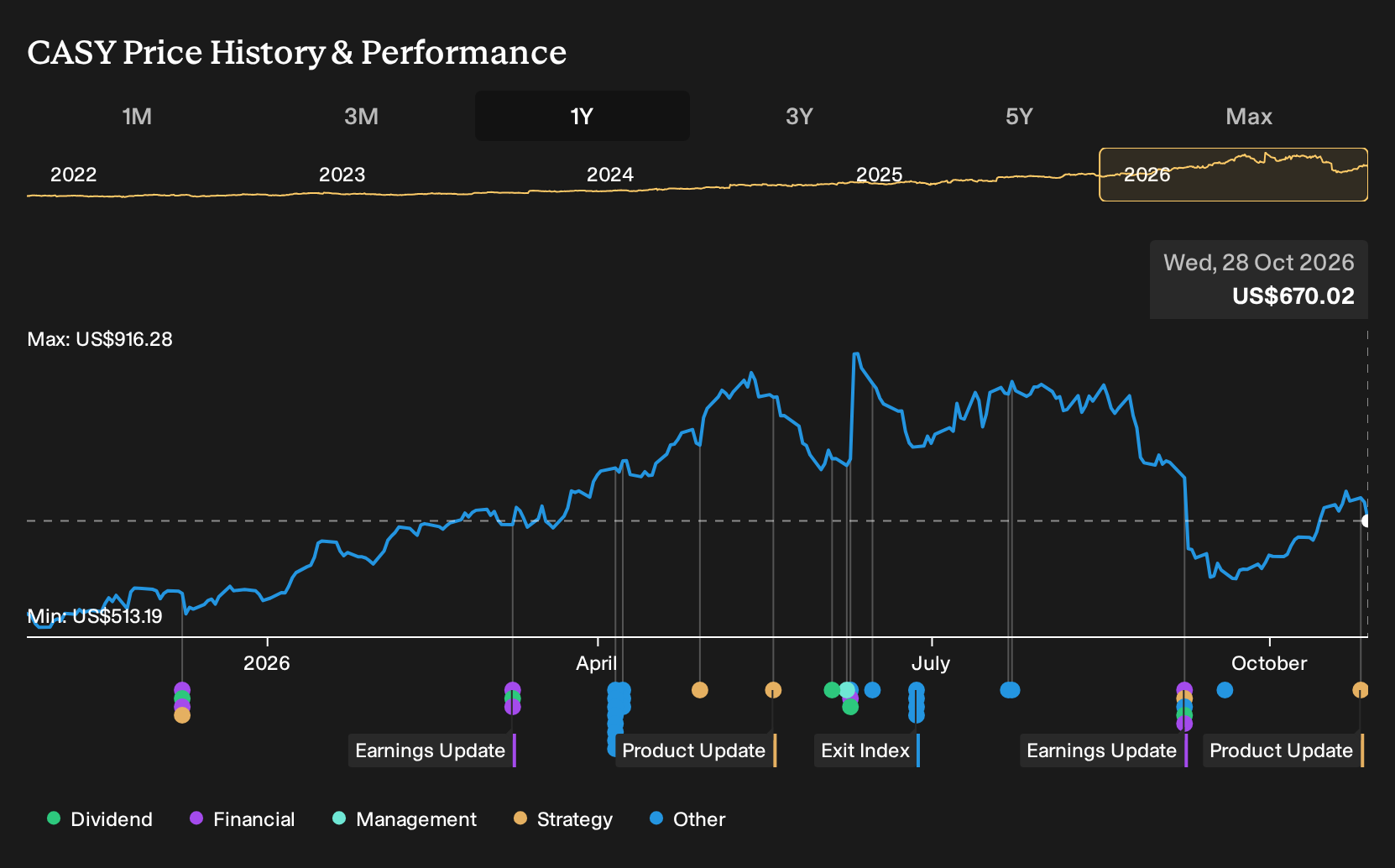
Casey’s General Stores spent the past year talking about store additions, food programs and digital upgrades, yet one concrete move kept grabbing attention: the decision to target at least 400 new locations over three years. Investors who held Casey's General Stores over the past year are up 27.1%, including dividends. If you were weighing a purchase back on 2025-10-28, what had to feel credible about that expansion story for this outcome to seem reasonable?
Casey's General Stores has already moved. See which of 26 high quality undervalued stocks still trade below our estimates.
The Argument You Would Have Been Weighing Up On Casey's General Stores
The shares cost US$532 at the start of the period, and anyone looking at Casey's General Stores then was really choosing between two credible stories.
The bullish narrative pointed to a Fair Value of US$571, a price level implied by assumptions such as 6.0% annual revenue growth and a future P/E of 32.9x over three years. That view leaned on store expansion, prepared foods, and digital investments as key drivers.
The bearish camp saw a Fair Value of US$450, reflecting worries that Fikes and CEFCO integration would strain margins. This view focused on acquisitions being earnings dilutive and the risk that higher interest, depreciation, and integration costs would weigh on results.
What The Evidence Did To The Casey's General Stores Thesis
The clearest development was Casey's General Stores pushing ahead with its 400 store plan through deals like Pak A Sak and ASAP, which backed the expansion-heavy bullish story. Reported Q1 2027 numbers showed revenue at US$5,678.336m and net income at US$273.72m, with net margin edging to 4.8% from 4.7%. The evidence cut both ways but leaned toward the optimistic case.
The lesson is straightforward. When a retailer promises growth from acquisitions and food programs, it can be useful to track store count additions, category level sales such as prepared foods, and the direction of net margin rather than only watching the share price.
What Casey's General Stores Price Already Assumes After A 27% Run
Casey's General Stores now trades at US$670. The selected Narrative places its Fair Value above that level and links the gap to how much faith you put in store growth and higher margin food and beverage categories doing the heavy lifting.
On this view, anyone buying today is really judging whether ongoing store conversions, prepared food momentum and technology driven cost control can deliver more EBITDA than the market currently credits.
"The main thing that has to go right is that Casey's continues to grow higher margin prepared food, beverages, and nicotine alternatives fast enough to offset category headwinds and rising operating expenses. Deployment of technology and AI tools in areas such as demand forecasting, real estate selection and field analytics, alongside a history of operating expenses growing about 600 basis points slower than EBITDA over the prior plan, provides a path for further operating expense leverage and EBITDA growth."
That disagreement has a full argument behind it. → Uncover the higher Fair Value this Narrative argues for
Where Casey's Growth Story Points Next
Casey's has focused attention on store additions and prepared food. That same shopper appetite for convenience is shaping other retailers too.
Big box chains are building out entertainment, specialty food and digital services. They are chasing the same customer who wants one quick stop.
One large operator has bundled amusement, niche beverages and online tools. It is using that bundle to keep people in its orbit longer.
If that model gains traction, convenience investors may need to watch how experiences and digital payments tug share of everyday spending.
That argument has a Narrative and a number behind it. → See the company one Narrative values 30% above its price
Have feedback on this article? Concerned about the content? Get in touch with us directly. Alternatively, email editorial-team@simplywallst.com