


Key Points
Like most other companies in this space, Blackstone pays its shareholders a recurring quarterly dividend.
Unlike most other names in the investment management industry, Blackstone’s dividend payments are neither predictable nor consistent, reflecting ever-changing net earnings.
This particular dividend-paying prospect has its pros and cons, but it also brings something to the table that could prove unusually important for the foreseeable future.
Stocks in the investment management industry are known for paying reliable dividends. And they should be. After all, these companies charge their clients a quarterly fee regardless of performance; revenue flows no matter how their portfolios perform. Indeed, some investment managers like Franklin Templeton and T. Rowe Price have solidified their businesses so well that they've committed to a minimum quarterly dividend payment... even when one quarter's earnings might not fully cover that payout.
Not Blackstone (NYSE: BX), though. This alternative investment management firm is one of only a handful of names in the business that pays out a preset percentage of the profits it manages to produce in any given quarter. Since its bottom line is forever changing, so too is its dividend payment.
Missed AI’s "Act 1"? Act 2 Could Be 15x Bigger. Most investors think they missed the AI boat because they didn't buy Nvidia in 2005. But according to our analysts, we’re only at the end of "Act 1"—the R&D phase. "Act 2" is the global rollout. Continue »
Built for recurring revenue
The money management business usually isn't a high-growth one. It is, however, a fairly consistent one.
Investment managers charge a small percentage-based fee on the amount of money they're managing for their customers, whether or not those customers are actually experiencing gains. More and bigger clients obviously translate into more revenue, but so does market growth that expands their clients' portfolio values. Conversely, a falling market reduces the value of the revenue-bearing assets under a firm's management. Market weakness can also prompt some customers to take their assets elsewhere, further reducing the asset base that ultimately generates revenue for a money manager. Since the market and investors' money tend to move rather slowly, management fees are reasonably predictable from one quarter to the next.

Image source: Getty Images.
Still, it's not perfectly consistent. The market always ebbs and flows at least a little, and operating costs are subject to some degree of change. That's why the dividend Blackstone pays -- a targeted 85% of any given quarter's distributable per-share earnings -- is at least a little different every quarter. Sometimes it's much different.
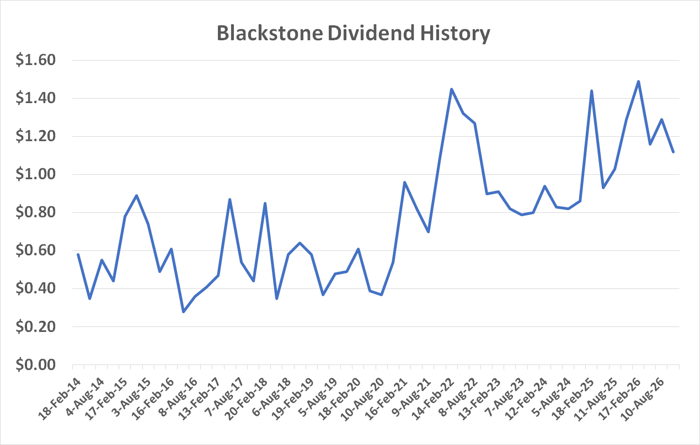
Data source: Blackstone. Chart by author.
Not right for every need, but better for some
This is a potential problem for investors needing a predictable amount of recurring dividend income -- a stake in Blackstone can't provide it. Look to a name like the aforementioned T. Rowe Price or Franklin Templeton for that sort of consistency.
Just understand the trade-off. Blackstone's dividend payments have also grown faster than most investment managers' over the past decade, though much more erratically. Shares of BX also offer greater potential for capital appreciation, even if they haven't made good on this promise of late.
That being said, perhaps the top reason to consider taking a stake in Blackstone right now isn't just its higher dividend yield or faster dividend growth. It's attractive here and now because it offers exposure to the alternative investment arena (private credit, real estate, etc.) at a time when the conventional publicly traded stock market is overvalued and may even be headed into something of a secular headwind. If nothing else, more kinds of diversification certainly can't hurt.
James Brumley has no position in any of the stocks mentioned. The Motley Fool has positions in and recommends Blackstone and T. Rowe Price Group. The Motley Fool has a disclosure policy.