


The restructuring of the foundation engineering industry in Hong Kong has moved from cyclical fluctuations to structural contraction. The total nominal value of private site projects completed by major contractors in 2025 fell 16.9% year on year, continuing the 15.9% year-on-year decline in the first quarter of 2026; the Construction Industry Council predicted that the total value of private projects in 2026/27 was about HK$90 billion, down 43% from the peak in 2018. Although the government's annual capital investment of around HK$120 billion forms a certain backbone, it is difficult to fully hedge against the contraction in private demand. At the same time, labor shortages are driving up subcontracting and construction costs. The cost rigidity of labor-intensive processes such as foundation engineering is particularly prominent, and the industry's gross margin center continues to decline.
The combination of shrinking demand and cost rigidity is simultaneously narrowing the profit buffer and capital operation space for small and medium-sized contractors, and is also making the listing arrangements for such companies more pragmatic. At this point, Hong Kong foundation engineering contractor Advance JV Group Limited (“Haina Construction”) publicly submitted an F-1 prospectus to the US SEC. It plans to issue 2.5 million shares of common stock at 1.5 to 2 US dollars each. The total amount raised is estimated to be about 5 million US dollars based on the upper limit of the issue price range.
Gross margin bucked the trend
According to the prospectus, the operating entity of Haina Construction is Hong Kong Haina Construction Co., Ltd., which changed its name in 2021 and focused on foundation engineering tracks. Its core business revolves around the entire foundation engineering chain: pile foundation, foundation support, foundation reinforcement, site clearance and earthwork allocation, and supporting geological drilling and geotechnical investigation. The company holds three types of special contractor licenses for foundation construction, site survey and site preparation issued by the Hong Kong Buildings Department, and has also obtained registration qualifications from the Construction Industry Council. Most of the upstream customers are general contractors and subcontractors for buildings and infrastructure projects in Hong Kong. The terminal owners are mainly government departments and public institutions, taking into account small and medium-sized private projects.
This is a typical local subcontractor in the Hong Kong segment. Its competitiveness is not its experience in construction management and control of small work spaces in high-density urban areas in Hong Kong, and its viability to switch flexibly between public works and private projects. This positioning determined its revenue volume ceiling: even in the best years, annual revenue was less than 10 million dollars.
According to financial data for the six months ended November 30, 2025 (mid-term of fiscal year 2025/26), the company fell into a “slight decline in revenue and a drop in net profit”; however, an in-depth breakdown of the profit statement structure revealed that the profitability of its core business did not deteriorate, and gross margin even bucked the trend.
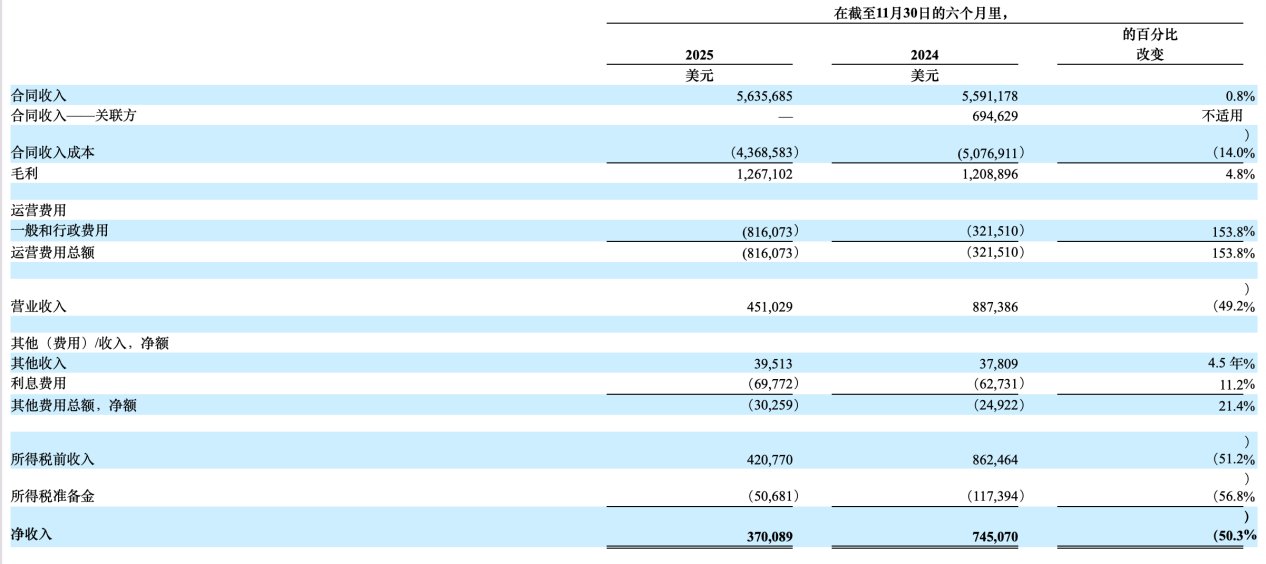
The company recorded contract revenue of US$5.6357 million during the reporting period, down 10.3% from US$6.285,800 in the same period last year. This decline is in line with the macro trend of continuing contraction in private site construction volume in Hong Kong. What is worth being wary of is a sudden shift in the income structure. In the same period of 2024, the company's contract revenue from related parties reached US$694,600, while in the same period in 2025, this indicator directly returned to zero. Excluding contributions from related parties, the company's revenue from independent third parties increased slightly from US$5.5912 million to US$5.6357 million (a slight increase of 0.8% over the previous year). On the one hand, this shows that the company has maintained a stable basic market in the external market after losing blood transfusions from related parties; but on the other hand, against the backdrop of the rapid contraction of the industry's overall market, there has been a lack of breakthroughs in the new volume market, and the revenue ceiling has already appeared.
Despite revenue pressure, Haina Construction's performance in the upper half of the profit statement was remarkable. During the reporting period, the cost of contract revenue fell sharply from US$5.07.69 million to US$4.368,600, a decrease of 14.0%, which was faster than the revenue decline. Driven by this, the company achieved gross profit of US$1,2671 million, an increase of 4.8% year over year; more importantly, gross margin bucked the trend of 19.2% in the same period last year to 22.5%.
At a time when labor shortages are driving up industry subcontracting and construction costs, the company's gross margin is not falling but rising, reflecting two positive operating signals: first, the company is more restrained in project selection and has abandoned low-profit projects with “bloodshed”; second, subcontractor management and internal cost control (such as material procurement and optimization of construction work efficiency) have achieved substantial results. This shows that the cost moat of Heiner architecture in subdivided tracks still exists.
The biggest turning point in financial performance came on the operating expenses side. During the reporting period, the company's general and administrative expenses (G&A) surged from US$32.15 million in the same period last year to US$8161,000, a sharp increase of 153.8% over the same period last year. Dragged down by this, the company's operating profit shrunk sharply from 887,400 US dollars to 451,000 US dollars, almost falling short.
In terms of non-operating income and expenditure, the company is under certain pressure. Interest expenses were recorded in the reporting period of US$69,800, an increase of 11.2% over the previous year. Against the backdrop of the Federal Reserve's high interest rate environment and high local financing costs in Hong Kong, asset-heavy and long-term projects such as foundation engineering take up a huge amount of working capital, and the rigid rise in interest expenses directly erodes meager operating profits. In addition, net other expenses rose 21.4% year over year to $30,300.
Due to the combined effects of the above factors, the company's pre-income tax revenue fell 51.2% year on year to US$420,800, and income tax reserves fell from US$117,400 to US$50,700. In the end, net profit was recorded at US$371,000, down 50.3% from US$745,500 in the same period last year, and net profit margin narrowed from 11.9% to 6.6%.
New business “surprise” savior
Although gross margin bucked the trend, judging from the two-way dismantling of revenue and costs, Haina Construction's traditional core business is facing significant headwinds. The good news, however, is that the new business changed the company's revenue landscape in a very short period of time.
As the company's absolute basic market for a long time, revenue from foundation engineering services — fixed price contracts fell sharply from US$6.284,500 in the same period last year to US$4.885 million, a sharp drop of 22.4% over the previous year. On the cost side, the cost of this operation fell from US$5.076 million to US$3.962 million, a decrease of 21.9%.

This data intuitively reflects the macro-reality of shrinking demand for private site projects in Hong Kong. Under the fixed total price model, the contractor bears the full risk of construction delays and fluctuations in raw material prices. At a time when labor is scarce and costs are rigid, Haina Construction has apparently voluntarily abandoned some fixed cost orders with high advance pressure, meager profits, and even the risk of loss in order to avoid the cash flow trap of “taking orders and finding death.”
Against the backdrop of a sharp decline in fixed price contracts, the company added basic engineering services - unit price contract business, which recorded revenue of 377,700 thousand US dollars and costs of 3192 million US dollars during the period. Unit price contracts (usually settled according to actual project volume) can effectively avoid the risk of material and labor cost fluctuations, and transfer part of the cost overexpenditure pressure to Party A. Although initially small, this marks a pragmatic step in the company's risk exposure management.
The most notable change comes from basic engineering consulting services. The sector's revenue exploded from only $1,283 in the same period last year to $386,500, an increase of over 30,000 percent). It was this $370,000 increase in the unit price contract, compounded by an increase of 380,000 US dollars in consulting, that just kept the decline in the company's total revenue in a less unimpressive position.
Preliminary analysis indicated that Haina's overall gross margin bucked the trend from 19.2% to 22.5% during the construction period. Combined with business disassembly data, this is due to subsidies for high-margin new businesses. During the period, the gross margin of the fixed-price contract business, which accounted for the absolute majority, did not increase; instead, its gross margin fell slightly from 19.2% to 18.8%; its gross profit contribution fell sharply from US$1.25,500 to US$916,500.
This shows that in an environment where overall project unit prices in the industry are under pressure, the bargaining power of even established subcontractors like Haina Construction has been squeezed in the traditional construction process, and absolute profit margins are being reduced.
The company's overall gross margin jumped 3.3 percentage points to 22.5%, thanks entirely to the impressive gross margin of 77.4% for infrastructure engineering consulting services. With less than 7% of total revenue, the business contributed $2991,000 in gross profit, accounting for 23.6% of the company's total gross profit ($1,2671 million). Consulting services are a typical asset-light, high-barrier business. They do not involve heavy machinery scheduling or heavy labor dependency, and the marginal cost is extremely low. Haina Construction extended its business chain to upstream survey, design, and project management consulting, which not only earned high added value, but also effectively hedged the risk of construction side profits being eroded.
Based on the above dismantling, Haina Construction's future growth space no longer depends on how many “piling up” jobs it can take on, but on the depth and breadth of its business structure transformation. In the Hong Kong/US stock market, pure construction subcontractors usually only get extremely low price-earnings ratios, while engineering consulting and design companies have a significant advantage in valuations. If Haina Construction continues to expand its consulting services sector, it will reshape its valuation logic. However, the jump from $1,283 to $380,000 can be seen as “breaking the ice,” but moving from $380,000 to the multi-million dollar level requires strong interprofessional team building and external market expansion capabilities. In the short term, the business base is too small to support the company's leapfrog development.
In summary, Haina Construction's mid-term business performance shows the survival wisdom of a regional SME at the bottom of the cycle: filling the traditional construction revenue gap with high-margin consulting services and hedging the risk of fixed costs with flexible unit price contracts. Its future growth space depends on whether it can solidify the occasional outbreak of consulting business into a normalized ability.