


- Texas Instruments reported third quarter 2026 sales of US$6,055 million and net income of US$2,425 million, with diluted EPS of US$2.62. The company guided fourth quarter revenue to a range of US$5.80 billion to US$6.30 billion, with EPS of US$2.45 to US$2.79.
- The earnings update highlighted broad demand from industrial, automotive and data center customers. This supports higher factory loading and reinforces Texas Instruments' focus on 300 millimeter manufacturing efficiency.
- We will now look at how Texas Instruments' broad based third quarter strength may reshape its longer term investment narrative for investors.
Scan how Texas Instruments' acquisition driven bond raise compares with other chip and hardware players by lining up the pre-vetted 54 AI infrastructure stocks now in your watchlist.
Texas Instruments Investment Narrative Recap
To own Texas Instruments, you need to believe its heavy investment in 300 millimeter fabs and its broader analog and embedded portfolio translate into steady demand from industrial, automotive and data center customers. The current operating story focuses on keeping those factories full while integrating Silicon Labs and maintaining healthy gross margins and free cash flow.
The key near term factor is whether industrial and automotive orders, along with data center spending on AI racks, remain strong enough to absorb the new capacity. The biggest risk is underutilized fabs, which could leave Texas Instruments with higher depreciation and weaker profitability. The recent earnings beat and guidance provide some support but do not fully remove that risk.
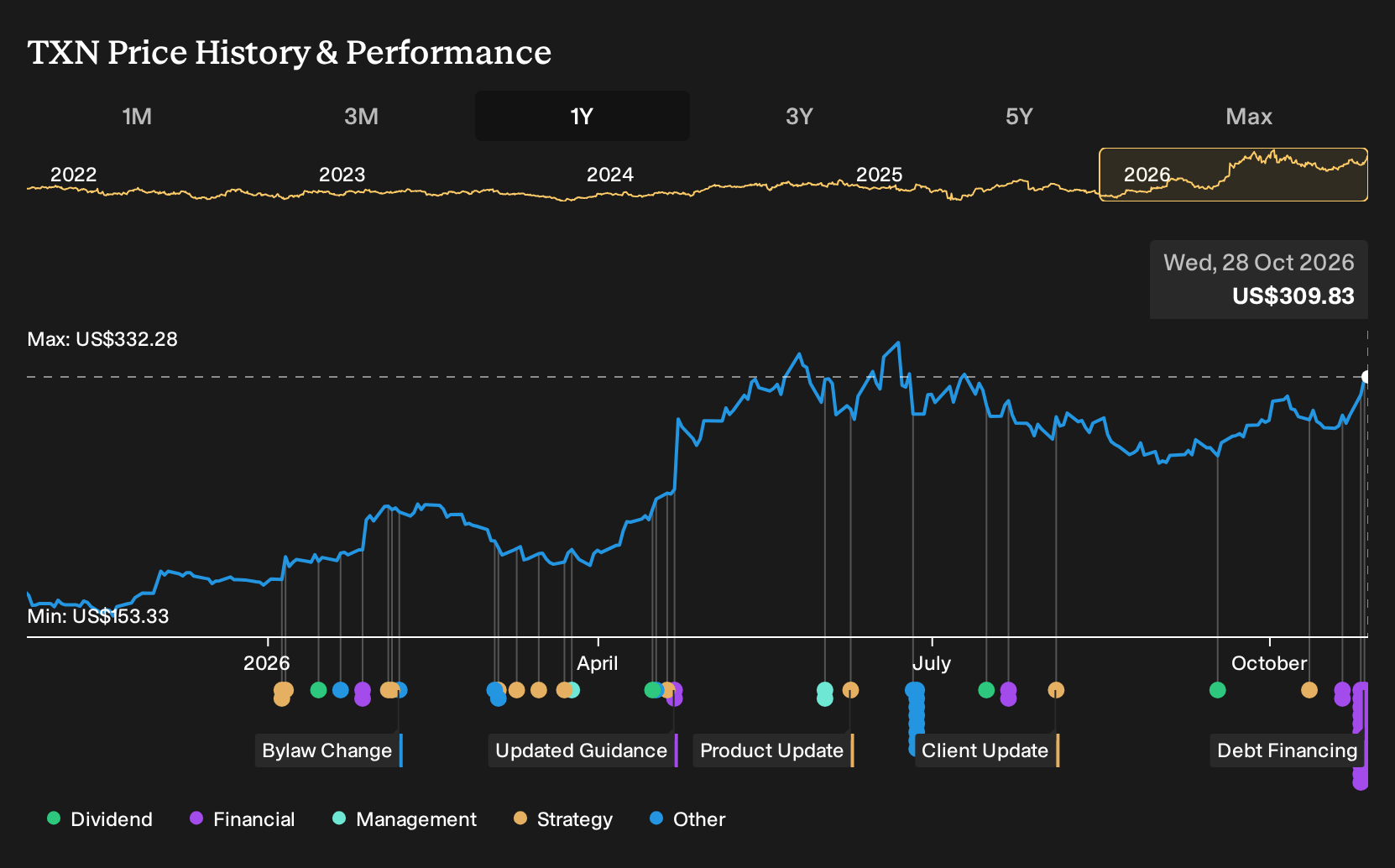
The clearest recent move tied to this story is the US$2.0b senior unsecured notes offering, with maturities from 2028 to 2036, that Texas Instruments expects to use to fund part of the Silicon Labs acquisition. That deal extends the embedded and wireless side of the portfolio rather than fundamentally changing the analog-heavy model.
For you as an investor, the question is whether adding debt for Silicon Labs strengthens the long term case around factory loading and end market breadth, or instead adds financial risk if demand or AI-driven data center orders weaken. Execution on integrating Silicon Labs and keeping fabs efficiently utilized is central to the next stage of the Texas Instruments thesis.
Texas Instruments Through the Analyst Lens
Analysts are effectively sketching a higher gear for Texas Instruments over the next several years, but the sketch comes with some bold assumptions that you need to weigh for yourself. They see the business lifting revenue at about 15.0% a year and widening profit margins from 34.1% today to 42.9% by 2029, which is a big jump for a company already operating at scale. That kind of step up in profitability would rest on Texas Instruments keeping its 300 millimeter fabs well used, integrating Silicon Labs cleanly and holding pricing power in analog and embedded markets that can turn lumpy when customers adjust inventory.
The earnings bridge is just as important. Consensus points to earnings of US$13.5b by around 2029, compared with US$7.1b today. That is roughly a 90% increase in absolute profit over a few years, even before you think about any share count creep that analysts expect at about 0.59% per year. For you, the key question is not whether that end number looks attractive in isolation. The real question is whether you are comfortable that industrial, automotive and data center demand can support almost doubling earnings while Texas Instruments absorbs higher depreciation from its factories and adds Silicon Labs to the mix.
The P/E assumptions show how much faith is already embedded in the current set up. To align with the analyst script, Texas Instruments would be trading on roughly 32.0x those 2029 earnings, down from about 36.1x today and below the cited US semiconductor industry multiple of 45.9x. That still leaves you paying a premium against many mature analog peers for the idea that margin expansion and consistent 15.0% revenue growth will show up. A lower future P/E in the model does not necessarily signal a cheaper entry point for you today. It just reflects that the forecast earnings base is much higher in the spreadsheet.
Price targets illustrate how wide the range of views has become. The consensus target sits at US$336.86, with the most optimistic at US$400.0 and the most cautious at US$250.0, compared with a recent share price around US$279.50. That implies about 17.0% upside to the midpoint of analyst opinions, yet it also means a material share of the Street already sees the stock as roughly fully valued or even stretched. When you see that spread, it usually signals that investors are debating core issues like utilization of new fabs, durability of AI data center orders and the impact of higher depreciation more than quibbling over small forecasting differences.
The revenue and earnings line items used in those targets are explicit. To land at that US$336.86 target, the consensus case assumes that by 2029 Texas Instruments will be generating about US$31.5b in annual revenue and US$13.5b in earnings. Those numbers connect directly to the factory buildout and end market breadth that management highlights. To get comfortable, you would want to think about how much of that US$31.5b is tied to industrial automation trends, how much leans on greater semiconductor content in vehicles and how much depends on AI heavy data center spending, then decide how resilient each bucket looks to you.
Pulling all this together into a personal view does not require replicating a discounted cash flow model. Treat the analyst framework as a checklist. If you think 15.0% yearly revenue growth is too aggressive for a company of Texas Instruments' size, or believe margins plateau before hitting 42.9%, then the implied US$31.5b revenue and US$13.5b earnings figures in 2029 may look ambitious. If you instead see the factory investments, Silicon Labs integration and AI infrastructure exposure as enough to support those numbers, then the current valuation and P/E multiple may look more reasonable. Either way, grounding your own expectations against these assumptions helps you avoid relying blindly on price targets that already bake in a specific future.
Texas Instruments' narrative projects US$31.5b revenue and US$13.5b earnings by 2029. This rests on 15.0% yearly revenue growth and an earnings increase of about US$6.4b from US$7.1b today.
Uncover why Texas Instruments' fair value indicates a 9% potential upside to its current price that may not last much longer.
Exploring Other Perspectives
One alternate take focuses on debt risk rather than factory upside. The most bearish analysts, using pre earnings data, were working off about US$26.6b of 2029 revenue and US$10.4b in earnings, well below consensus. You can read that as a warning that Texas Instruments' new US$2.0b bond stack could squeeze future flexibility more than the optimistic camp expects. These views were formed before the latest bond pricing and results, so treat them as a starting point and explore how the story might shift from here.
Explore 6 other Texas Instruments fair value estimates, including one that suggests as much as 31% downside from the current price!
Decide For Yourself
Don't just follow the ticker. Dig into the data and build a conviction that's truly your own.
- A great starting point for your Texas Instruments research is our analysis highlighting 4 key rewards and 1 important warning sign that could impact your investment decision.
- See our latest analysis for Texas Instruments. The report includes a comprehensive fundamental analysis summarized in a single visual, the Snowflake, making it easy to evaluate Texas Instruments' overall financial health at a glance.
Looking For More Investment Ideas Beyond Texas Instruments?
If the Texas Instruments story has sharpened your thinking and you want to pressure test that framework on other opportunities, the Simply Wall St Screener can help you quickly filter for stocks that better fit your risk, income or quality preferences.
- If capital preservation and steady compounding matter most to you, start by focusing on resilient businesses through a 32 resilient stocks with low risk scores that keep overall portfolio volatility in check.
- If reliable income is a priority, narrow your search to mature companies with robust payout profiles using our 6 dividend fortresses that emphasise higher yielding, established payers.
- If you prefer hunting for earlier stage potential, concentrate on under followed quality stories by scanning a 19 high quality undiscovered gems that filters for stronger fundamentals and cleaner balance sheets.
Have feedback on this article? Concerned about the content? Get in touch with us directly. Alternatively, email editorial-team@simplywallst.com