



Building materials company Builders FirstSource (NYSE:BLDR) announced better-than-expected revenue in Q3 2026, but revenue fell by 2.2% year on year to $3.85 billion. The company’s full-year revenue guidance of $14.4 billion at the midpoint came in 1.1% above analysts’ consensus estimates. Its non-GAAP profit of $1.51 per share was 44.8% above analysts’ consensus estimates.
For more on Builders FirstSource, read our free full research report.
Builders FirstSource (BLDR) Q3 2026 highlights:
- Revenue $3.85 billion vs S&P analysts’ consensus estimates of $3.75 billion (2.2% year-on-year decline, 2.8% beat)
- Adjusted EPS $1.51 vs S&P analysts’ consensus estimates of $1.04 (44.8% beat)
- Adjusted EBITDA $311.1 million vs analysts’ consensus estimates of $298.6 million (8.1% margin, 4.2% beat)
- Revenue guidance The company reconfirmed its revenue guidance for the full year of $14.4 billion at the midpoint
- EBITDA guidance $1.1 billion at the midpoint for the full year, above analysts’ consensus estimates of $1.06 billion
- Operating margin 2.6%, down from 5.8% in the same quarter last year
- Free cash flow margin 1.9%, down from 11.7% in the same quarter last year
- Market capitalization $6.01 billion
“Our third quarter results reflect the disciplined execution of our team and the resilience of our platform. While housing market conditions remain challenging, we are focused on what we can control: delivering solutions that help builders operate more efficiently and investing in value-added products and technology to drive productivity and fuel growth. These efforts are reinforcing our leadership position and our role as the partner of choice for homebuilders,” commented Peter Jackson, CEO of Builders FirstSource.
Revenue growth
Reviewing a company’s long-term revenue performance reveals insights into its quality. Any business can deliver a good quarter or two, but the best consistently grow over the long haul. Builders FirstSource struggled to consistently generate demand over the last five years as its revenue dropped at a 4.2% annual rate. That underwhelming result is a sign of poor business quality.
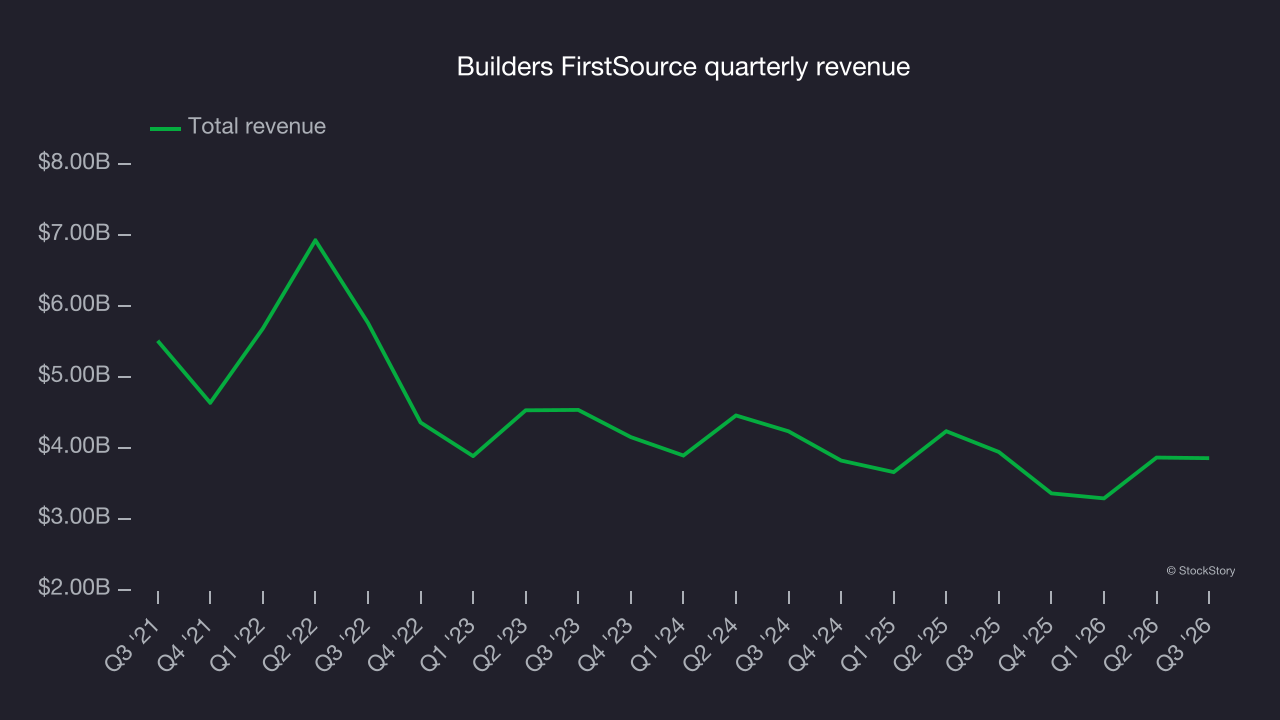
Long-term growth matters most, but within industrials, a half-decade historical view may miss cycles, industry trends or a company capitalizing on catalysts such as a new contract win or a successful product line. Builders FirstSource’s recent performance shows its demand remained suppressed as its revenue has declined by 7.4% annually over the last two years. 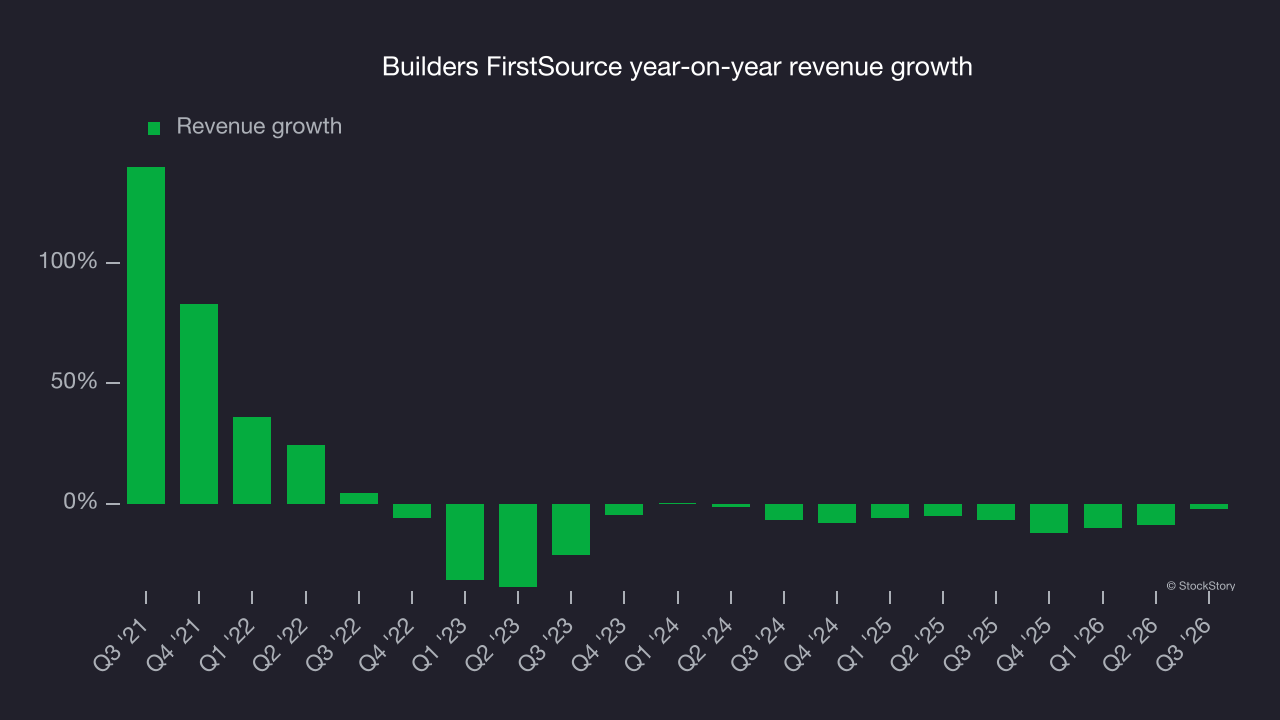
Builders FirstSource also breaks out the revenue for its most important segments, Manufactured products and Windows, doors & millwork, which are 21.9% and 24.3% of revenue. Over the last two years, Builders FirstSource’s Manufactured products revenue (floors, wall panels and engineered wood) averaged 12.5% year-on-year declines while its Windows, doors & millwork revenue (self-explanatory) averaged 8.1% declines. 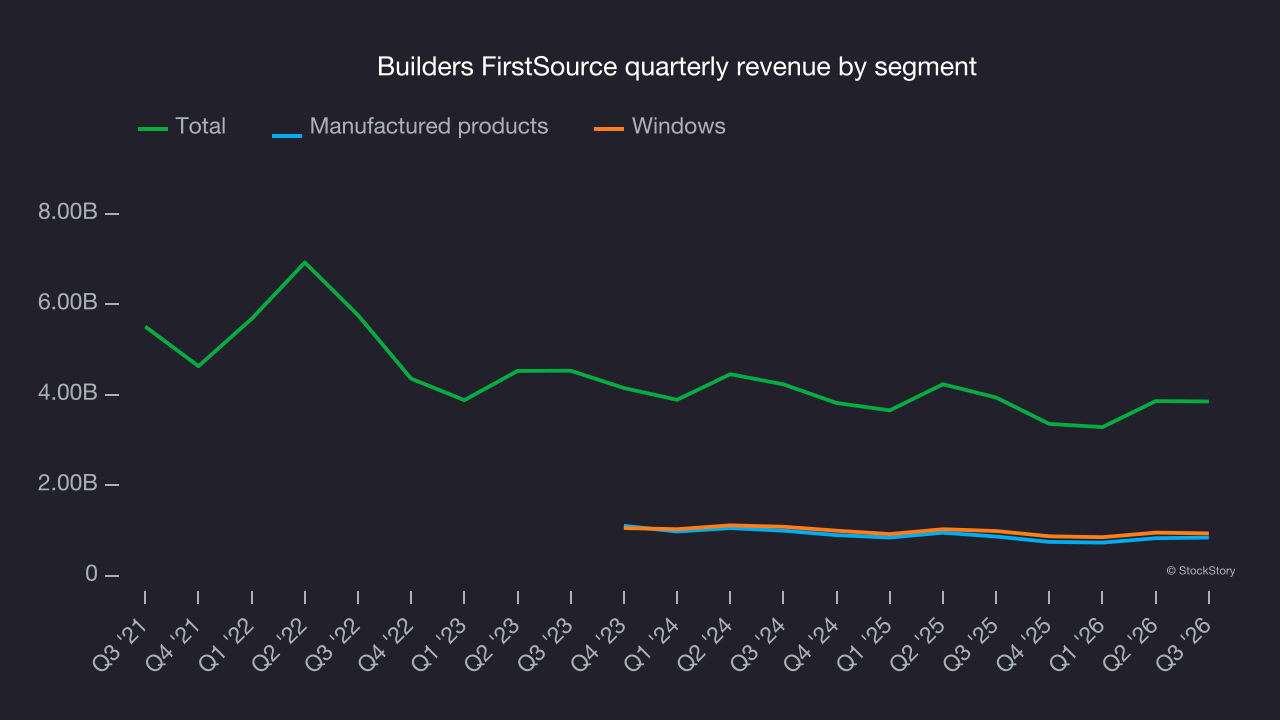
This quarter, Builders FirstSource’s revenue fell by 2.2% year on year to $3.85 billion but beat Wall Street’s consensus estimates by 2.8%.
Looking ahead, sell-side analysts expect revenue to remain flat over the next 12 months, according to S&P. Although this projection suggests its newer products and services will drive better top-line performance, it is still below the sector average.
Operating margin
Operating margin is a key measure of profitability. Think of it as net income – the bottom line – excluding the impact of taxes and interest on debt, which are less connected to business fundamentals.
Builders FirstSource has managed its cost base well over the last five years. It demonstrated solid profitability for an industrials business, producing an average operating margin of 10.6%.
Looking at the trend in its profitability, Builders FirstSource’s operating margin decreased by 14.7 percentage points over the last five years. Even though its historical margin was healthy, shareholders will want to see Builders FirstSource become more profitable in the future.
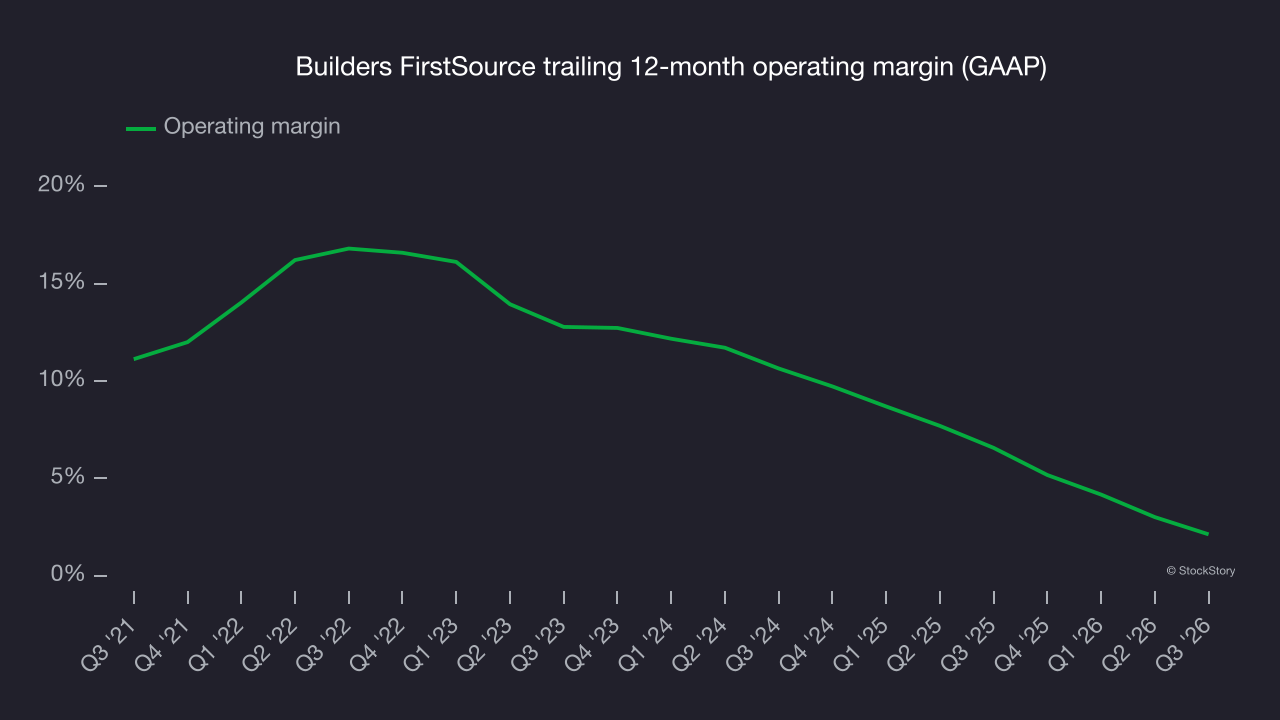
This quarter, Builders FirstSource generated an operating margin of 2.6%, down 3.2 percentage points year on year. Its operating margin decreased more than its gross margin, suggesting it was less efficient because expenses such as marketing, R&D and administrative overhead increased.
Earnings per share
Revenue trends explain a company’s historical growth, but the long-term change in earnings per share (EPS) points to the profitability of that growth. For example, a company could inflate its revenue through excessive spending on advertising and promotions.
Builders FirstSource’s EPS declined by 13.7% annually over the last five years, more than its revenue. This indicates the company struggled because its fixed cost base made it difficult to adjust to shrinking demand.
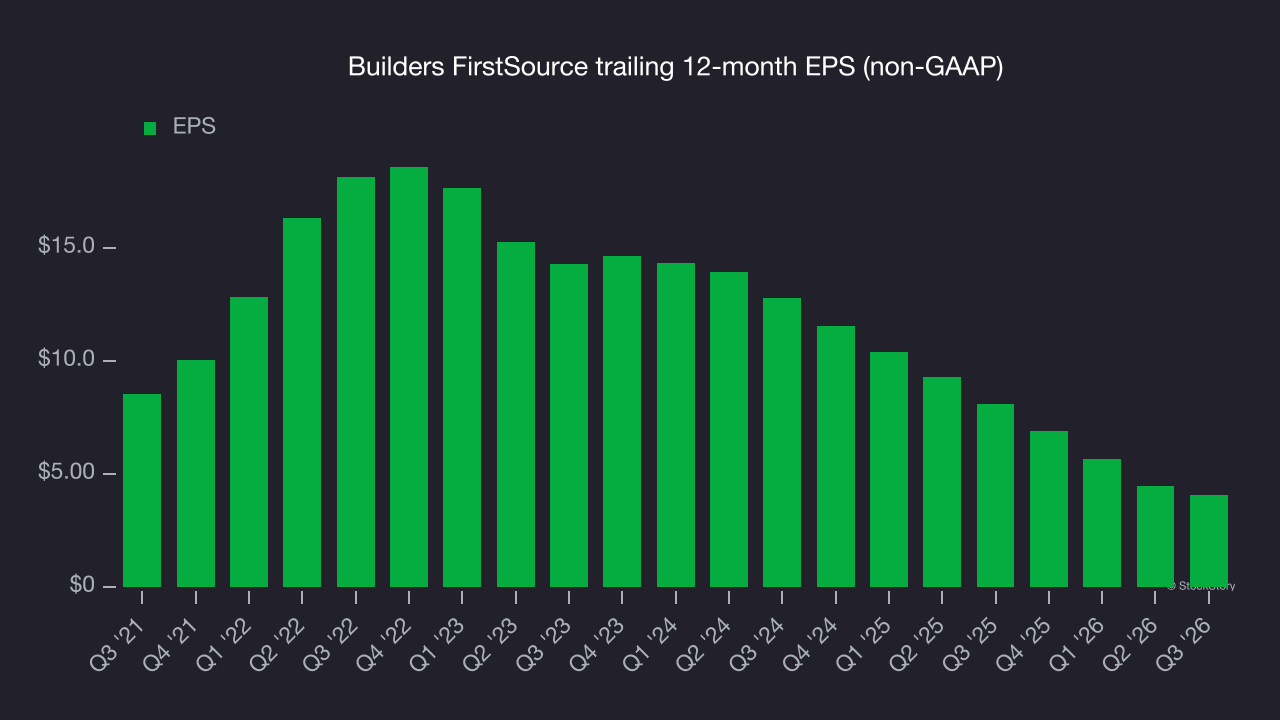
We can take a deeper look into Builders FirstSource’s earnings to better understand the drivers of its performance. As we mentioned earlier, Builders FirstSource’s operating margin declined by 14.7 percentage points over the last five years. This was the most relevant factor (aside from the revenue impact) behind its lower earnings; interest expenses and taxes can also affect EPS but don’t tell us as much about a company’s fundamentals.
Like with revenue, we analyze EPS over a shorter period to see if we are missing a change in the business.
For Builders FirstSource, its two-year annual EPS declines of 43.5% show it’s continued to underperform. The results were poor across both periods.
In Q3, Builders FirstSource reported adjusted EPS of $1.51, down from $1.88 in the same quarter last year. Despite falling year on year, the result comfortably beat analysts’ consensus estimates. Over the next 12 months, Wall Street expects Builders FirstSource’s full-year EPS to shrink by 19.2% from $4.07 to $3.29, according to S&P.
Key takeaways from Builders FirstSource’s Q3 results
Builders FirstSource delivered a solid quarter, with EPS beating analysts’ consensus estimates and full-year EBITDA guidance topping Wall Street’s consensus. Shares surged 5.1% to $58.70 immediately after the report.
Builders FirstSource had a solid quarterly earnings result, but that alone does not determine whether the stock is a good investment. The latest quarter is only one piece of the longer-term business quality puzzle. Quality, combined with valuation, can help determine whether the stock is a buy. For more on those factors, read the full research report here (it’s free).