


Biopharmaceutical company Incyte Corporation (NASDAQ:INCY) reported revenue ahead of Wall Street’s expectations in Q3 2026, with revenue up 14% year on year to $1.56 billion. On the other hand, the company’s full-year revenue guidance of $5.26 billion at the midpoint came in 11.3% below analysts’ consensus estimates. Its non-GAAP loss of $3.60 per share was 6.9% above analysts’ consensus estimates.
For more on Incyte, read our free full research report.
Incyte (INCY) Q3 2026 highlights:
- Revenue $1.56 billion vs S&P analysts’ consensus estimates of $1.46 billion (14% year-on-year growth, 6.5% beat)
- Adjusted EPS -$3.60 vs S&P analysts’ consensus estimates of -$3.87 (6.9% beat)
- Revenue guidance The company lifted its revenue guidance for the full year to $5.26 billion at the midpoint from $5.20 billion, a 1.2% increase
- Operating margin -45.5%, a decline from 32.5% in the same quarter last year
- Market capitalization $23.69 billion
“Our third quarter was marked by strong commercial performance, meaningful pipeline progress and important regulatory achievements,” said Bill Meury, Chief Executive Officer, Incyte. “Net sales growth was strong in both the U.S. and internationally, creating a durable core business beyond Jakafi. At the same time, we are advancing a pipeline led by a CALR-targeted monoclonal antibody for myeloproliferative neoplasms, a novel Protein S modulator for von Willebrand disease, a KRAS G12D inhibitor for pancreatic and colorectal cancers and a TGFβR2×PD-1 bispecific antibody for colorectal cancer. Each represents a significant opportunity for Incyte, and together they give us multiple paths to growth beyond 2029. With important clinical, regulatory and commercial catalysts ahead, we are well positioned to create long-term value for patients and shareholders.”
Revenue growth
Examining a company’s long-term performance can provide clues about its quality. Any business can have short-term success, but a top-tier one grows for years. Incyte’s 15.6% annualized revenue growth over the last five years was solid. Its growth surpassed that of the average healthcare company and shows its offerings resonate with customers.
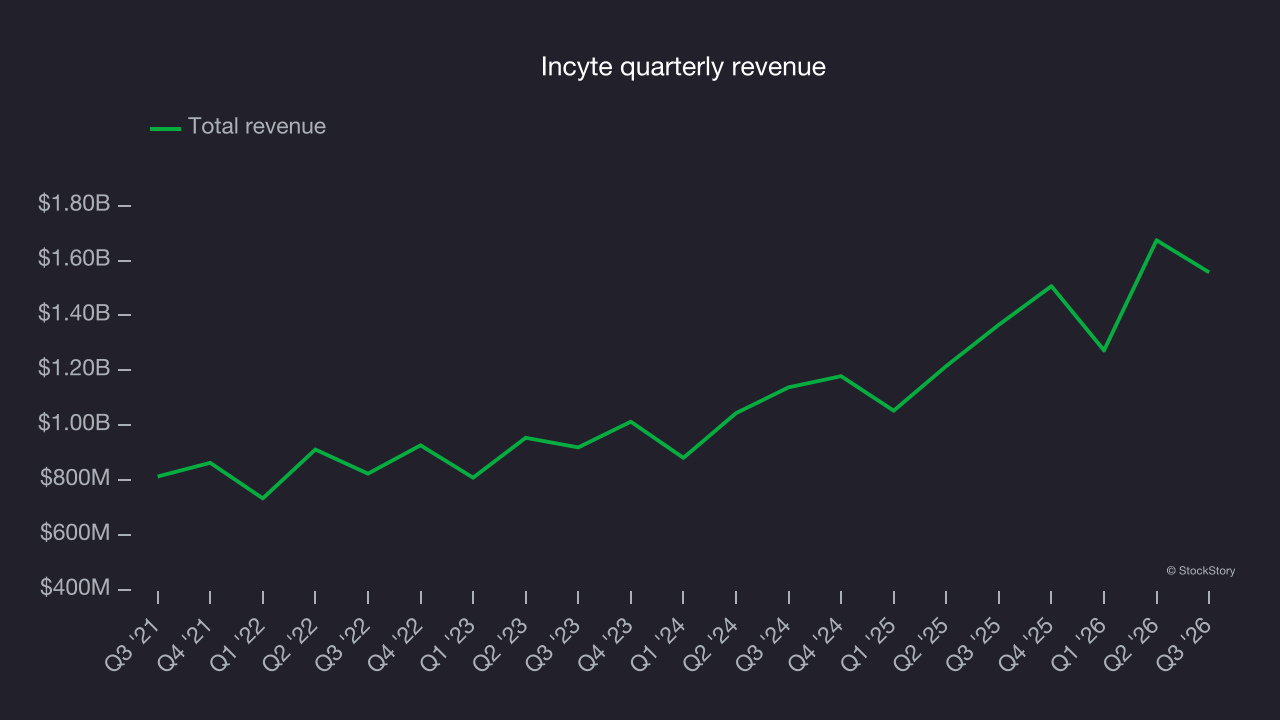
Long-term growth is the most important, but within healthcare, a half-decade historical view may miss new innovations or demand cycles. Incyte’s annualized revenue growth of 21.4% over the last two years is above its five-year trend, suggesting its demand was strong and recently accelerated. 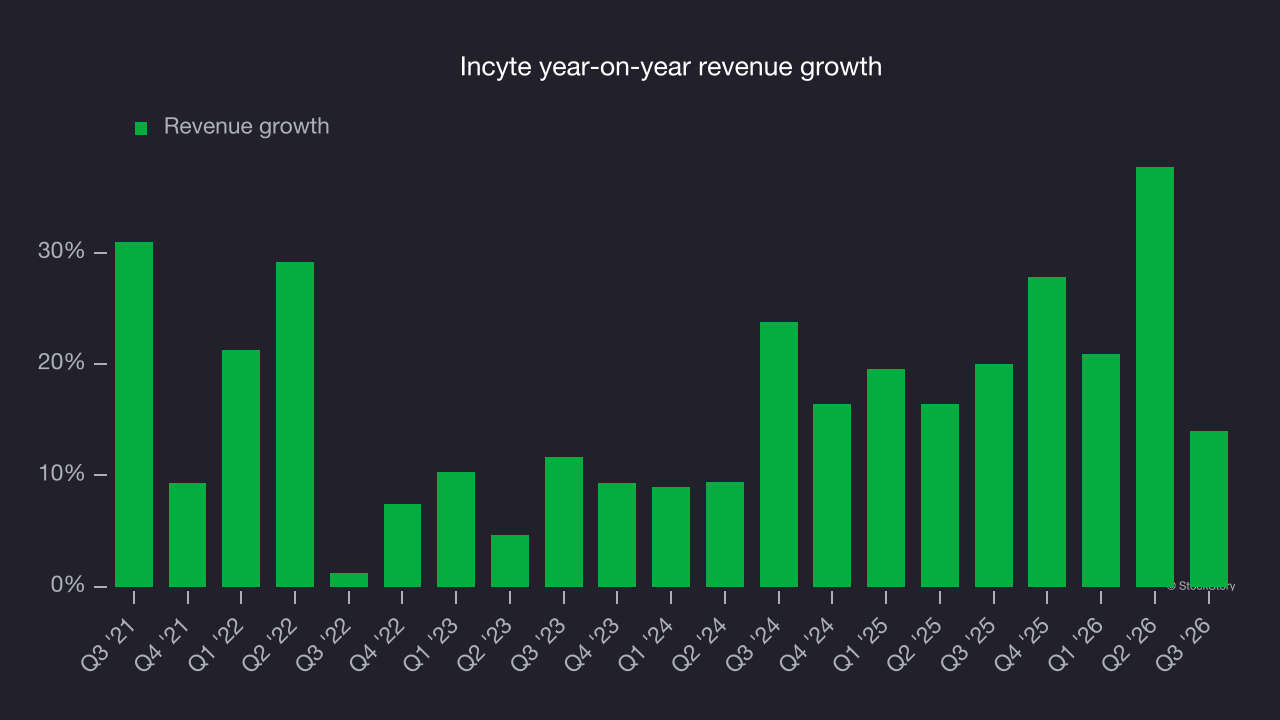
This quarter, Incyte reported year-on-year revenue growth of 14%, and its $1.56 billion of revenue exceeded Wall Street’s consensus estimates by 6.5%.
Looking ahead, sell-side analysts expect revenue to remain flat over the next 12 months, according to S&P, a deceleration versus the last two years. This uninspiring projection indicates its products and services will face some demand challenges. Still, the company is performing well on other measures of financial health.
Adjusted operating margin
Adjusted operating margin is one of the best measures of profitability because it shows how much a company earns after subtracting all core expenses, like marketing and R&D. It also removes various one-time costs to paint a better picture of normalized profits.
Incyte has managed its cost base well over the last five years. It demonstrated solid profitability for a healthcare business, producing an average adjusted operating margin of 19.9%.
Incyte’s adjusted operating margin decreased by 9.3 percentage points over the last five years, but it rose by 7.7 percentage points on a two-year basis. Incyte remains appealing, but a sustained margin recovery is still needed.
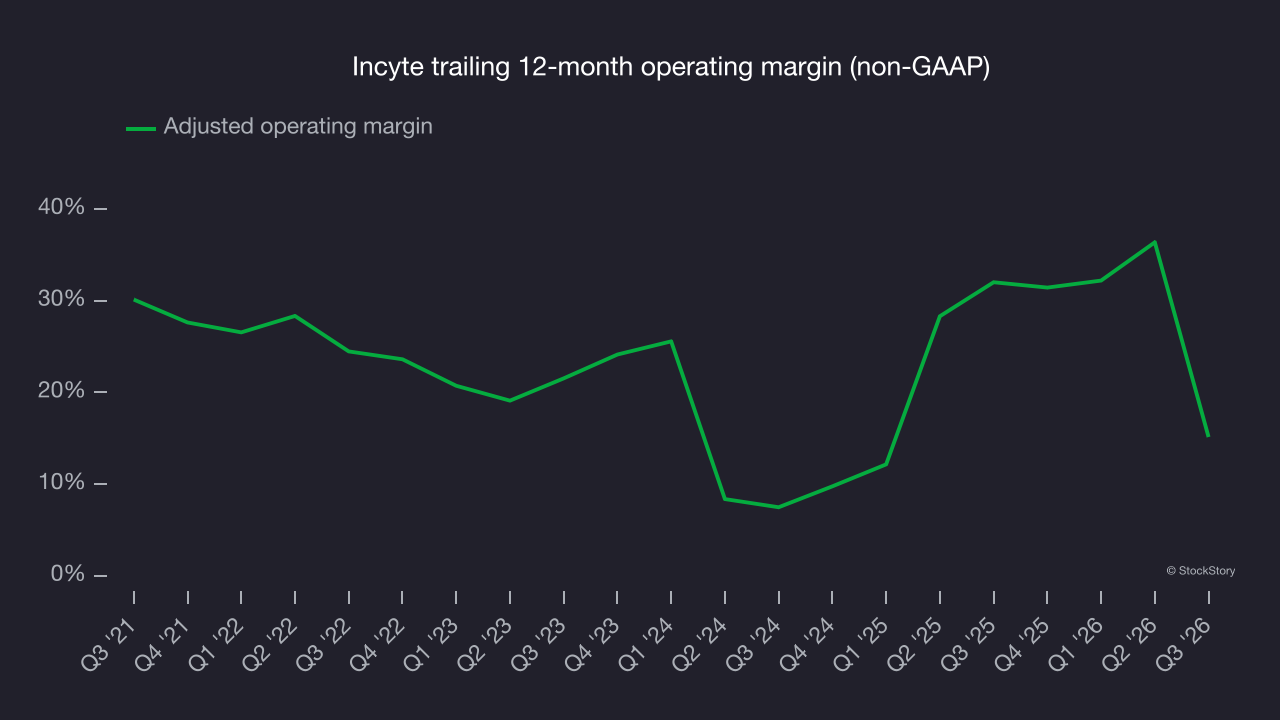
In Q3, Incyte generated an adjusted operating margin of negative 45.5%, down 82 percentage points year on year. This contraction shows it was less efficient because its expenses grew faster than its revenue.
Earnings per share
Revenue trends explain a company’s historical growth, but the long-term change in earnings per share (EPS) points to the profitability of that growth. For example, a company could inflate its revenue through excessive spending on advertising and promotions.
Incyte’s EPS declined by 2.8% annually over the last five years while its revenue grew by 15.6%. The company became less profitable on a per-share basis as it expanded due to non-fundamental factors such as interest expenses and taxes.
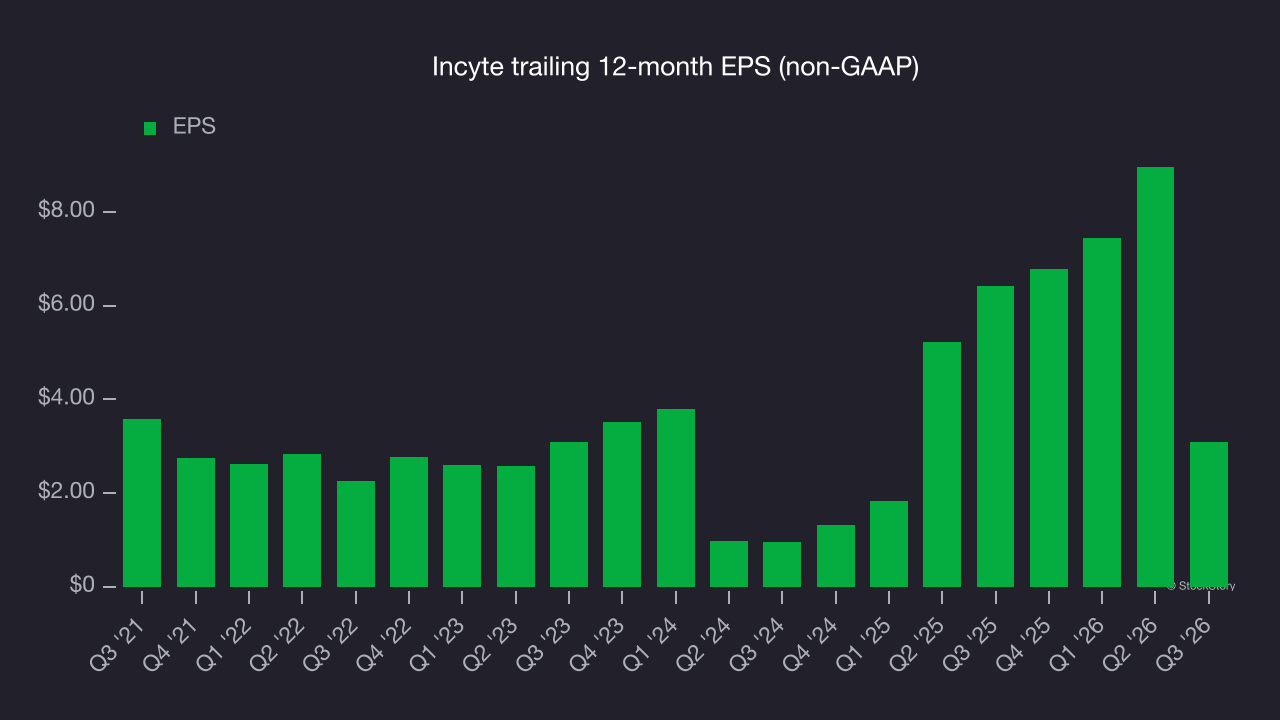
A closer look at Incyte’s earnings helps explain its performance. As mentioned earlier, Incyte’s adjusted operating margin declined by 9.3 percentage points over the last five years. This was the most relevant factor (aside from the revenue impact) behind its lower earnings; interest expenses and taxes can also affect EPS but don’t tell us as much about a company’s fundamentals.
In Q3, Incyte reported adjusted EPS of negative $3.60, down from $2.26 in the same quarter last year. Despite falling year on year, EPS beat analysts’ consensus estimates by 6.9%. Over the next 12 months, Wall Street expects Incyte’s full-year EPS to grow 161% from $3.10 to $8.10, according to S&P.
Key takeaways from Incyte’s Q3 results
Incyte’s Q3 was mixed: revenue came in well above analysts’ consensus estimates and EPS also topped expectations, but full-year revenue guidance fell short. Shares edged higher 1.1% to $118.10 immediately after the results.
The latest quarter matters when deciding whether to buy the stock, but not nearly as much as longer-term fundamentals and valuation. For more, read the full research report here (it’s free).