


- Salesforce has been active on several fronts, from agreeing to acquire Braze and rolling out usage based AI agent pricing to deepening partner integrations like Demandbase and Navatar within its CRM and Agentforce stack.
- The mix of sector pressure, stagnant operating margin signals and a pivot toward metered AI monetization puts Salesforce’s underlying profitability model and contract economics under closer scrutiny from investors.
- We will now look at how Salesforce's AI usage pricing shift might reshape its broader investment narrative around durable monetization.
Scan beyond Salesforce to spot other software and AI players where earnings power and contract quality might be mispriced with our curated list of 26 high quality undervalued stocks in this space.
Salesforce Investment Narrative Recap
To own Salesforce, you need to believe the firm can turn its AI agent push and large installed CRM base into steadier, higher quality usage revenue while keeping customer churn low. The near term catalyst is proof that usage based AI pricing and premium bundles can offset sector pressure and relatively flat operating margin signals.
The biggest risk right now sits around trust and economics. Security concerns around Agentforce, any repeat of service disruptions, or buyer pushback on AI pricing could cap AI attach rates and usage. Recent Braze and partner news matter mainly if they translate into cleaner renewals, stronger contract quality and clearer AI related unit economics.
The most relevant fresh data point for this thesis is Salesforce’s move to usage based pricing for AI agent calls, combined with new Agent Fabric cost controls. This shifts the conversation from selling seats to selling actual AI work, which directly links Braze style engagement, Hunter pilots and Navatar integrations to measurable interaction volume.
For catalysts, the key question is execution. Enterprises will test whether these AI agents, plus Demandbase and Navatar context, can sit in critical workflows without security incidents, outages or runaway bills. If customers consistently run more sales and service volume through Agentforce on the new pricing model, that would speak directly to Salesforce’s earnings power debate.
What The Current Salesforce Forecasts Assume
Salesforce's narrative projects US$58.5b revenue and US$10.7b earnings by 2029. This ties back to analyst assumptions of 10.0% yearly revenue growth and an earnings increase of about US$1.0b from US$9.7b today.
Uncover why Salesforce's fair value indicates a 19% potential upside to its current price that could narrow quickly.
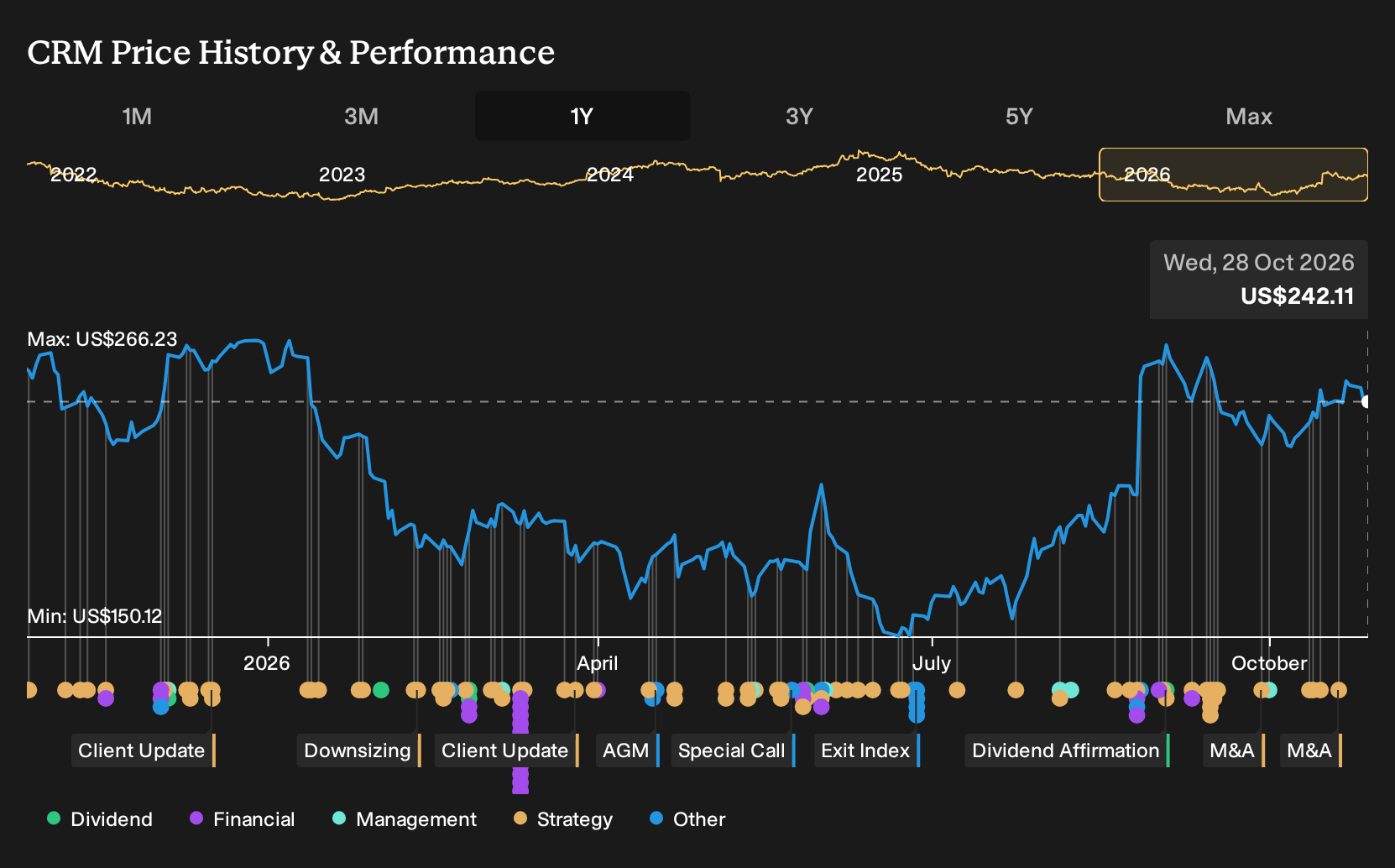
Exploring Other Perspectives
Some of the most optimistic analysts frame the Braze acquisition as a potential accelerator for Salesforce, arguing that deeper engagement data could justify revenue projections of about US$60.9b and earnings near US$11.4b by 2029. Those forecasts were set before this deal discussion, so your own view might shift as the integration story unfolds.
Explore 17 other Salesforce fair value estimates, including one that suggests as much as 115% upside from the current price!
Decide For Yourself
Disagree with existing narratives? Extraordinary investment returns rarely come from following the herd, so consider conducting your own research and going with your instincts.
- A great starting point for your Salesforce research is our analysis highlighting 3 key rewards and 3 important warning signs that could impact your investment decision.
- See our latest analysis for Salesforce. The report includes a comprehensive fundamental analysis summarized in a single visual, the Snowflake, making it easier to evaluate Salesforce's overall financial health at a glance.
Looking for more investment ideas beyond Salesforce?
If Salesforce has sharpened how you think about AI, contracts and earnings quality, it can be useful to compare it with other businesses that offer different mixes of risk and balance sheet strength. The Simply Wall St Screener helps you filter for these types of opportunities quickly so you can focus on the detailed research that matters.
- If you want income plus resilience, focus on companies with robust payouts and balance sheets by scanning our 6 dividend fortresses that clear a 5% yield hurdle.
- If capital preservation is a priority, concentrate on stability and financial strength by reviewing a 32 resilient stocks with low risk scores that screens for resilient businesses with lower risk scores.
- If you are searching for overlooked potential, start with quality fundamentals and sensible pricing through a 19 high quality undiscovered gems that highlights companies the market may not be fully pricing in yet.
Have feedback on this article? Concerned about the content? Get in touch with us directly. Alternatively, email editorial-team@simplywallst.com