


Nvidia (NVDA) continues to play a central role in the artificial intelligence (AI) infrastructure expansion, but many involved in stock trading on Wall Street don't seem to believe the company’s dominance in the market will completely avoid negative consequences. Seaport Research recently reiterated a “Sell” rating, with analyst Jay Goldberg stating that competitive pressures have been “mounting.” Goldberg set a price target of $180 for NVDA stock.
Notably, this price target looks rather unusual considering the fact that Nvidia stock closed at $215.38 on Oct. 28. Seaport's price target is 16% below current levels. Goldberg's concerns aren't limited to the competition from other chip manufacturers; the analyst is also worried about the increased financial obligations of Nvidia in the AI space, adding cyclical risks to its data-center expansion and financing activities. However, the company's operating performance is impossible to overlook, thus setting the stage for an interesting discrepancy between the bearish view and Nvidia's growth.
About Nvidia Stock
Based in Santa Clara, California, Nvidia (NVDA) designs graphics processing units (GPUs), accelerated computing platforms, networking products, and software utilized in AI, gaming, professional visualization, and other high-performance computing (HPC) industries. With a market capitalization of approximately $5.3 trillion, Nvidia is one of the largest public companies.
NVDA stock closed at $215.38 on Oct. 28, losing about 1% for the day. Shares are approximately 12% below the 52-week high of $243.37, but they also remain 31% above the 52-week low of $164.27. Nvidia stock has risen 15% year-to-date (YTD), slightly outperforming the S&P 500 Index's ($SPX) gain of about 13% over the same period.
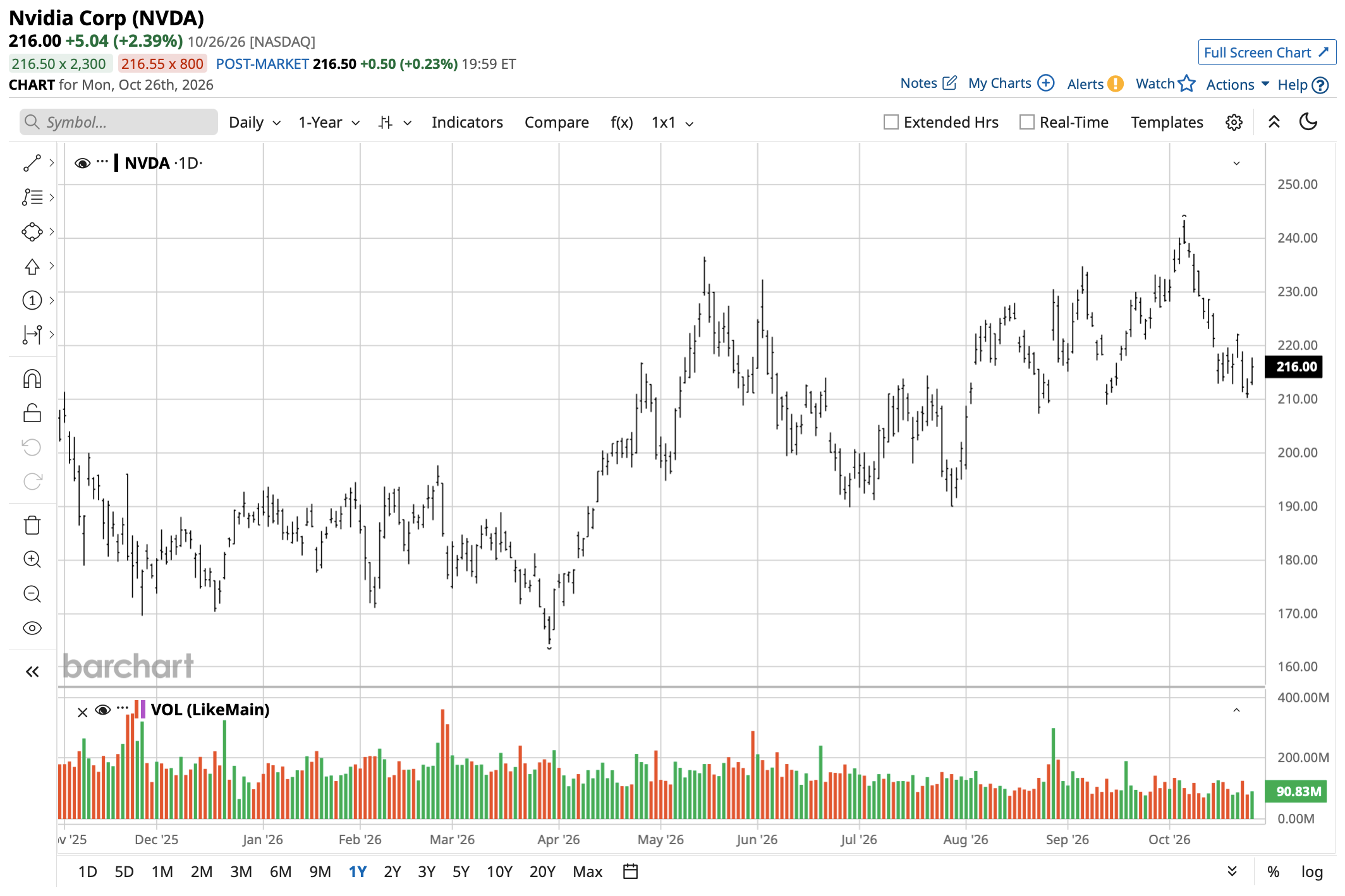
The valuation story is more complicated, however. Nvidia stock trades at trailing price-to-earnings (P/E) ratio of 31.7 times, a forward P/E ratio of 22.6 times, and a price-to-sales (P/S) ratio of 24.4 times. The sales multiple is definitely pricey, but the P/E multiple is less challenging than Nvidia's own historical multiples. Thus, investors are paying a premium for NVDA stock, but this premium has been greatly reduced as earnings have caught up with the stock price.
Nvidia Beats on Earnings
From a fundamental perspective, there is little evidence that demand has started to weaken lately. In August, Nvidia reported second-quarter fiscal 2027 revenue of $96.2 billion, up 106% year-over-year (YOY) and 18% sequentially. Revenue also beat Wall Street's consensus estimate of approximately $92 billion. Non-GAAP EPS amounted to $2.22 as well, up 120% from $1.01 a year ago and beating the consensus estimate of $2.09.
Perhaps more importantly, Data Center revenue came in at $89 billion, up 117% YOY. Despite the enormous scale of expansion, Nvidia also managed to maintain a non-GAAP gross margin of 75%. Thus, even though it is increasing, competition hasn't stopped Nvidia from more than doubling its largest business segment.
Looking forward, management guided Q3 revenue of approximately $108 billion, plus or minus 2%, slightly above Wall Street's estimate of roughly $104.2 billion. However, Nvidia also forecast a 74% gross margin, which is slightly lower than the roughly 74.7% gross margin expected by analysts. This could suggest that supply costs, as well as an increasingly challenging AI infrastructure expansion efforts, have started putting on pressure.
But there is one more thing to consider. These estimates assume no data-center compute revenues from China. Meanwhile, the next-generation Vera Rubin platform is now in full production. This suggests that the near-term growth story doesn't rely on a China recovery, giving Nvidia some room for further upside in case of improved access to that market.
What Do Analysts Expect From Nvidia Stock?
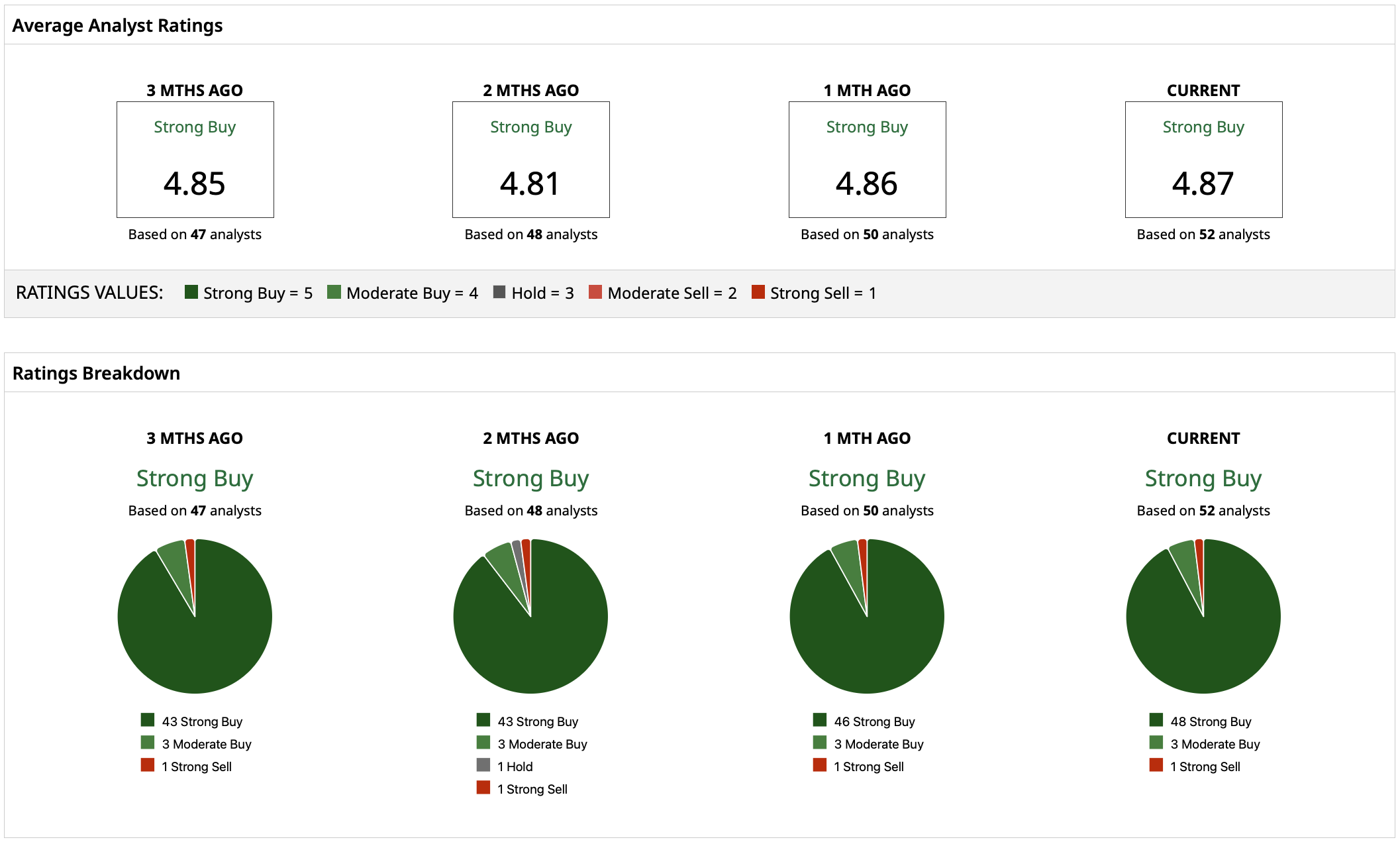
Seaport's bearish view is clearly an outlier in the grand scheme of things. Currently, NVDA stock has a consensus “Strong Buy” rating on Wall Street. The average price target of $328.75 implies potential upside of 53% from current levels. The high target for NVDA stock currently sits at $515, while Seaport has the lowest target of $180 per share.
On the date of publication, Yiannis Zourmpanos did not directly have a position in any of the securities mentioned in this article. All information and data in this article is solely for informational purposes. For more information please view the Barchart Disclosure Policy here.