


- First Merchants reported third quarter 2026 net interest income of US$161.07 million and net income of US$68.32 million, while net charge offs for the quarter reached US$29.389 million compared with US$5.148 million a year earlier.
- The bank paired higher quarterly earnings per share with a much larger charge off figure than last year. This combination highlights the mix of stronger core profitability and emerging credit cost pressure that could shape how investors interpret the current earnings power of First Merchants.
- We will look at how First Merchants' investment narrative is affected by stronger net interest income alongside sharply higher third quarter charge offs.
Compare how First Merchants' credit costs stack up against peers by scanning a hand picked list from 32 resilient stocks with low risk scores that currently show stronger resilience in their risk profiles.
First Merchants Investment Narrative Recap
To own First Merchants, you need to be comfortable with a community bank leaning into higher yielding lending while keeping problem credits contained. The third quarter story is mixed. Net interest income and quarterly earnings per share were stronger, but net charge offs of US$29.389 million introduce fresh questions about how clean the loan book really is.
The key short term swing factor is whether credit costs settle down while the balance sheet remix into higher yielding loans and core deposits stays on track. The biggest risk is that elevated charge offs and provisions persist and eat into earnings and tangible book value. The latest quarter suggests that risk is more visible now, not less.
The share repurchase activity from July to October 2026, with 287,431 shares bought back for US$12 million, matters in this context. It interacts directly with the narrative that First Merchants can use capital returns alongside loan growth and digital efficiency gains to lift earnings per share and total shareholder return over time.
For you as a shareholder, that buyback only works if underlying profitability keeps covering both higher credit costs and capital distributions. When paired with the preferred dividend declaration and ongoing common payout, the repurchases put more weight on execution around loan pricing, credit discipline and expense control. Those are the levers to watch as the credit story evolves.
What The Long Term Forecasts Assume For First Merchants
Analysts looking at First Merchants are tying the current credit conversation back to some fairly specific long term targets. Their projections rest on the idea that revenue can compound at 15.3% a year over the next few years, while profit margins step up from 28.7% today to 35.2% by around 2029. On those inputs, consensus points to earnings of US$347.2 million and earnings per share of US$4.9 by about October 2029, compared with US$184.1 million today, alongside gradual share count growth of 7.0% a year as new equity is issued.
Those earnings estimates also anchor the current price target logic. To line up with the analyst view, investors would need to be comfortable with First Merchants trading on a P/E of 12.9x in 2029. This is a lower multiple than the 13.6x ascribed today and above the 11.5x figure cited for the wider US banks group. This framing matters if you are weighing up whether the bank's mix of higher credit costs, reinvestment of mortgage sale proceeds and funding from higher coupon subordinated notes can support that kind of profit profile over time.
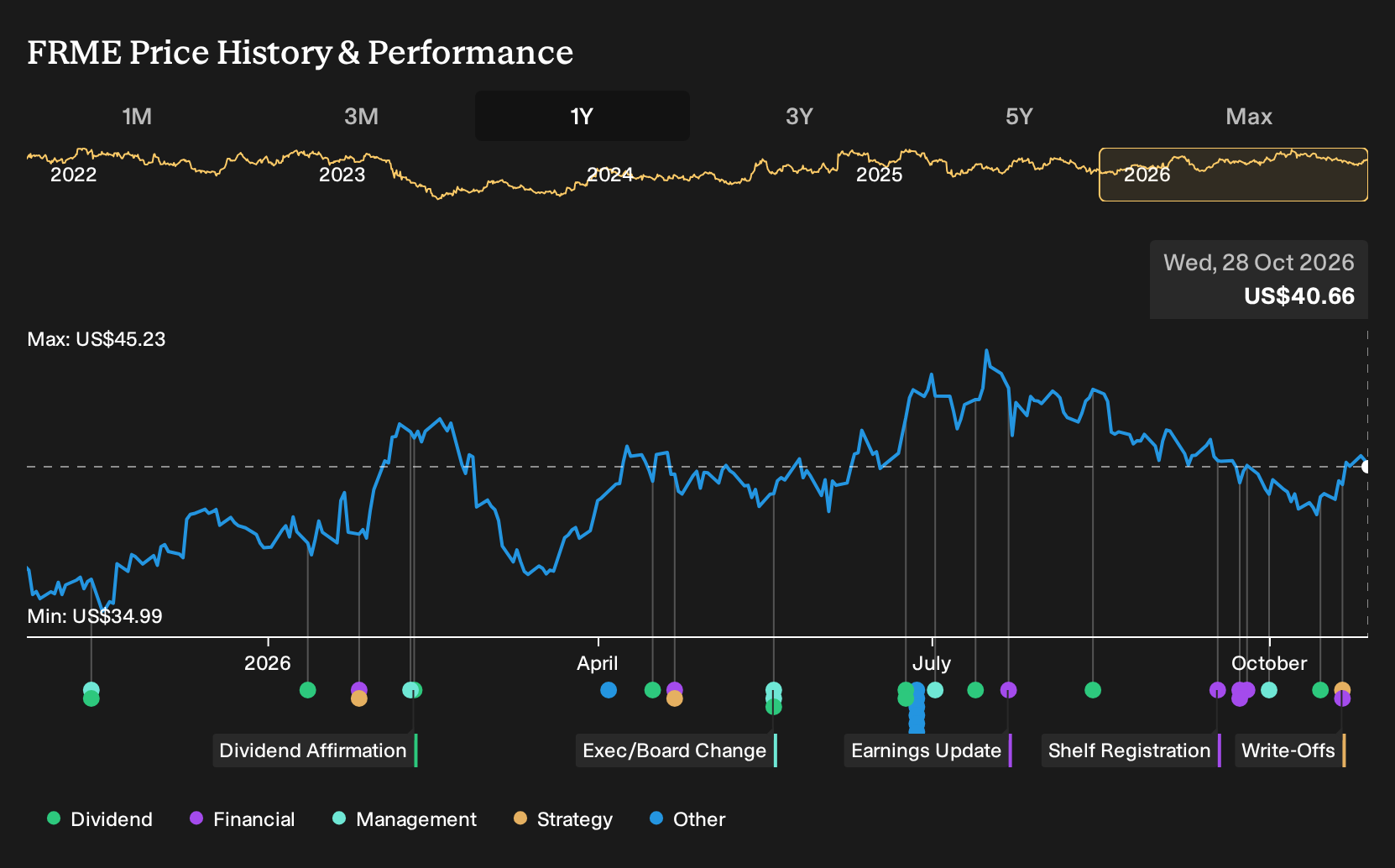
On top of that, the valuation work in the consensus report pulls all these moving parts together into a price target of US$47.0 per share. With First Merchants changing hands at US$39.77 at the time of the analysis, the implied upside to that objective is 15.4%. Anyone using that figure as a reference point still needs to test their own view on credit losses, net interest margin potential and fee growth rather than relying on the consensus alone.
First Merchants' narrative projects US$985.3 million revenue and US$347.2 million earnings by 2029. This requires 15.3% yearly revenue growth and an earnings increase of about US$163.1 million from US$184.1 million today.
Uncover why First Merchants' fair value indicates a 16% potential upside to its current price, which could narrow quickly.
Exploring Other Perspectives
Fair value estimates for First Merchants from 2 Simply Wall St Community members span roughly US$47 to almost US$76 per share, so private investors are clearly not aligned. Some are focused on loan demand, digital efficiency gains and capital returns, while others emphasise higher net charge offs and provision trends. Use these contrasting views to pressure test your own thesis.
Explore another First Merchants fair value estimate, including one that suggests it could be worth just $47.00.
Reach Your Own Conclusion
Don't just follow the ticker; dig into the data and build a conviction that's truly your own.
- A great starting point for your First Merchants research is our analysis highlighting 3 key rewards that could impact your investment decision.
- See our latest analysis for First Merchants. The report includes a comprehensive fundamental analysis summarized in a single visual, the Snowflake, making it easy to evaluate First Merchants' overall financial health at a glance.
Looking for more First Merchants style investment ideas?
If the First Merchants story has you thinking about portfolio balance, broaden your watchlist with companies that show different combinations of quality, risk and income using the Simply Wall St Screener.
- If capital preservation is high on your checklist, start with a basket of businesses that score well on resilience and risk control through the 32 resilient stocks with low risk scores.
- If income is the focus, compare payout profiles and balance sheet support by scanning a curated group of high yielding payers using the 6 dividend fortresses.
- If you want ideas that are less crowded, look for under followed companies with solid fundamentals by screening through the 19 high quality undiscovered gems.
Have feedback on this article? Concerned about the content? Get in touch with us directly. Alternatively, email editorial-team@simplywallst.com