


When a major company reports earnings, Wall Street and investors pay close attention. After all, the latest numbers can reveal whether the business is keeping up with expectations or has a few surprises up its sleeve. For ExxonMobil (XOM), the upcoming report is particularly interesting, with oil prices and refining margins shaping the outlook.
The energy giant is set to release its third-quarter 2026 results before the market opens on Friday, Oct. 30. Exxon has beaten Wall Street’s EPS estimates in three of the past four quarters, and revenue has followed a similar pattern. Analysts are now looking for year-over-year growth in both revenue and earnings.
There are a few moving parts to watch. In its latest SEC filing, Exxon indicated that lower liquid prices could reduce upstream earnings by $1.3 billion sequentially. However, oil prices remained considerably higher than a year earlier, offering support to its exploration and production business. Average WTI crude prices rose from around $64 to $68 per barrel in the third quarter of 2025 to roughly $80 to $97 per barrel across the corresponding months of 2026.
Meanwhile, stronger margins in its Energy Products segment could provide a $4.5 billion sequential boost. Exxon’s production strength in the Permian Basin and Guyana also remains important to its growth outlook.
With XOM stock already enjoying an impressive run in 2026, investors will want to know whether the latest results can support that momentum. Let’s take a closer look at how Exxon Mobil has performed so far and what analysts expect from the upcoming report.
About Exxon Mobil Stock
Headquartered in Spring, Texas, outside of Houston, Exxon Mobil is one of the world’s largest integrated energy companies, operating across the oil and gas industry, from exploration and production to refining and petrochemicals. Its diversified business model helps it navigate changing energy markets, with its upstream operations benefiting from stronger oil and gas prices, while refining and chemicals add another source of earnings.
With operations spanning the globe, ExxonMobil plays a major role in supplying energy to economies and industries worldwide. The company is also investing in lower-emission technologies as it explores opportunities beyond traditional fossil fuels. Its market capitalization currently stands at around $764.9 billion.
For investors, ExxonMobil’s broad operations and exposure to energy prices make its stock worth watching, particularly as shifting market conditions create fresh opportunities and challenges.
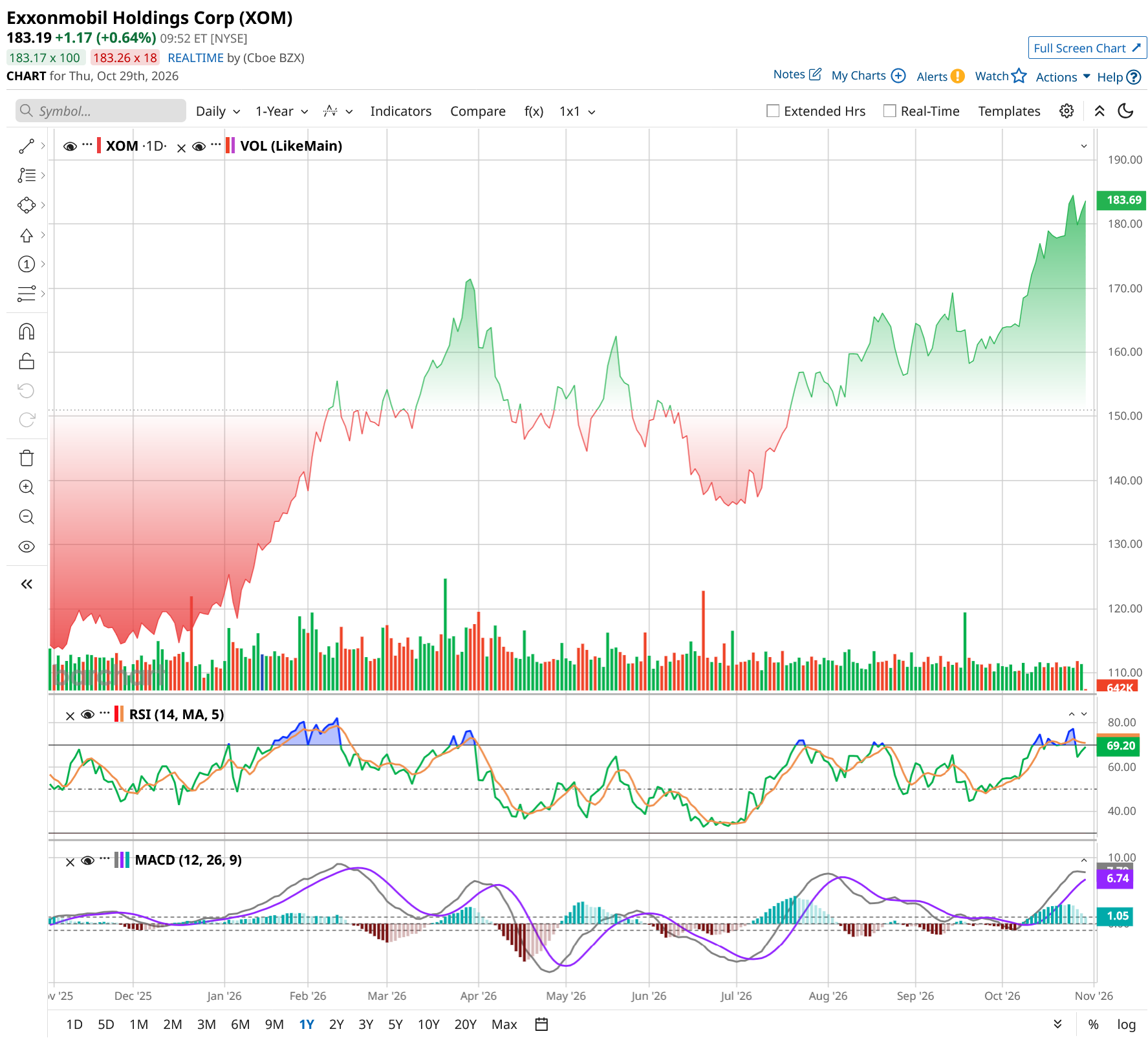
Exxon’s broad business reach has helped it turn a favorable energy market into an impressive run on Wall Street. XOM stock has climbed 53% year-to-date (YTD) and 58% over the past 52 weeks, including a solid 19% gain over the past six months. The shares have also hit multiple record highs this year, most recently reaching $184.88 on Oct. 27.
Rising oil prices have certainly helped fuel the rally. This week, Brent crude surged to $117 a barrel, its highest level since April, amid fears of renewed hostilities involving Iran. Although prices have pulled back from that peak, geopolitical tensions and concerns about global supply disruptions continue to support the energy market.
The pressure on oil supplies intensified in October after a Gulf tanker attack disrupted traffic through the Strait of Hormuz, while hurricane-related shutdowns curtailed production in the Gulf of Mexico. These disruptions pushed Brent (QAF27) and WTI (CLZ26) crude prices higher, improving the outlook for major oil producers. Strong refining margins and Exxon Mobil’s preliminary third-quarter earnings update have added to investor optimism.
Beyond higher oil prices, Exxon has another advantage—its production engine. Its major operations in the Permian Basin and offshore Guyana continue to support output, with relatively low breakeven costs helping protect profitability. In the Permian, the company is using advanced drilling techniques and AI to improve efficiency and produce more at lower costs. Meanwhile, continued discoveries and production growth in Guyana strengthen its longer-term outlook.
Exxon’s integrated business model also helps it capture opportunities across exploration, production, refining, and chemicals, while cost savings and operational efficiencies provide additional support. With oil prices rising and production remaining strong, investors have plenty to watch. The key question now is whether these favorable conditions can continue supporting Exxon Mobil’s earnings and stock momentum.
XOM’s technical indicators also point to strong momentum behind the rally. The 14-day RSI has cooled from overbought territory, suggesting the stock’s rapid climb may be easing slightly after an extended run.
However, the MACD remains firmly bullish, with the MACD line above its signal line and the histogram staying positive. Together, these signals suggest that despite some cooling, ExxonMobil’s upward momentum could have further room to run.
When it comes to valuation, ExxonMobil's stock may be a little more expensive than some investors expect from an oil giant. XOM trades at around 13.55 times forward non-GAAP earnings, putting it at a premium to its historical levels and the broader energy sector. Its forward PEG ratio of about 1.35 also indicates investors are paying up for its growth prospects.
And while investors may be paying a premium for the stock, they are also getting a steady stream of dividend income. ExxonMobil has paid dividends for 43 consecutive years and has consistently increased its payouts, earning it a place among the “Dividend Aristocrats.” Last month, the company paid a quarterly dividend of $1.03 per share, bringing its forward annual dividend to $4.12. At current prices, that translates into a yield of around 2.29%.
The payout ratio of approximately 44.4% also leaves room for Exxon to reward shareholders without stretching its finances too far. Strong cash flows allow the company to fund dividends and share buybacks while continuing to invest in LNG and offshore projects. Adding its solid balance sheet and relatively low production breakeven costs, Exxon offers more than just exposure to rising oil prices. The premium valuation may give investors pause, but its income stream and financial strength help explain why the stock continues to attract attention.
A Snapshot of Exxon Mobil’s Q2 Numbers
Exxon Mobil’s second-quarter 2026 results proved that the energy giant can keep its operations moving even when the business faces a few bumps along the way. Reported on July 31, the results delivered strong revenue growth, although earnings fell short of Wall Street’s expectations.
Revenue climbed 42.3% year-over-year (YoY) to $116 billion, beating estimates, while adjusted EPS surged 114.6% annually to $3.52. However, scheduled maintenance, higher depreciation costs from recent investments, and production disruptions linked to conditions in the Middle East weighed on the quarter. In other words, Exxon generated plenty of revenue, but some operational expenses and supply challenges kept earnings from going further.
Still, its production business remained a major bright spot. Upstream operations, which cover oil and gas exploration and production, generated $9.19 billion in adjusted earnings. Total production reached 4.514 million oil-equivalent barrels per day, while output from the Permian Basin topped a record 1.8 million barrels per day. Management expects growth in the Permian to support a planned 9% compound annual growth rate through 2030.
Exxon is also preparing for its next phase of growth in Guyana. Its fifth floating production, storage, and offloading (FPSO) vessel set sail during the quarter, with production startup expected in Q4. Once operational, it is expected to add 250,000 barrels per day of capacity.
The company’s cash generation was another highlight. Q2 operating cash flow (non-GAAP) reached $23.6 billion, while free cash flow (non-GAAP) came in at $17.25 billion. Exxon returned $9.4 billion to shareholders, including $4.3 billion in dividends and $5.1 billion in share repurchases. It also reduced net debt by more than $7 billion, bringing its net debt-to-capital ratio down to 11%.
Looking ahead, Q3 could bring some near-term pressure. Exxon expects lower Guyana net entitlement volumes of around 100,000 barrels per day due to production-sharing adjustments, rather than weaker production performance. Corporate and financing expenses are projected at $800 million to $1 billion, while lower scheduled maintenance in Product Solutions should offer some relief. Middle East disruptions remain an uncertainty.
Overall, Exxon enters the next quarter with strong cash generation and major production projects progressing, although geopolitical risks and near-term operating expenses remain important factors to watch in the upcoming earnings report.
Meanwhile, analysts tracking the company expect Exxon’s Q3 revenue to be $106 billion, while EPS is anticipated to rise 107.5% YoY to $3.90. Looking ahead, EPS is expected to surge 94.7% annually to about $13.61 in fiscal 2026 but then dip by 3.3% YoY to $13.16 in fiscal 2027.
What Do Analysts Expect for XOM Stock?
Analysts are heading into ExxonMobil’s third-quarter 2026 earnings report with a more optimistic view, supported by stronger refining margins and higher earnings expectations. UBS raised its price target on XOM stock to $199 from $185 while maintaining a “Buy” rating. The brokerage also lifted its Q3 EPS estimate to $4.14, above Wall Street’s consensus, citing better-than-expected capture of refining margins.
UBS has also become more bullish on Exxon’s longer-term earnings outlook, raising its 2026 EPS estimate to $13.35. Its estimates for 2027 and 2028 now stand at $11.33 and $12.86 per share, respectively. These revisions followed Exxon’s third-quarter earnings considerations filing, which provided additional details for analysts to update their forecasts.
Barclays has also raised its price target to $200 from $177 while maintaining an “Overweight” rating. The firm believes normalized refining margins in Q3, combined with tight global refining capacity, could support stronger and more durable earnings from Exxon’s refining business.
Meanwhile, JPMorgan increased its price target to $186 from $166 and retained an “Overweight” rating after updating its financial model ahead of the results.
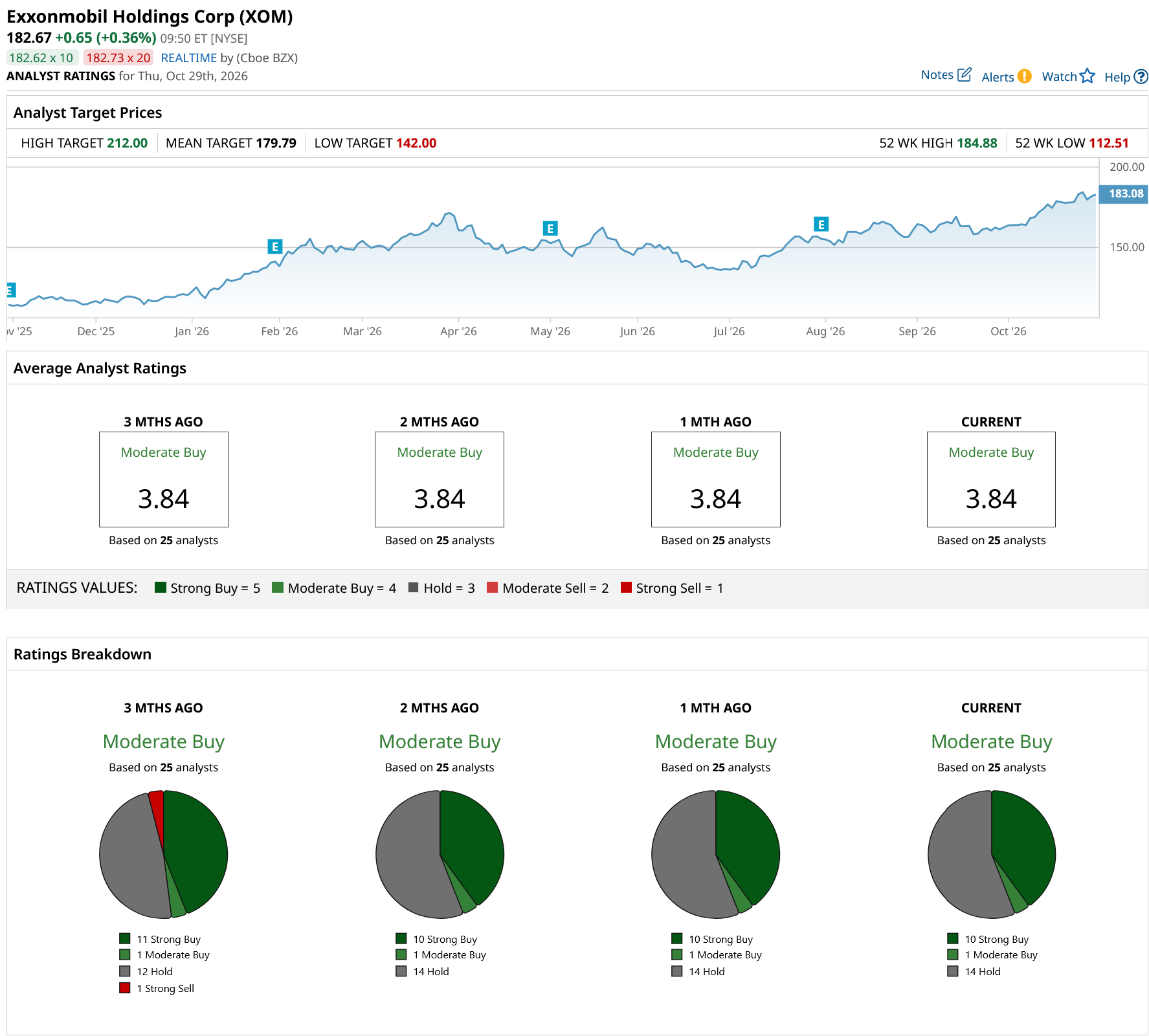
Overall, XOM has a consensus “Moderate Buy” rating from the 25 analysts covering the oil and gas stock. Among them, 10 advise a “Strong Buy,” one suggests a “Moderate Buy,” and 14 analysts are playing it safe with a “Hold” rating.
While XOM currently trades above its average analyst price target of $178.12, the Street-high target price of $206 suggests that the stock could rally as much as 14.5%.
On the date of publication, Sristi Suman Jayaswal did not directly have a position in any of the securities mentioned in this article. All information and data in this article is solely for informational purposes. For more information please view the Barchart Disclosure Policy here.