


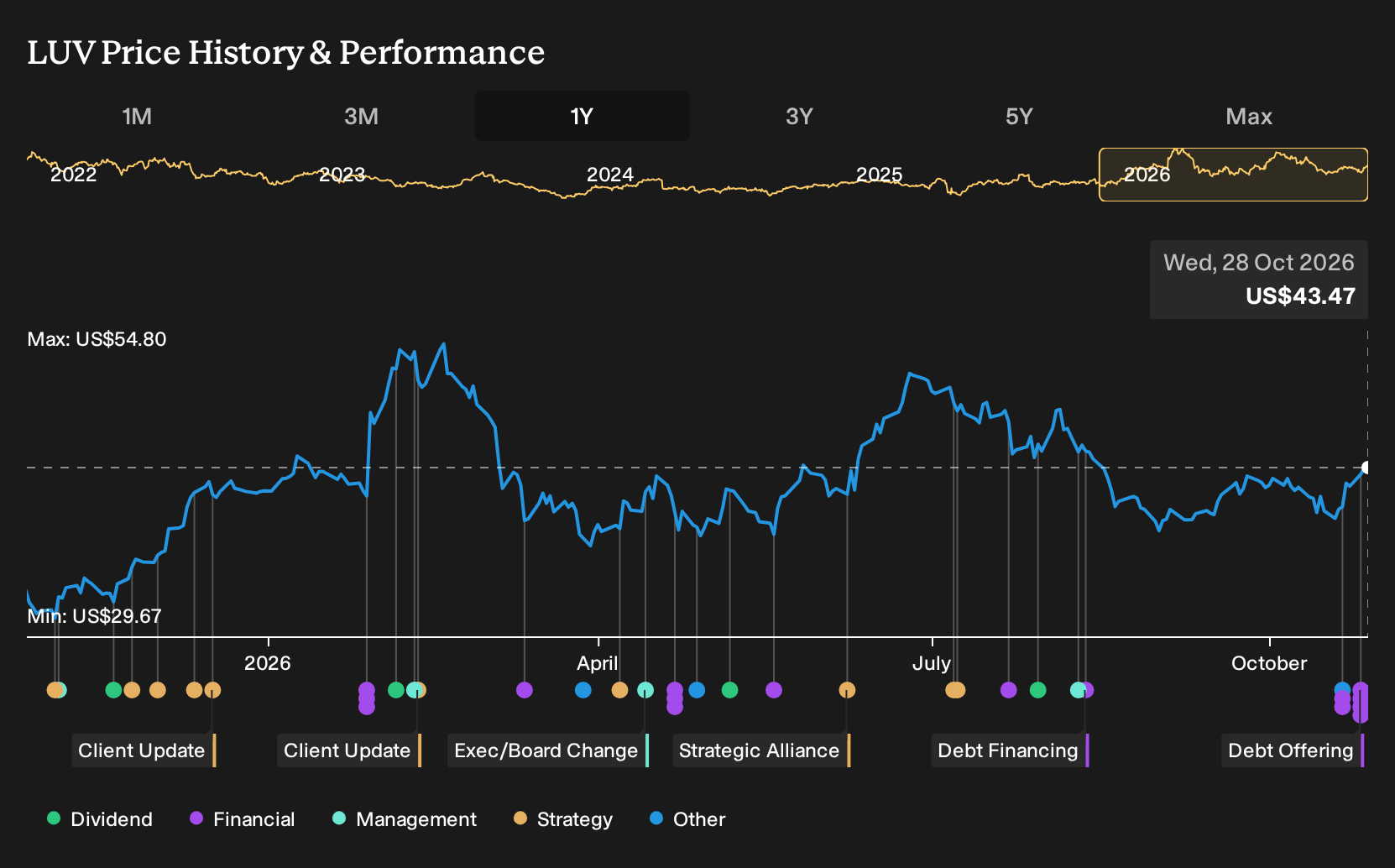
If you had bought Southwest Airlines on 28 October 2025 and simply sat tight, the next twelve months would have looked very different from the debate that raged at the start. Holding Southwest Airlines over the past year would have returned 44.3%, including dividends. At the decision point, investors were weighing bullish talk of product changes and point to point strength against warnings about fuel, labor, and domestic dependence. Which of those trade offs would have mattered most to you then?
On Simply Wall St, a Narrative is an investor's thesis written down: the reasoning, plus the numbers it rests on. Run those numbers and you get an estimated Fair Value.
If the move has made Southwest Airlines harder to judge, start where the gap is still open and scan 26 high quality undervalued stocks.
The Two Stories Southwest Airlines Investors Had In Front Of Them
The shares cost US$31.09 at the start of the period, and anyone looking at Southwest Airlines then was choosing between two very different stories that both sounded plausible.
On the optimistic side, the bullish Narrative put Fair Value at US$46, 48% above the start price. That view leaned on product changes like bag fees and assigned seating, plus new distribution partnerships, as key drivers of higher revenue and wider margins.
The bearish Narrative saw Fair Value at US$19, 39% below the start price. This case focused on remote work cutting into domestic business travel and rising labor and regulatory costs eroding profitability over time.
What The Results Changed For The Southwest Airlines Thesis
Record Q3 2026 revenue of US$8.4b and net income of US$270m, up from US$6.9b and US$54m in Q3 2025, gave clear support to the bullish Southwest Airlines story that product changes could lift earnings power. Net margin moved from 0.8% to 3.2%. Rising jet fuel costs and lower 2026 profit guidance pulled the other way, so the evidence cut both ways.
The key hinge here was not sentiment. It was whether higher fees and new products would show up in revenue and margin. When you assess another airline, track the change in net margin and profit against any promised product or pricing shift, and compare it with management’s own guidance over several quarters.
What You Are Paying For In Southwest Airlines Today
Southwest Airlines now trades at US$43.47, with this cautious Narrative putting Fair Value below that level. The argument turns on whether new fees, product tiers, lounges, and tech spending translate into durable earnings strength rather than just keeping pace with higher fuel and operating costs.
If you buy at today’s price, you effectively assume Southwest Airlines keeps converting product and loyalty gains into profit that more than offsets fuel, capacity, and reputational pressure described in the Narrative.
"The main factor that has to go right is that Southwest Airlines converts its new product segmentation, loyalty growth, and technology and fleet investments into sustained earnings power that outweighs fuel, capacity, and reputational headwinds. The current numbers suggest that Southwest Airlines' share price already reflects a successful commercial transformation and ongoing capital deployment. This narrative views that pricing as leaving limited room for upside and skewing the risk toward overvaluation."
One Narrative has put a figure on that disagreement. → See the Narrative with its lower Fair Value, assumptions and all
Find Your Own Contrarian Opportunity
The story behind this run has already been told. The next one could be taking shape somewhere else. Where could you start looking before it becomes the headline?
- Company 1 - 37% below our estimate - helps clients run complex investigations combining AI analysis, human judgment and regulatory needs.
- Company 2 - 43% below our estimate - converts a strong backlog of technology-intensive projects into recurring building systems service relationships.
- Company 3 - 32% below our estimate - targets AI-focused data centre operators dependent on its integrated GPU hardware and software stack.
That is three of the list. See the full list of 24 financially solid companies →
Have feedback on this article? Concerned about the content? Get in touch with us directly. Alternatively, email editorial-team@simplywallst.com