


UK forecasts now point to squeezed living standards, patchy growth and tighter money for years, which puts many consumer stocks on the back foot while a smaller group quietly gains importance. Investors who ignore this shift risk missing where capital may quietly compound or where dividends could prove more dependable. This article unpacks that tension and highlights three UK consumer staples stocks that appear better aligned with this new reality.
The three stocks covered below are a small sample of what screens well on these criteria. The wider filter surfaced 8 more UK defensive consumer staples companies with equally solid stories that are not included in this article.
If you want to identify potential income anchors and lower risk consumer staples in one pass, head straight to the UK Defensive Consumer Staples screener to analyze candidates side by side and focus on the ideas that best fit your own portfolio rules.
Cranswick (LSE:CWK)
Overview: Cranswick is a UK-based food producer supplying supermarkets and food service with pork, poultry, cooked meats, pastry and Mediterranean products.
Operations: Cranswick generates about £2.93b from food and £48 million from other activities, with roughly £2.91b coming from United Kingdom customers.
Market Cap: £2.84b
Cranswick provides exposure to essential UK food spending, with non-discretionary products, a domestic focus and resilient earnings trends in a weaker consumer climate. The stock combines this staples profile with revenue growth that is ahead of the wider UK market. Future returns may depend on what happens when one unseen pressure on profitability finally shifts.
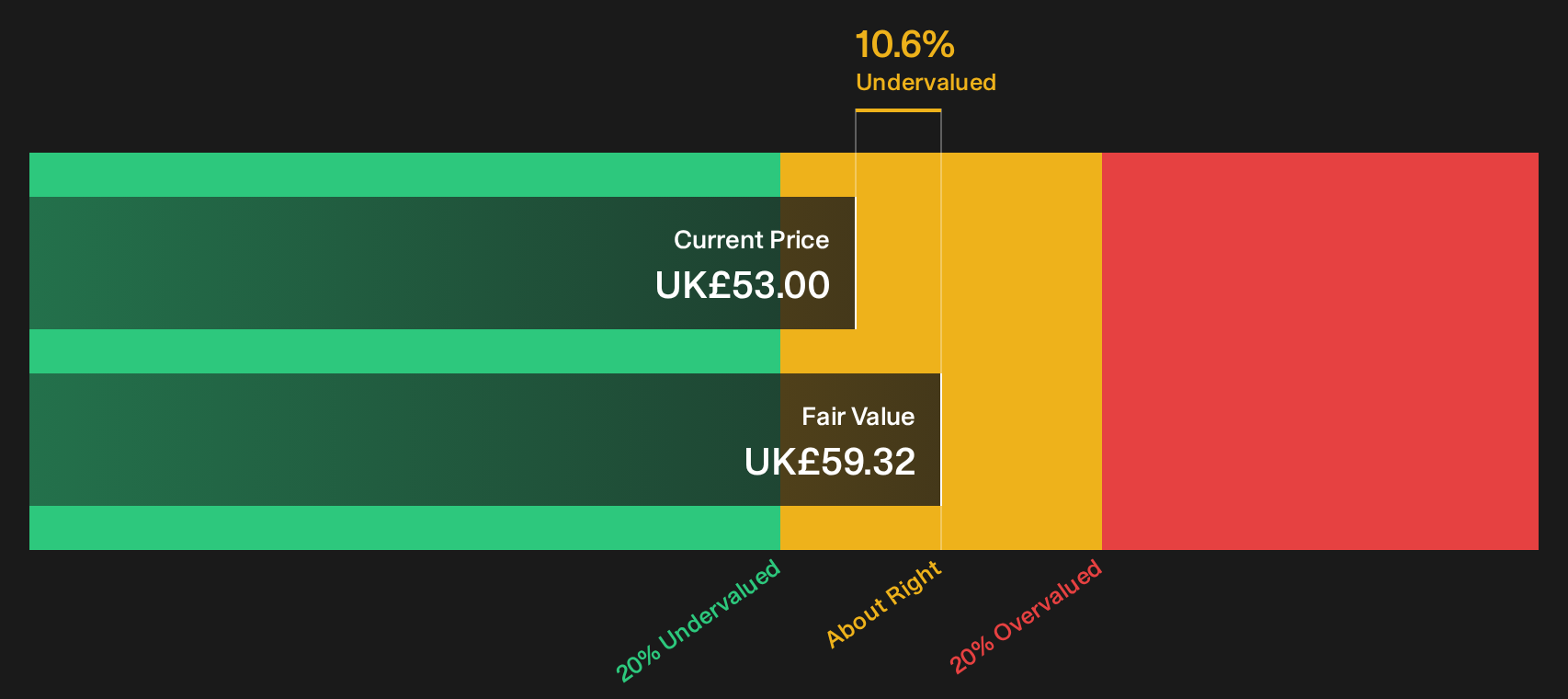
That unseen pressure is already baked into expectations, so use the DCF valuation analysis for Cranswick to see how much of Cranswick's potential is still unpriced.
McBride (LSE:MCB)
Overview: McBride manufactures private label household and personal care products like laundry detergents and cleaners for major UK and European retailers, giving it direct exposure to staple spending when shoppers trade down to retailer brands.
Operations: McBride generates £526 million from Liquids, £226.3 million from Unit Dosing, £88.7 million from Powders, £67.3 million from Aerosols and £25.9 million from Asia Pacific, with additional sales spread across European markets and the United Kingdom.
Market Cap: £302.3 million
McBride matters to this screener because private label cleaning and hygiene products are exactly the kind of everyday essentials households keep buying even when budgets tighten. As a result, its fortunes are closely tied to how far retailers and consumers lean into own-brand ranges as real incomes come under strain.
"Although the long term production agreement with Vestacy adds volume visibility in liquids, the sizeable capital spend, higher finance costs and the operational complexity of integrating two additional Iberian factories may restrict progress in net margins and delay any improvement in earnings."
For investors, what really counts now is whether one quiet shift in how those new volumes convert to cash ultimately reshapes the earnings profile.
If that earnings mix is what you are really testing with McBride, read the full narrative for McBride to see how the risk reward balance could be shifting.

C&C Group (LSE:CCR)
Overview: C&C Group manufactures and distributes beer, cider, wine, spirits and soft drinks across the UK, Ireland and selected international markets.
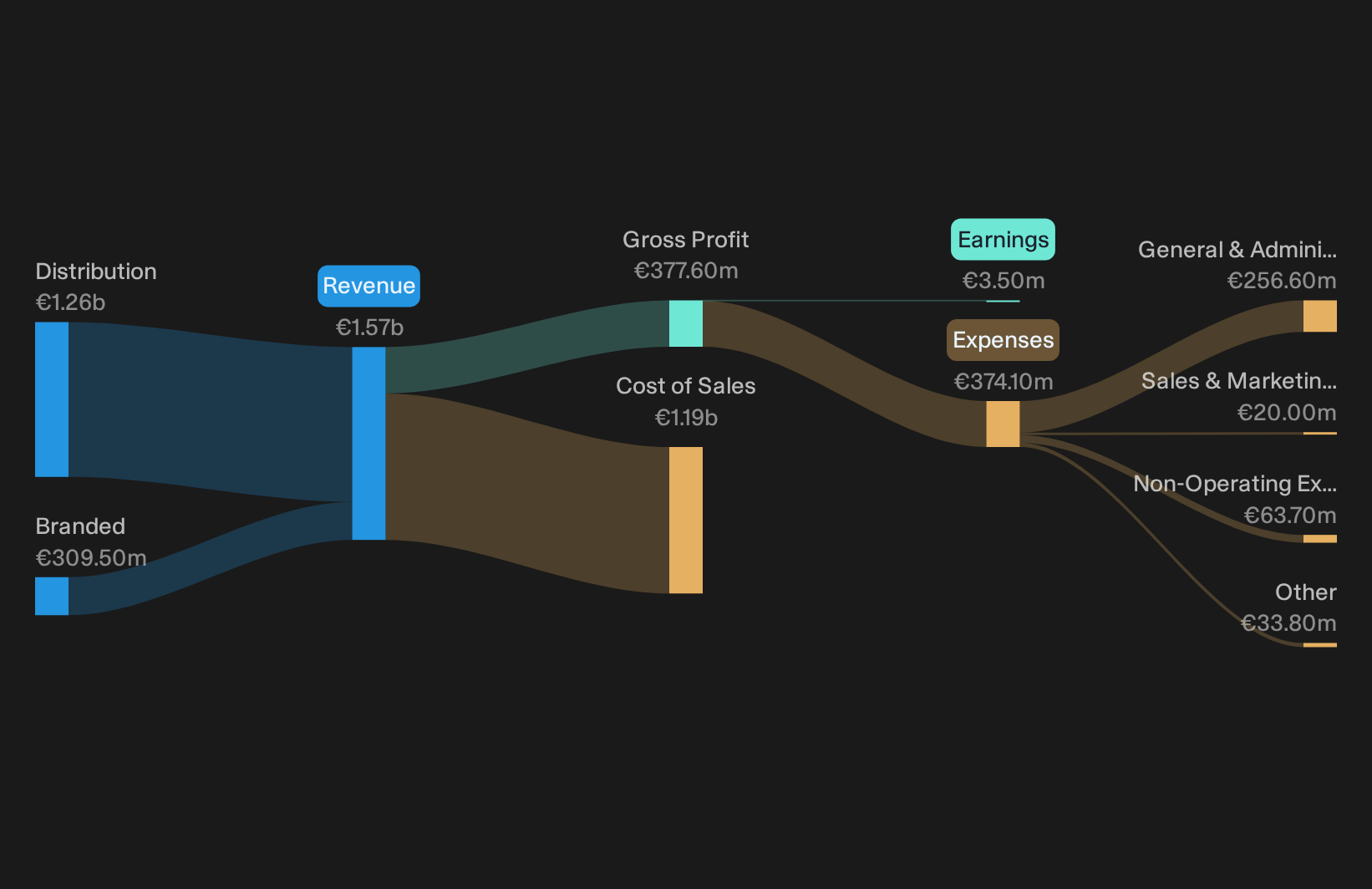
Operations: C&C Group generates about €309.5 million from Branded products and €1.26b from Distribution, with most sales coming from Great Britain and Ireland.
Market Cap: £389.1 million
C&C Group brings the UK Defensive Consumer Staples theme into the pub and bar, giving this screener direct exposure to everyday beverage spending even as households cut back elsewhere and trade down within hospitality.
"Although Tennent's already holds strong positions in Scotland and ranks among the largest lager brands by volume across Great Britain, if C&C Group continues to build on this base in both on trade and off trade channels, the company could see stronger branded volumes and pricing resilience than the bearish view assumes, which would support revenue and operating profit."
What happens if one planned improvement in a lower margin part of C&C Group quietly becomes the swing factor for future cash generation?
That cash swing is the crux. Read the full narrative for C&C Group to see how C&C Group’s branded strength and distribution footprint could be quietly decoupling from the bearish story.
Seeking Fresh Alternatives Before They Fly?
Some of the most interesting breakout stories start quiet, then move fast while everyone else is caught looking backward. Use these fresh stock lists before the momentum drops, and consider acting promptly if they fit your strategy.
- Spot potential trend leaders early by scanning the 5 high quality undiscovered gems curated to surface quality businesses that still sit under the radar for now.
- Target resilient income ideas by checking the 4 dividend fortresses built around companies where yields and balance sheets both matter before the broader market reacts.
- Explore structural tech themes by reviewing the 54 AI infrastructure stocks focused on businesses supplying the picks and shovels behind artificial intelligence demand as that story continues to develop.
Have feedback on this article? Concerned about the content? Get in touch with us directly. Alternatively, email editorial-team@simplywallst.com