


Energy markets just delivered a jolt, with Shell reporting Q3 adjusted profit of $10.8b, bigger share buybacks and record refining margins that underline how powerful this earnings engine can be when commodity prices move sharply. These shifts can quickly reprice expectations, which is why sitting on the sidelines risks missing key turning points. This article walks through three large integrated oil and gas stocks exposed to the same forces shaping Shell today.
The companies covered below are just a sample, and the full screen surfaced 11 more large-cap integrated oil and gas producers with equally compelling narratives that are not discussed in this article. To identify and analyze the highest conviction plays in this space, head straight to the Large-Cap Integrated Oil & Gas Producers screener.
Marathon Petroleum (MPC)
Overview: Marathon Petroleum runs a large integrated US refining, fuel marketing, midstream logistics, and renewable diesel business tied directly to global oil and gas pricing.
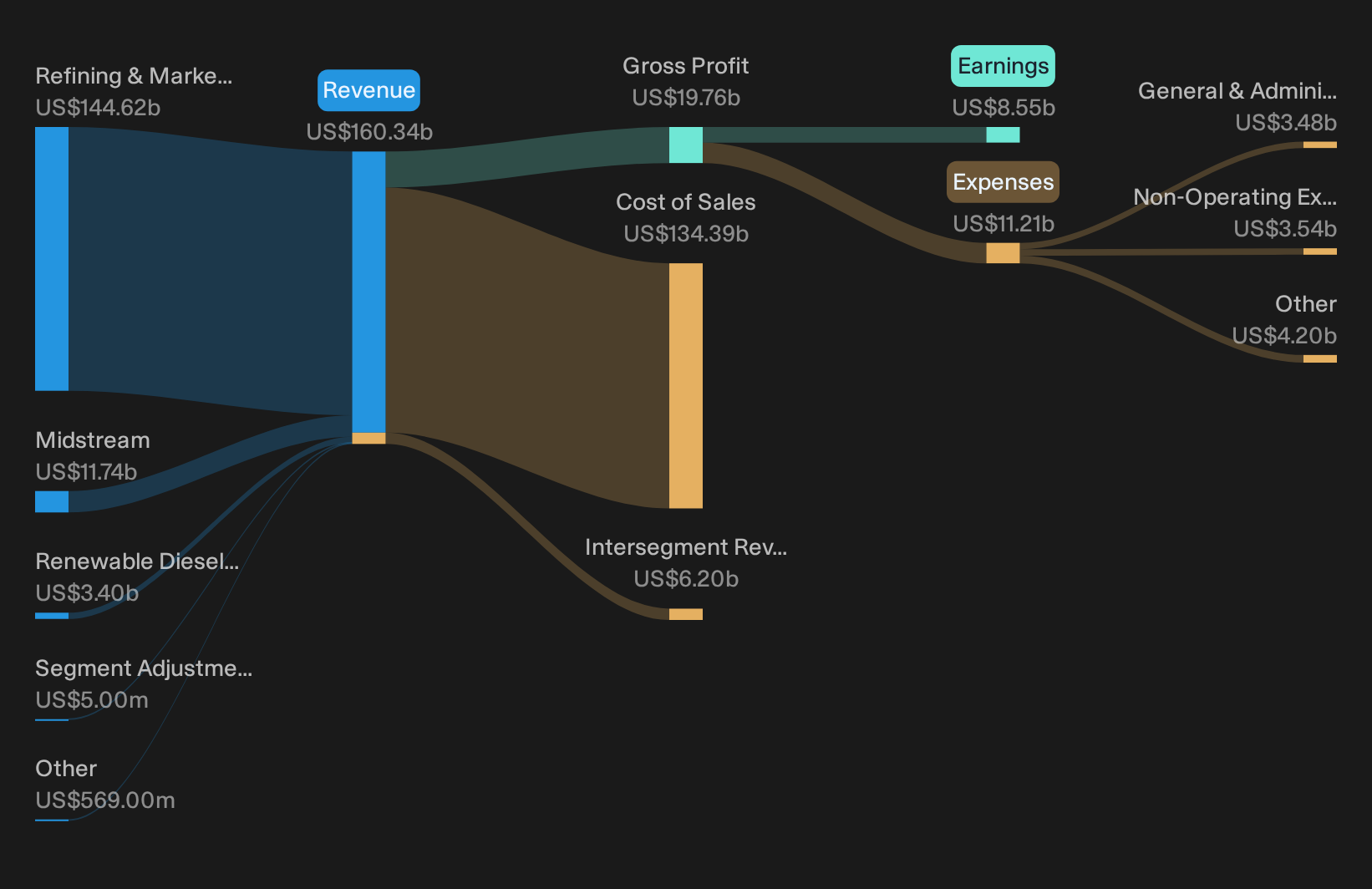
Operations: Marathon Petroleum generates about US$144.6b from Refining & Marketing, US$11.7b from Midstream, and US$3.4b from Renewable Diesel, almost entirely in the United States.
Market Cap: US$122.4b
For an investor looking at large integrated oil and gas producers, Marathon Petroleum matters because it is a pure expression of how tight fuel supply and strong refinery economics can reshape earnings for a downstream focused giant.
Ongoing tight global refining capacity, with millions of barrels per day of capacity offline and fuel inventories around or below 5 year ranges, supports the idea that current refining margins and Marathon Petroleum earnings already reflect an enhanced mid cycle environment through at least 2027.
What happens if a single assumption about how long fuel markets stay tight starts to shift will be critical for future margins.
As that assumption shifts, read the full narrative for Marathon Petroleum to see how refining power, capital returns, and policy risks could be quietly reshaping Marathon Petroleum.
Valero Energy (VLO)
Overview: Valero Energy runs a large global refining and fuel marketing network, supplying petroleum and low carbon fuels that tie directly to crack spreads.
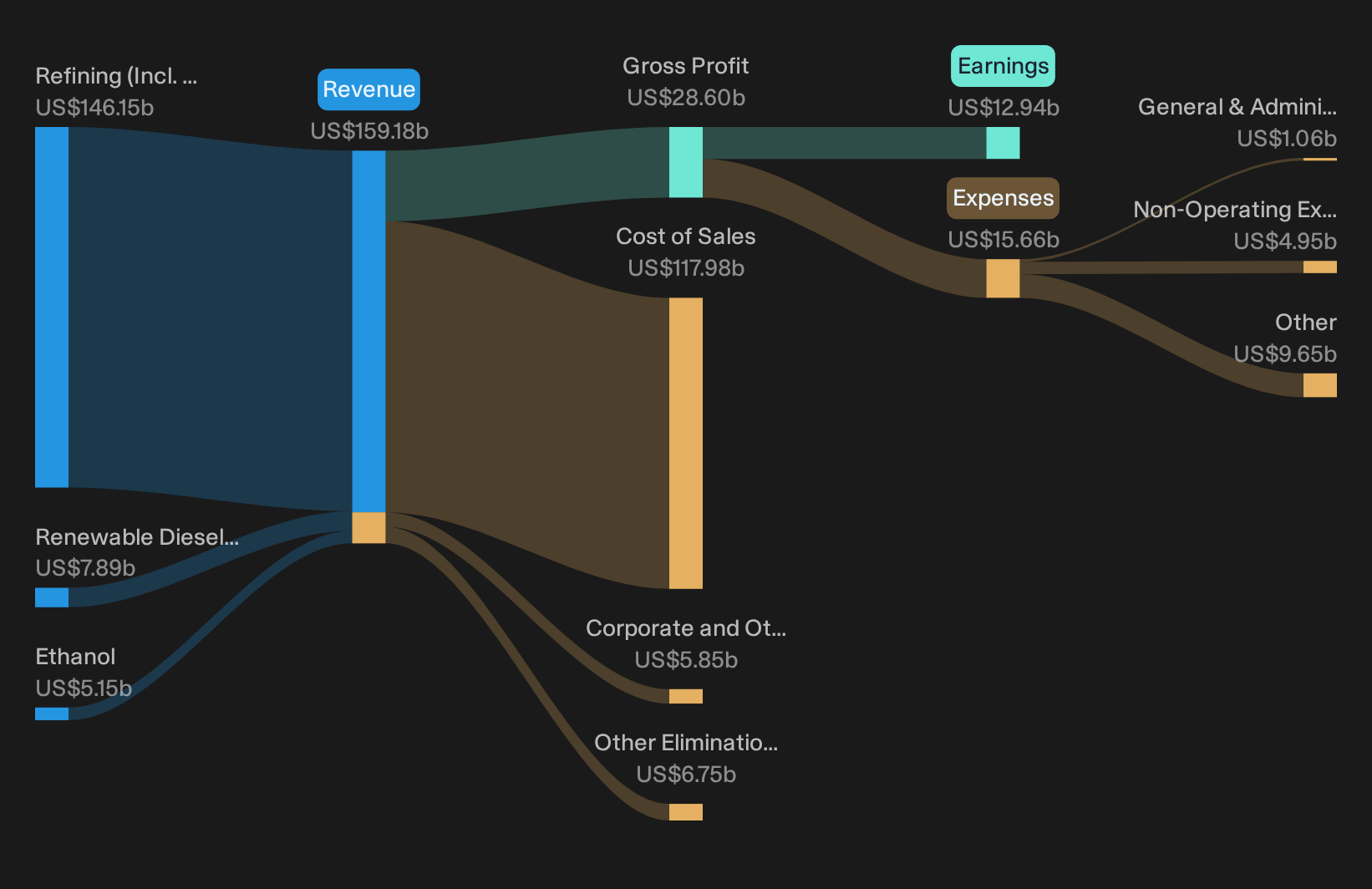
Operations: Valero Energy generates about US$146.1b from Refining, US$7.9b from Renewable Diesel, and US$5.1b from Ethanol, with Corporate and Other at negative US$5.9b.
Market Cap: US$111.5b
Valero Energy is one of the purest ways to connect to the screener’s focus on large integrated oil and gas players whose results are closely tied to refining economics, because its Gulf Coast heavy system turns tight fuel supply into direct exposure to crack spreads.
Continuing tight global refining capacity, with several million barrels per day still offline and product inventories below typical levels, can keep Valero Energy’s crack spreads and refining margins elevated relative to historical mid-cycle assumptions.
How one still underappreciated pressure on those product spreads evolves may significantly influence future earnings power.
That underappreciated pressure on product spreads is exactly where the story gets interesting, and the full narrative for Valero Energy shows how Valero Energy’s earnings power could be quietly recalibrating.
Equinor (OB:EQNR)
Overview: Equinor is a large Norwegian energy major that explores, produces, processes, transports, and markets oil, gas, power, and renewables worldwide.
Market Cap: NOK1,055.4b
Equinor ties directly into the screener’s theme, with integrated oil, gas, and processing exposure that gives investors broad leverage to the same commodity and refining forces now lifting peers like Shell.
The ambitious plan to keep Norwegian Continental Shelf production around 1.3 million boe per day through 2035 via about 900 wells, 75 tiebacks and 230 projects may be encouraging investors to extrapolate current production and cash generation, even though visible cost pressure and higher engineering hours could affect future net margins.
What happens if one quietly rising cost pressure starts to eat into those long term production ambitions will matter a great deal.
As that cost pressure builds, read the full narrative for Equinor to see how Equinor’s long term plan could still turn rising spend into accelerating opportunity.

Seeking Alternatives Before The Crowd?
Fresh ideas move first. Breakout themes, rising momentum, and quality that might be flying under the radar for now can get caught quickly, so do the work while it matters and act now.
- Spot income engines that aim to keep paying when markets get jumpy by scanning a curated group of 6 dividend fortresses.
- Chase early-stage upside where strong balance sheets meet tiny market caps by reviewing a focused set of 9 elite penny stocks with strong financials before momentum drops off.
- Position ahead of the next infrastructure buildout cycle by tracking a filtered pool of 43 power grid technology and infrastructure stocks while they are still flying under the radar.
Have feedback on this article? Concerned about the content? Get in touch with us directly. Alternatively, email editorial-team@simplywallst.com