


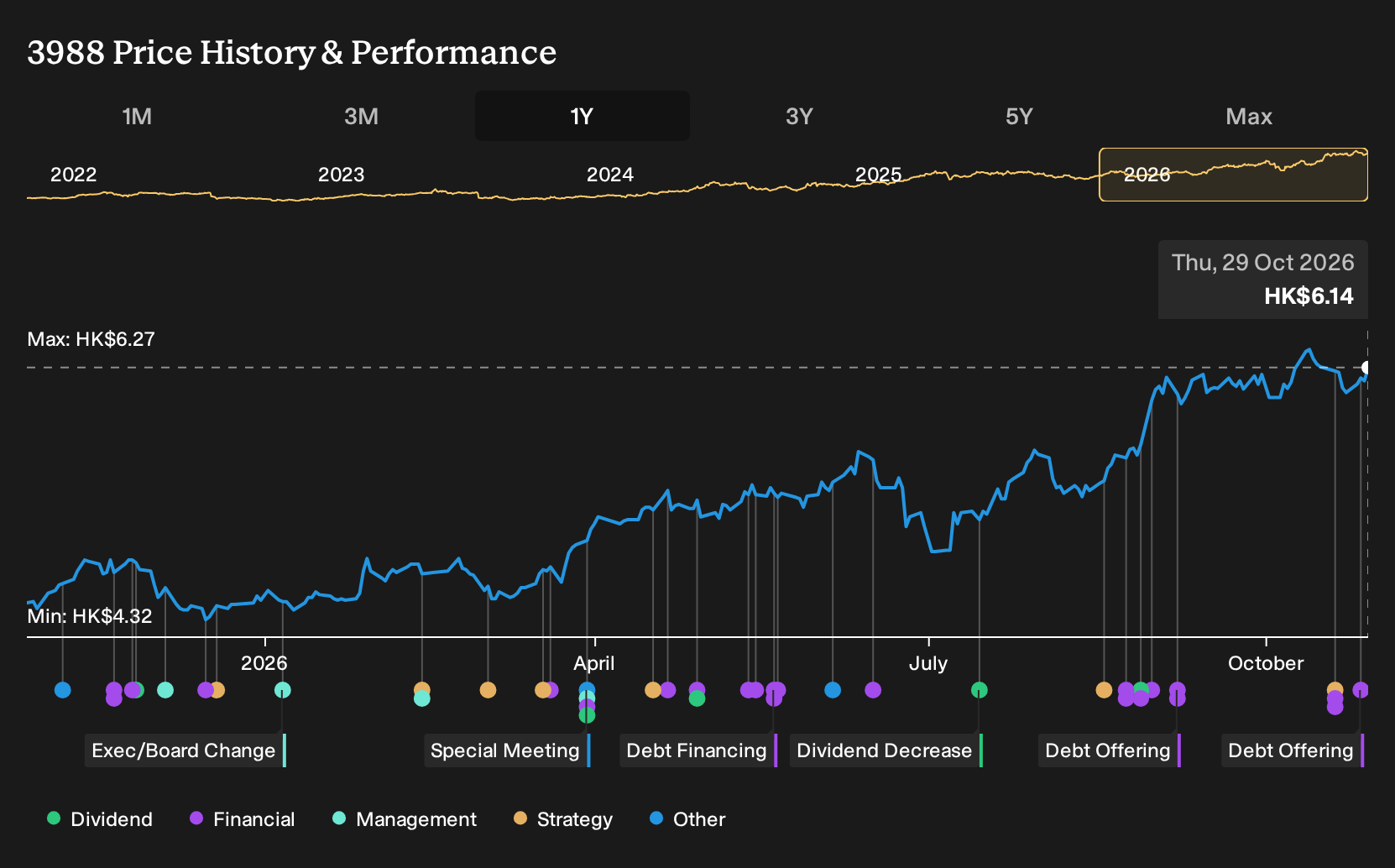
- Bank of China recently completed several funding deals, including US$250 million in floating rate notes due 2029 and CNY 50 billion in fixed rate callable notes due 2036, alongside RMB 50 billion in 10 year write down tier 2 capital bonds issued on October 20, 2026.
- These bond sales highlight Bank of China’s current focus on funding flexibility and regulatory capital strength, which directly shapes its cost of funding and capacity to support lending and fee based activity.
- We now examine how Bank of China’s tier 2 capital issuance may influence the existing investment narrative around earnings quality and risk.
Scan how Bank of China’s new funding moves compare with other lenders by reviewing a curated list of solid balance sheet and fundamentals (207 results) in similar capital-raising mode.
Bank of China Investment Narrative Recap
To own Bank of China, you need to be comfortable with a large, systemically important lender that leans on fee income, overseas operations and policy aligned areas such as green and tech finance. The short term swing factor remains how net interest margins hold up against deposit repricing and loan growth, especially in Chinese Mainland.
The fresh funding does not radically change that near term equation. It reinforces the capacity to keep writing business if credit demand stays healthy, but sector wide worries about hidden bad debts, real estate exposure and overseas shocks remain the biggest risk that could force higher provisions and pressure earnings quality.
The recent RMB 50b, 10 year tier 2 capital bond issue at a 1.74% fixed coupon looks most relevant here. It is explicitly earmarked to replenish Bank of China’s tier 2 capital, which feeds into loss absorbing buffers that regulators scrutinise closely for a bank with sizeable domestic and global exposure.
Stronger regulatory capital can support growth in fee based, cross border and green financing activities that analysts see as key business drivers, while also giving more room to absorb any future non performing loan uplift. For you as a shareholder, the trade off to monitor is the ongoing cost of this funding relative to returns on the assets it supports.
What The New Capital Means Against Analyst Forecasts
Bank of China’s recent tier 2 issue comes against a consensus picture that already reflects fairly steady earnings power rather than a dramatic reset. Analysts currently model revenue rising by 14.1% each year over the next three years, while profit margins are expected to move from 41.2% today to 32.6% by 2029. From that perspective, the new loss-absorbing capital appears less focused on aggressive expansion and more on supporting a balance between regulatory demands and the earnings profile that investors currently consider reflected in the shares.
The same forecasts center on earnings today of CN¥236.6b and a consensus projection of CN¥278.0b by 2029, which implies an increase of around CN¥41.4b. The top-line assumptions also point to revenues of CN¥853.4b and earnings of CN¥278.0b in 2029, alongside a P/E multiple of 8.1x, compared with 7.1x now and 5.1x for the broader HK banks sector. Tier 2 instruments that count toward regulatory buffers can support this scenario by absorbing potential stress without immediately diluting common equity. However, they also add a fixed funding cost that investors may want to weigh against the expected changes in earnings and revenue.
Bank of China's narrative cites CN¥853.4b revenue and CN¥278.0b earnings by 2029. This implies 14.1% yearly revenue growth and an earnings increase of about CN¥41.4b from CN¥236.6b today.
Uncover why Bank of China's fair value indicates a 6% potential upside to its current price that may not last much longer.
Exploring Other Perspectives
Some of the most optimistic analysts focus on Bank of China’s capital position as a catalyst. They were already pencilling in CN¥898.3b of revenue and CN¥297.9b of earnings by 2029 before this funding round. This can be read as a much stronger earnings story that fresh tier 2 issuance might eventually reshape.
Explore 5 other Bank of China fair value estimates, including one that suggests the potential for as much as 99% upside from the current price.
Reach Your Own Conclusion
Disagree with existing narratives? Extraordinary investment returns rarely come from following the herd, so consider trusting your own analysis and judgment.
- A great starting point for your Bank of China research is our analysis highlighting 4 key rewards that could impact your investment decision.
- See our latest analysis for Bank of China. The report includes a comprehensive fundamental analysis summarized in a single visual, the Snowflake, which makes it easy to evaluate Bank of China's overall financial health at a glance.
Looking For More Investment Ideas Beyond Bank of China?
If you want to pressure test your view on Bank of China against other opportunities, it can help to scan a wider field of listed businesses with different balance sheet profiles and income streams.
- Prefer to back stronger financial footing and lower refinancing risk? Start with a list of solid balance sheet and fundamentals (207 results) that filters for companies with sturdier capital positions and cleaner balance sheets than the average.
- Hunting for potential mispricing instead of just following consensus? Use a curated 191 high quality undervalued stocks and compare how these candidates stack up against Bank of China on valuation and fundamentals.
- Looking to tilt your portfolio toward income rather than just price moves? Review a focused 228 dividend fortresses that surfaces companies with higher yields and more resilient dividend profiles.
Have feedback on this article? Concerned about the content? Get in touch with us directly. Alternatively, email editorial-team@simplywallst.com