


- SoftBank Corp. declared interim dividends for Series 1 and Series 2 bond type class shares and communicated expected year-end payouts, while also setting an interim dividend of ¥4.40 per share for the second quarter ending March 31, 2027, all scheduled for payment on December 4, 2026.
- The richer cash distributions across both bond type class shares and the common interim dividend show how SoftBank is prioritising shareholder returns alongside spending on AI infrastructure, fintech expansion and data centers.
- This article examines how SoftBank's investment narrative intersects with its higher interim dividend, and what that may imply for its cash allocation priorities.
Scan beyond SoftBank's richer interim payouts and explore other potential income ideas by reviewing our hand picked list of 30 dividend fortresses
SoftBank Investment Narrative Recap
To own SoftBank, you need to be comfortable with a telecom and internet operator that is leaning harder into AI, data centers and fintech while still trying to keep cash generation healthy. The higher interim dividend and bond type class payouts show management is willing to return more cash even as SB Neo and other projects keep capital needs elevated.
The key short term swing factor remains whether heavy AI and data center spending converts into solid recurring fees without putting prolonged strain on free cash flow. The biggest risk is that cash outlay and debt stay high relative to earnings, which could make investors question how flexible SoftBank really is.
The JPY 4.40 interim dividend on common shares for the second quarter ending March 31, 2027, looks small in absolute terms. Yet it matters because it comes on top of large AI and infrastructure commitments. You are seeing a telecom and fintech platform try to keep an income story alive while also funding growth projects.
This payout sits beside bond type class dividends of JPY 100.00 annually for Series 1 and JPY 256.00 for Series 2, all landing on December 4, 2026. That is a clear cash outflow date. It focuses attention on execution in AI data centers, PayPay centered financial services and enterprise cloud, because these areas need to support both debt service and this richer dividend profile.
What SoftBank's Forecasts Suggest About Cash And Dividends
SoftBank's narrative projects revenues of ¥8,632.9b and earnings of ¥707.8b by 2029, based on analysts expecting 6.3% yearly revenue growth and an earnings increase of about ¥161.7b from current earnings of ¥546.1b.
Those projections sit in the background of the richer dividend profile. Analysts are working off earnings today of ¥546.1b and consensus forecasts of ¥707.8b by 2029, which assumes some improvement in profit margins from 7.6% to 8.2% alongside that revenue growth rate of 6.3% a year. The income story that appeals to dividend focused holders is being built on those assumptions as much as on the current payout decisions.
For anyone watching the stock primarily for distributions, the link between dividends and these forecast earnings matters. A higher interim dividend today effectively leans on the idea that future profits in 2029 will be larger than earnings now and that free cash flow will be supported by AI data centers, enterprise cloud and fintech fees. If those areas track below expectations, the tension between cash returns and ongoing investment could feel tighter.
Analyst models also assume the shares trade on a P/E of 21.5x on those 2029 earnings, compared with about 21.2x now and 21.3x for the domestic wireless telecom peer group. That valuation yardstick is not about calling the stock cheap or expensive. It simply shows how much of the dividend and AI story is being underwritten by the idea that SoftBank will keep earning more on a slightly higher multiple several years from today.
Uncover why SoftBank's fair value indicates a 17% potential upside to its current price, which could narrow quickly.
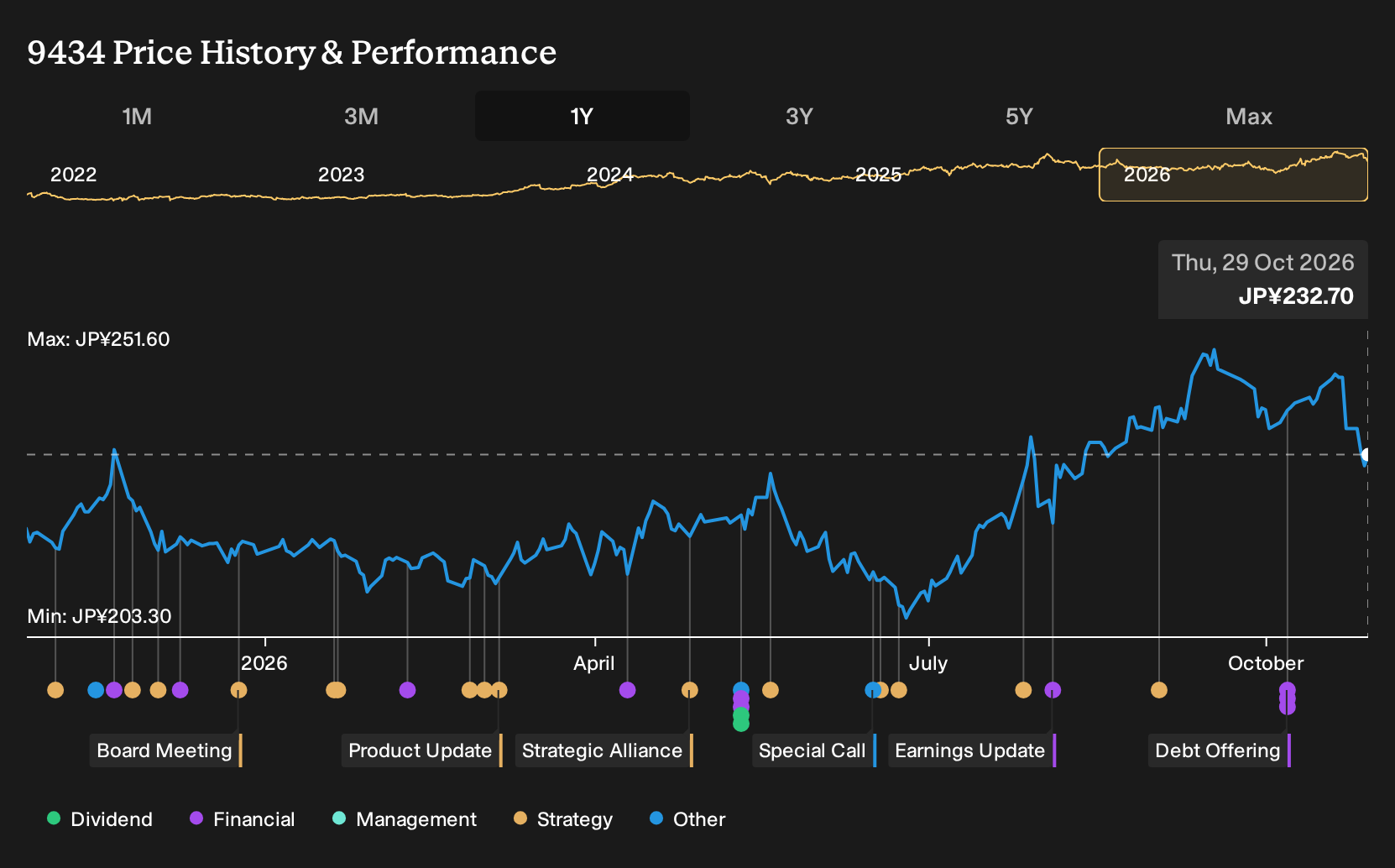
Exploring Other Perspectives
Some of the most optimistic analysts focus on the zinc halogen battery plan as the key swing factor for SoftBank. They were already working off revenue projections of ¥9,191.3b and earnings of ¥760.1b by 2029 before this dividend news. You can treat that as one upbeat scenario and compare it with more cautious views that may adjust once these richer payouts are fully absorbed into models.
Explore another SoftBank fair value estimate, including one that suggests up to 33% upside from the current price.
Form Your Own Verdict
Don't just follow the ticker. Dig into the data and build a conviction that's truly your own.
- A great starting point for your SoftBank research is our analysis highlighting 3 key rewards and 1 important warning sign that could impact your investment decision.
- See our latest analysis for SoftBank. The report includes a comprehensive fundamental analysis summarized in a single visual, the Snowflake, making it easy to evaluate SoftBank's overall financial health at a glance.
Looking For More Ideas Beyond SoftBank?
If SoftBank's mix of dividends, telecom cash flows and AI exposure has your attention, it can be useful to line it up against a few very different income and quality profiles. The Simply Wall St Screener lets you jump straight into groups of companies that match specific traits rather than sifting through the whole market one ticker at a time.
- If capital preservation is front of mind, start with sturdier balance sheets and filter for lower risk profiles using our 26 resilient stocks with low risk scores.
- If quality at a reasonable entry point is your priority, sort through companies that pair stronger fundamentals with valuations that may look appealing through the 71 high quality undiscovered gems.
- If you want income ideas beyond SoftBank, compare its distributions with other high yield candidates using this curated 30 dividend fortresses.
Have feedback on this article? Concerned about the content? Get in touch with us directly. Alternatively, email editorial-team@simplywallst.com